Resume example
Back-End Developer resume example
By the Resumade team · About our content
A back-end developer resume must prove architectural thinking and measurable system impact, not just list languages. This example leads with quantified latency wins and uptime figures that stop a hiring manager mid-scroll.
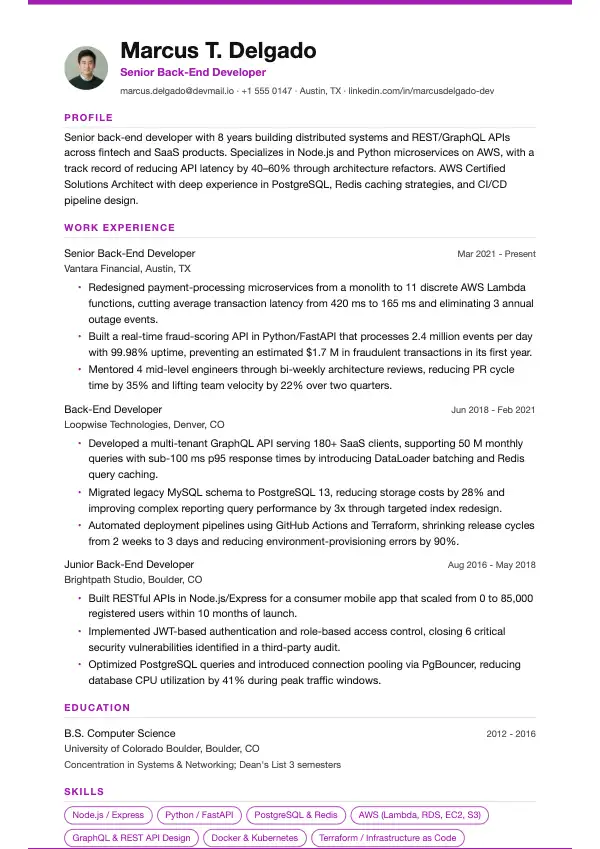
Template: Ribbon
Read this resume as text
Marcus T. Delgado
Senior Back-End Developer
marcus.delgado@devmail.io · +1 555 0147 · Austin, TX · linkedin.com/in/marcusdelgado-dev
- Profile
- Senior back-end developer with 8 years building distributed systems and REST/GraphQL APIs across fintech and SaaS products. Specializes in Node.js and Python microservices on AWS, with a track record of reducing API latency by 40–60% through architecture refactors. AWS Certified Solutions Architect with deep experience in PostgreSQL, Redis caching strategies, and CI/CD pipeline design.
- Work Experience
Senior Back-End Developer
Vantara Financial, Austin, TX · Mar 2021 - Present
- Redesigned payment-processing microservices from a monolith to 11 discrete AWS Lambda functions, cutting average transaction latency from 420 ms to 165 ms and eliminating 3 annual outage events.
- Built a real-time fraud-scoring API in Python/FastAPI that processes 2.4 million events per day with 99.98% uptime, preventing an estimated $1.7 M in fraudulent transactions in its first year.
- Mentored 4 mid-level engineers through bi-weekly architecture reviews, reducing PR cycle time by 35% and lifting team velocity by 22% over two quarters.
Back-End Developer
Loopwise Technologies, Denver, CO · Jun 2018 - Feb 2021
- Developed a multi-tenant GraphQL API serving 180+ SaaS clients, supporting 50 M monthly queries with sub-100 ms p95 response times by introducing DataLoader batching and Redis query caching.
- Migrated legacy MySQL schema to PostgreSQL 13, reducing storage costs by 28% and improving complex reporting query performance by 3x through targeted index redesign.
- Automated deployment pipelines using GitHub Actions and Terraform, shrinking release cycles from 2 weeks to 3 days and reducing environment-provisioning errors by 90%.
Junior Back-End Developer
Brightpath Studio, Boulder, CO · Aug 2016 - May 2018
- Built RESTful APIs in Node.js/Express for a consumer mobile app that scaled from 0 to 85,000 registered users within 10 months of launch.
- Implemented JWT-based authentication and role-based access control, closing 6 critical security vulnerabilities identified in a third-party audit.
- Optimized PostgreSQL queries and introduced connection pooling via PgBouncer, reducing database CPU utilization by 41% during peak traffic windows.
- Education
B.S. Computer Science
University of Colorado Boulder, Boulder, CO · 2012 - 2016
Concentration in Systems & Networking; Dean's List 3 semesters
- Skills
- Node.js / Express · Python / FastAPI · PostgreSQL & Redis · AWS (Lambda, RDS, EC2, S3) · GraphQL & REST API Design · Docker & Kubernetes · Terraform / Infrastructure as Code · CI/CD (GitHub Actions, Jenkins) · AWS Certified Solutions Architect – Associate
- Links
- LinkedIn: linkedin.com/in/marcusdelgado-dev · GitHub: github.com/mdelgado-dev · Portfolio: marcusdelgado.dev
What makes this resume work
- Every bullet opens with a strong action verb and closes with a specific number — latency in milliseconds, cost reductions in percentages, user counts — so recruiters can gauge scope instantly without reading between the lines.
- The summary names seniority level, years of experience, two domain verticals (fintech and SaaS), and two concrete specialisms in three sentences, giving ATS parsers and humans the same fast signal.
- Skills are grouped by function (language, database, cloud, DevOps, certification) rather than listed alphabetically, which mirrors how job descriptions are written and improves keyword-match scoring.
- Progression from Junior to Senior across three companies tells a clear growth story, and each role's bullets reflect increasing ownership — from feature work at Brightpath to architecture decisions and mentorship at Vantara.
Keywords that help you pass the ATS
Work the ones that fit your experience into your resume, naturally, not stuffed.
How to write a Back-End Developer resume
Choose the right format for a Back-End Developer resume
Use a reverse-chronological format. Hiring managers and applicant tracking systems both expect it, and back-end roles are experience-heavy enough that your job history is your strongest asset. A functional or hybrid format raises red flags and buries the work history recruiters actually want to see.
Keep the resume to one page if you have fewer than ten years of experience; two pages are acceptable beyond that. Use standard section headers (Experience, Skills, Education) so ATS parsers don't drop your data. Stick to a clean single-column layout — tables and multi-column designs break many parsers, including Greenhouse and Lever, which dominate tech hiring.
- File format: submit as a PDF unless the job posting explicitly requests a .docx
- Margins: 0.5–1 inch; font: 10–12 pt in Inter, Calibri, or Georgia
- Place a Skills section near the top so ATS keyword matching catches your stack immediately
- No headshot, no 'References available upon request'
Write a professional summary that speaks to back-end hiring managers
Your summary is three to four lines at most. Name your years of experience, your primary language stack, the scale you've worked at (requests per second, data volume, team size), and one concrete outcome. Skip adjectives like 'passionate' or 'results-driven' — they signal nothing.
Example: "Back-End Engineer with 7 years building distributed systems in Python and Go. Designed and maintained REST and gRPC APIs serving 40 M+ daily active users at sub-100 ms p99 latency. Reduced infrastructure costs 28% at Series B SaaS company by migrating monolith to event-driven microservices on AWS. AWS Certified Solutions Architect – Associate."
Write work-experience bullets that show scale and impact
Every bullet should follow an action-verb → task → measurable result structure. Back-end work is inherently quantifiable: latency, throughput, uptime, cost, lines of legacy code removed, deployment frequency. If you optimized a database query, say by how much. If you built a pipeline, state the data volume it handles. Vague bullets like 'worked on API development' get ignored.
Recruiters at FAANG and mid-size product companies specifically look for evidence of scale, ownership, and cross-functional collaboration. Mention the systems you owned end-to-end, not just the tickets you closed.
- Refactored PostgreSQL query layer for a multi-tenant SaaS product, cutting average query time from 1.8 s to 210 ms and eliminating 3 recurring production incidents per month
- Architected a Kafka-based event streaming pipeline in Java (Spring Boot) processing 2.5 TB of clickstream data daily, enabling real-time personalization features that lifted conversion 11%
Skills and certifications recruiters and ATS systems look for
List skills in a dedicated section grouped by category: languages, frameworks, databases, cloud/infrastructure, and tools. Don't rate yourself with stars or bars — just list what you can defend in a technical screen. Recruiters filter by exact keyword matches, so spell out both 'Kubernetes' and 'K8s' if you use both.
Certifications carry real weight in back-end hiring, especially for roles touching cloud infrastructure or security. The AWS Certified Developer – Associate, AWS Solutions Architect, Google Professional Cloud Developer, and Certified Kubernetes Administrator (CKA) are the most recognized. MongoDB's certification matters for document-store-heavy shops.
- Languages: Python, Go, Java, Node.js, Ruby, Rust
- Frameworks: Django, FastAPI, Spring Boot, Express.js, Rails
- Databases: PostgreSQL, MySQL, Redis, MongoDB, Cassandra, DynamoDB
- Cloud & infra: AWS (EC2, RDS, Lambda, SQS, EKS), GCP, Docker, Kubernetes, Terraform
- Tools: Git, GitHub Actions, Jenkins, Datadog, Prometheus, Grafana, Postman
Education, licenses, and extras that round out the resume
List your highest degree, institution, and graduation year. A CS, Software Engineering, or related degree is still the norm at larger companies, but a bootcamp or self-taught background paired with strong experience and certifications is widely accepted at startups and mid-size product companies. If your GPA was above 3.5 and you graduated within the last three years, include it; otherwise omit it.
Add an open-source section or a projects section only if the work is public, substantial, and relevant — link directly to the GitHub repo with a one-line description of the tech and impact. Contributions to well-known projects (PostgreSQL, Django, Kubernetes) are worth naming explicitly. Omit hobby projects that haven't shipped or have no users.
- Include any published technical writing (engineering blogs, conference talks) with a URL
- Security clearances are worth listing if you're targeting government or defense contractors
- Omit 'proficient in Microsoft Office' — it wastes space on a back-end resume
Mistakes to avoid
- Listing every language you've ever touched instead of the three to five you can genuinely defend in a system-design interview signals poor self-awareness and dilutes your actual expertise.
- Writing bullets that describe job duties rather than outcomes — 'responsible for maintaining APIs' tells a hiring manager nothing about the scale, reliability, or business value of your work.
- Omitting version numbers or specifics for databases and cloud services, such as writing 'AWS' instead of 'AWS Lambda, SQS, and RDS (Aurora PostgreSQL)', which causes ATS mismatches and raises doubts about depth.
- Burying the Skills section at the bottom of a two-page resume, which causes ATS systems to miss critical keywords and forces recruiters on a quick first scan to work harder than they will.
Frequently asked questions
- Should a back-end developer include front-end skills on their resume?
- Include them only if they're genuinely relevant to the role you're applying for — for example, if you're targeting a full-stack-leaning back-end position or a startup where engineers own the whole feature. If you list React or Vue, expect to be asked about them in the technical screen. For pure back-end roles at larger companies, front-end skills add noise and can make your profile look unfocused.
- How important are personal GitHub projects on a back-end developer resume?
- They matter most when your professional experience is thin — under two years — or when you're making a language or framework transition. A well-documented, deployed project with a README, test coverage, and real usage data can substitute for commercial experience in those cases. Beyond that, hiring managers at companies with structured technical interviews weight your work history and system-design ability far more than side projects.
- What metrics should a back-end developer include on a resume if their company doesn't share data publicly?
- Use percentage improvements, order-of-magnitude descriptors, or relative comparisons that don't expose proprietary figures — for example, 'reduced p99 latency by 60%' or 'scaled service from 10 K to 2 M daily requests.' You can also describe team or org size, deployment frequency, or uptime SLAs, none of which are confidential. When in doubt, check your employment agreement, but most of these operational metrics are not considered trade secrets.
Make it yours in minutes
Open this example in the builder, swap in your details, and export a clean, ATS-ready resume.
Once your resume is ready
More for this application
- Cover letter example
- Software Engineer Cover Letter Example
- Template style
- Software Engineer resume templates