Resume example
Career Change resume example
By the Resumade team · About our content
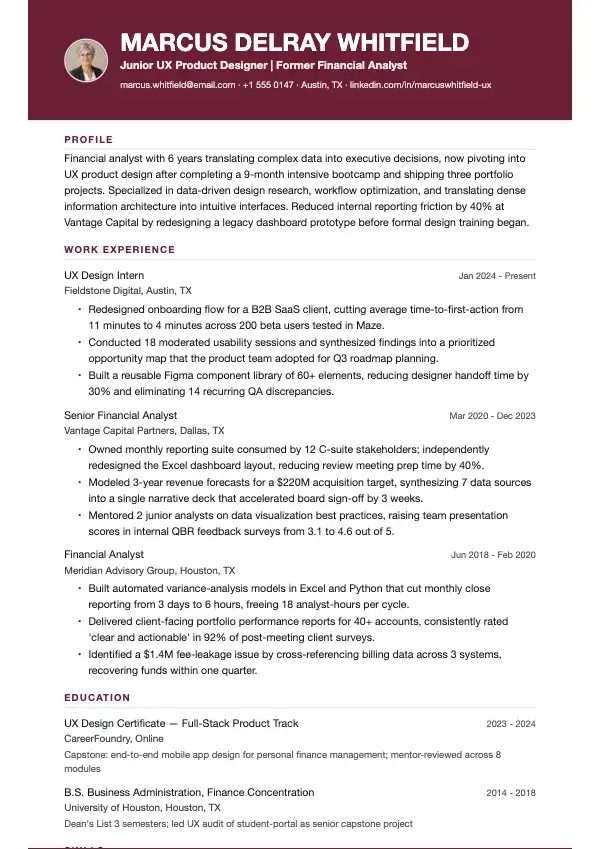
A career-change resume must prove transferability before the hiring manager reaches the second paragraph. This example leads with a summary that names the prior field, quantifies prior impact, and immediately signals design competence.
Template: Bold
Read this resume as text
Marcus Delray Whitfield
Junior UX Product Designer | Former Financial Analyst
marcus.whitfield@email.com · +1 555 0147 · Austin, TX · linkedin.com/in/marcuswhitfield-ux
- Profile
- Financial analyst with 6 years translating complex data into executive decisions, now pivoting into UX product design after completing a 9-month intensive bootcamp and shipping three portfolio projects. Specialized in data-driven design research, workflow optimization, and translating dense information architecture into intuitive interfaces. Reduced internal reporting friction by 40% at Vantage Capital by redesigning a legacy dashboard prototype before formal design training began.
- Work Experience
UX Design Intern
Fieldstone Digital, Austin, TX · Jan 2024 - Present
- Redesigned onboarding flow for a B2B SaaS client, cutting average time-to-first-action from 11 minutes to 4 minutes across 200 beta users tested in Maze.
- Conducted 18 moderated usability sessions and synthesized findings into a prioritized opportunity map that the product team adopted for Q3 roadmap planning.
- Built a reusable Figma component library of 60+ elements, reducing designer handoff time by 30% and eliminating 14 recurring QA discrepancies.
Senior Financial Analyst
Vantage Capital Partners, Dallas, TX · Mar 2020 - Dec 2023
- Owned monthly reporting suite consumed by 12 C-suite stakeholders; independently redesigned the Excel dashboard layout, reducing review meeting prep time by 40%.
- Modeled 3-year revenue forecasts for a $220M acquisition target, synthesizing 7 data sources into a single narrative deck that accelerated board sign-off by 3 weeks.
- Mentored 2 junior analysts on data visualization best practices, raising team presentation scores in internal QBR feedback surveys from 3.1 to 4.6 out of 5.
Financial Analyst
Meridian Advisory Group, Houston, TX · Jun 2018 - Feb 2020
- Built automated variance-analysis models in Excel and Python that cut monthly close reporting from 3 days to 6 hours, freeing 18 analyst-hours per cycle.
- Delivered client-facing portfolio performance reports for 40+ accounts, consistently rated 'clear and actionable' in 92% of post-meeting client surveys.
- Identified a $1.4M fee-leakage issue by cross-referencing billing data across 3 systems, recovering funds within one quarter.
- Education
UX Design Certificate — Full-Stack Product Track
CareerFoundry, Online · 2023 - 2024
Capstone: end-to-end mobile app design for personal finance management; mentor-reviewed across 8 modules
B.S. Business Administration, Finance Concentration
University of Houston, Houston, TX · 2014 - 2018
Dean's List 3 semesters; led UX audit of student-portal as senior capstone project
- Skills
- Figma (components, auto-layout, prototyping) · User Research & Moderated Usability Testing · Information Architecture · Maze & UserTesting platforms · Python (data wrangling, pandas) · Accessibility Standards (WCAG 2.1) · Google Analytics & Mixpanel · Agile / Scrum ceremonies · Financial Data Visualization
- Links
- Portfolio: marcuswhitfieldux.com · LinkedIn: linkedin.com/in/marcuswhitfield-ux · GitHub: github.com/mwhitfield-design
What makes this resume work
- The job title line uses a dual-label format — 'Junior UX Product Designer | Former Financial Analyst' — so ATS indexes both roles while the hiring manager instantly understands the pivot context without reading the summary.
- Every bullet in the finance roles is reframed around skills that map directly to UX: data synthesis, stakeholder communication, and interface redesign, so past work reads as design experience rather than unrelated history.
- The summary opens with a concrete bridge metric (40% dashboard friction reduction) achieved before formal training, which pre-empts the 'no real design experience' objection that kills most career-change applications.
- Education lists the bootcamp first and above the undergraduate degree, signaling that the candidate treats the new field seriously and ensuring the most relevant credential appears before a recruiter scrolls away.
Keywords that help you pass the ATS
Work the ones that fit your experience into your resume, naturally, not stuffed.
How to write a Career Change resume
Choose the right format for a Career Change resume
Use a hybrid (combination) format that leads with a strong skills section before your chronological work history. This lets you front-load transferable competencies — project management, data analysis, client communication — before a recruiter notices your job titles don't match the target role.
Keep the resume to one page if you have under 15 years of total experience, two pages maximum otherwise. Remove or compress roles older than ten years that add no relevant context to your new direction.
- Place a 'Core Competencies' or 'Relevant Skills' section directly below your summary, before work history
- Group older, unrelated roles under a single 'Additional Experience' subheading to save space
- Use standard section headers (Summary, Skills, Experience, Education) so ATS parses the file correctly
- Submit a text-based PDF unless the job posting asks for .docx; if you cannot select and copy the text in your PDF, neither can an ATS
Write a professional summary that reframes your background
Your summary is the one place where you control the narrative before the reader starts connecting dots. It should name the role you're targeting, call out two or three transferable skills backed by evidence, and signal genuine commitment to the new field through credentials or hands-on projects.
Example: "Operations manager with eight years leading cross-functional teams in logistics now transitioning into UX research. Completed the Google UX Design Certificate and conducted twelve moderated usability studies for a nonprofit client, reducing task-completion errors by 34%. Skilled in stakeholder interviews, affinity mapping, and Dovetail for synthesis."
Write work-experience bullets that transfer value
Reframe past accomplishments using the language of your target industry. If you're moving from retail management into HR, 'coached a team of 22 associates' becomes evidence of performance management. Lead every bullet with a strong action verb and anchor it to a number — percentage, dollar amount, headcount, or time saved.
Avoid describing job duties. Describe outcomes. Recruiters hiring career changers need proof that your skills travel, and quantified results are the fastest way to show that.
- Redesigned onboarding workflow for a 60-person warehouse team, cutting time-to-productivity from 3 weeks to 11 days and reducing 90-day turnover by 18%
- Built and maintained Tableau dashboards tracking $4.2M in regional inventory, flagging shrinkage anomalies that recovered $310K in a single quarter
Skills and certifications recruiters and ATS look for
Career changers must close the credential gap visibly on the page. List hard skills, software, and certifications in a dedicated section so ATS keyword matching works in your favor. Prioritize credentials that are recognized industry-wide over employer-specific training.
Mirror the exact terminology from job postings — if the posting says 'Agile' not 'agile methodology,' use their phrasing. Soft skills belong in your bullets as demonstrated behavior, not in a standalone list.
- Project management: PMP, CAPM, PMI-ACP, Certified ScrumMaster (CSM), Jira, Asana, Monday.com
- Data and analytics: SQL, Python (pandas), Power BI, Tableau, Google Analytics 4, Excel (pivot tables, VLOOKUP)
- UX and product: Google UX Design Certificate, Figma, Dovetail, UserTesting, Hotjar, JTBD framework
- HR and people ops: SHRM-CP, PHR, Workday, BambooHR, ADP, performance management frameworks
- Marketing: HubSpot Content Marketing Certification, Salesforce CRM, SEMrush, Meta Ads Manager, Google Ads
Education, licenses, and extras that strengthen your case
List your highest degree first with institution, graduation year, and relevant coursework or honors if they connect to the new field. If you're mid-career, GPA is optional unless it's above 3.7 and you graduated within the past five years.
Below formal education, add a separate 'Professional Development' or 'Certifications' subsection. Include bootcamps, online certificates from accredited platforms (Coursera, edX, LinkedIn Learning), volunteer work where you applied target-field skills, and freelance or contract projects. A GitHub link, portfolio URL, or LinkedIn profile URL should appear in your contact header — not buried at the bottom.
- List bootcamps and certificates with the issuing organization and completion date, not just the course name
- Include volunteer or pro-bono projects that produced real deliverables — treat them exactly like paid work
- Add a portfolio link for any role in design, writing, marketing, or data — hiring managers will check before calling
Mistakes to avoid
- Using a pure functional (skills-only) format, which ATS systems often fail to parse correctly and which experienced recruiters associate with candidates trying to hide something.
- Keeping every past job at full length regardless of relevance — compress or omit roles that share no skills or context with your target field to protect the reader's attention.
- Listing certifications you started but haven't completed; mark in-progress credentials as 'Expected [Month Year]' or leave them off entirely.
- Writing a summary that explains why you want to change careers rather than why you're already qualified — the resume is not the place for your personal journey, only your transferable value.
Frequently asked questions
- Should I explain my career change in my resume or save it for the cover letter?
- Your resume should show transferable skills and relevant credentials without requiring explanation — the work speaks for itself. Use the cover letter to briefly frame your motivation and connect the dots between your background and the role. Never use valuable resume space to apologize for or justify your pivot.
- How do I handle a resume gap caused by retraining or getting certified for a new field?
- List the gap period as an active entry: for example, 'Career Transition and Professional Development, 2023–2024' followed by the specific courses, certificates, or projects you completed. This turns a potential red flag into evidence of intentional preparation and keeps your timeline transparent.
- Do I need a different resume for every job when changing careers?
- Yes — more so than in a traditional job search. The keywords, skill emphasis, and even the order of your competencies should shift based on each posting's language and priorities. Build one strong master resume, then create targeted versions by adjusting the summary, reordering the skills section, and swapping in the most relevant bullets for each application.
Make it yours in minutes
Open this example in the builder, swap in your details, and export a clean, ATS-ready resume.
Once your resume is ready
More for this application
- Template style
- Career Change resume templates