Resume example
Chef resume example
By the Resumade team · About our content
A Chef resume must clear ATS keyword filters for culinary certifications and cost-control terms, then prove to a hiring manager that you can run a kitchen profitably. This example does both with metrics in every bullet and credentials surfaced in the skills block.
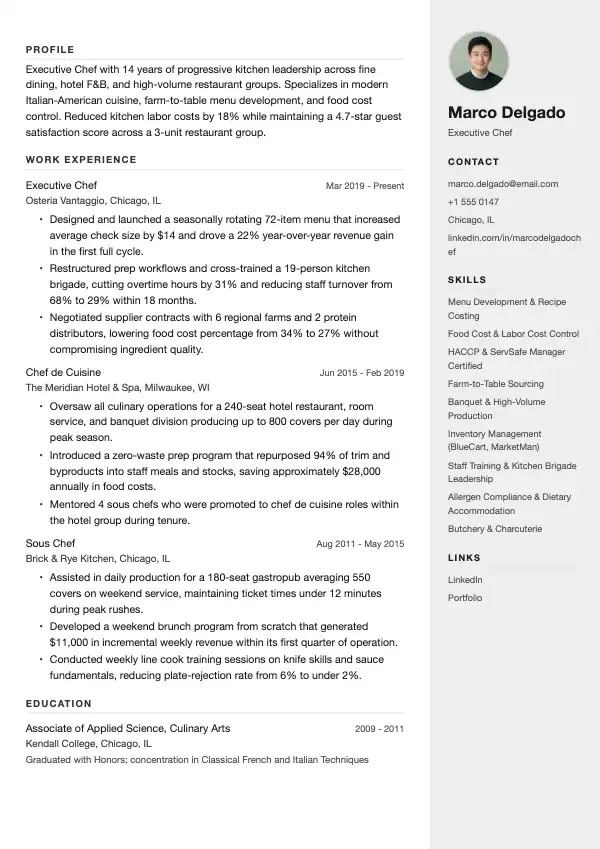
Template: Mist
Read this resume as text
Marco Delgado
Executive Chef
marco.delgado@email.com · +1 555 0147 · Chicago, IL · linkedin.com/in/marcodelgadochef
- Profile
- Executive Chef with 14 years of progressive kitchen leadership across fine dining, hotel F&B, and high-volume restaurant groups. Specializes in modern Italian-American cuisine, farm-to-table menu development, and food cost control. Reduced kitchen labor costs by 18% while maintaining a 4.7-star guest satisfaction score across a 3-unit restaurant group.
- Work Experience
Executive Chef
Osteria Vantaggio, Chicago, IL · Mar 2019 - Present
- Designed and launched a seasonally rotating 72-item menu that increased average check size by $14 and drove a 22% year-over-year revenue gain in the first full cycle.
- Restructured prep workflows and cross-trained a 19-person kitchen brigade, cutting overtime hours by 31% and reducing staff turnover from 68% to 29% within 18 months.
- Negotiated supplier contracts with 6 regional farms and 2 protein distributors, lowering food cost percentage from 34% to 27% without compromising ingredient quality.
Chef de Cuisine
The Meridian Hotel & Spa, Milwaukee, WI · Jun 2015 - Feb 2019
- Oversaw all culinary operations for a 240-seat hotel restaurant, room service, and banquet division producing up to 800 covers per day during peak season.
- Introduced a zero-waste prep program that repurposed 94% of trim and byproducts into staff meals and stocks, saving approximately $28,000 annually in food costs.
- Mentored 4 sous chefs who were promoted to chef de cuisine roles within the hotel group during tenure.
Sous Chef
Brick & Rye Kitchen, Chicago, IL · Aug 2011 - May 2015
- Assisted in daily production for a 180-seat gastropub averaging 550 covers on weekend service, maintaining ticket times under 12 minutes during peak rushes.
- Developed a weekend brunch program from scratch that generated $11,000 in incremental weekly revenue within its first quarter of operation.
- Conducted weekly line cook training sessions on knife skills and sauce fundamentals, reducing plate-rejection rate from 6% to under 2%.
- Education
Associate of Applied Science, Culinary Arts
Kendall College, Chicago, IL · 2009 - 2011
Graduated with Honors; concentration in Classical French and Italian Techniques
- Skills
- Menu Development & Recipe Costing · Food Cost & Labor Cost Control · HACCP & ServSafe Manager Certified · Farm-to-Table Sourcing · Banquet & High-Volume Production · Inventory Management (BlueCart, MarketMan) · Staff Training & Kitchen Brigade Leadership · Allergen Compliance & Dietary Accommodation · Butchery & Charcuterie
- Links
- LinkedIn · Portfolio
What makes this resume work
- Every bullet ends with a concrete number — revenue gains, cost percentages, cover counts, or time savings — giving hiring managers immediate proof of kitchen impact rather than a list of duties.
- The skills section leads with HACCP and ServSafe Manager Certified, the two compliance credentials recruiters and ATS systems filter for first when screening executive-level culinary candidates.
- The summary front-loads seniority (14 years), domain specialty (modern Italian-American, farm-to-table), and one headline financial result, so a chef recruiter reading quickly gets the full value proposition instantly.
- Progression from Sous Chef to Chef de Cuisine to Executive Chef is shown across three distinct employers, demonstrating earned advancement rather than lateral moves — a pattern that signals reliability to F&B directors and hotel groups.
Keywords that help you pass the ATS
Work the ones that fit your experience into your resume, naturally, not stuffed.
How to write a Chef resume
Choose the right format for a Chef resume
Most chefs benefit from a reverse-chronological format. Hiring managers at restaurants, hotels, and catering companies want to see your most recent kitchen experience first — they are not reading linearly, they are scanning for familiar establishment names, cuisine types, and tenure length.
Keep the resume to one page if you have fewer than ten years of experience; two pages are acceptable for executive chefs or culinary directors with multi-unit oversight. Use clean section headers, consistent font sizing (10–12 pt body, 14–16 pt name), and avoid decorative borders or chef-hat graphics that break ATS parsing.
- Use reverse-chronological order for all experience sections
- Stick to one column — two-column layouts often scramble ATS readings
- List cuisine specialties and kitchen type (fine dining, fast-casual, institutional) near the top
- File name: FirstLast_ChefResume.pdf unless the posting requests .docx
Write a professional summary that gets you past the first cut
Your summary sits directly below your contact information and should be three to four sentences. Name your culinary specialty, the scale of kitchens you have run, a standout achievement, and one trait that reflects your leadership or operational style. Generic phrases like 'passionate about food' waste the space.
Here is a strong example: "Executive Chef with 12 years of progressive experience in upscale American and French bistro kitchens, including five years leading a 14-person brigade at a 200-seat AAA Four Diamond property. Reduced food cost from 34% to 27% over 18 months by restructuring vendor contracts and tightening prep yields. Known for building cohesive kitchen teams with turnover rates consistently 20% below industry average."
Write work-experience bullets that prove impact
Every bullet should follow an action-verb + task + measurable result structure. Chefs have more quantifiable data available than most realize: food cost percentages, cover counts, menu item counts, team size, revenue generated by catering contracts, health inspection scores, and labor cost ratios. Pull those numbers from memory, past P&L reports, or performance reviews.
Avoid vague bullets like 'responsible for menu creation' or 'oversaw kitchen staff.' Recruiters for mid-scale and above properties expect specificity about cuisine, scale, and outcome.
- Developed a 72-item seasonal menu for a 350-seat hotel restaurant, increasing average check size by $8 and boosting beverage attachment rate by 15% within the first quarter of launch
- Managed daily prep and service for a 1,200-cover-per-day corporate cafeteria, maintaining a food cost of 28% and achieving a 97/100 on three consecutive unannounced health department inspections
Skills and certifications recruiters and ATS systems look for
Include a dedicated skills section that lists both hard culinary skills and operational competencies. Recruiters at larger hospitality groups, hotel chains, and contract food service companies (Aramark, Sodexo, Compass Group) often search their ATS for specific terms, so name yours exactly.
Certifications carry real weight in this profession and belong in both the skills section and a separate certifications line. Do not bury them.
- ServSafe Manager Certification (include expiration date)
- HACCP plan development and implementation
- Culinary software: Compeat, CrunchTime, ChefTec, or Toast back-of-house reporting
- Knife skills by cuisine (butchery, fish fabrication, charcuterie)
- Skills to list: menu costing, recipe standardization, vendor negotiation, allergen management, garde manger, saucier, pastry basics, staff scheduling, POS systems
Education, licenses, and extras that close the deal
List your culinary degree or diploma from institutions like the Culinary Institute of America, Johnson & Wales, Le Cordon Bleu, or a community college culinary arts program. If you completed a formal apprenticeship through the American Culinary Federation (ACF), list it here with the designation earned — CC, CPC, CEC, or CMC carry immediate recognition. If you hold a food protection manager certification required by your state or local health department, list the issuing body and expiration date.
Add an extras section only if the content is genuinely relevant: stage experience at a Michelin-recognized kitchen, competition wins (ACF competitions, Iron Chef-style events), published recipes, or teaching roles at culinary schools. Omit hobbies unless they directly connect to the role, such as foraging experience for a farm-to-table concept.
- ACF certifications: CC, CPC, CEC, CEPC, CMC — always spell out the full designation once
- Food protection manager certification with issuing body and expiration year
- Relevant stage or extern experience at named properties
Mistakes to avoid
- Listing every station you have ever worked without connecting those stations to the scale, cuisine, or outcome relevant to the job you are applying for.
- Omitting food cost and labor cost percentages when you have managed a budget — these are the first numbers an executive chef or GM looks for.
- Using an expired or unlisted ServSafe certification, which is an immediate red flag for any property subject to health department oversight.
- Writing a summary that describes what you want from the job rather than what you bring to the kitchen — hiring managers care about your output, not your career goals.
Frequently asked questions
- Do I need a culinary degree to have a strong chef resume?
- No, but you need to compensate with specificity elsewhere. Emphasize the caliber of kitchens you trained in, any ACF certifications you hold, and quantified results from your experience. Many executive chefs at respected properties are self-taught or came up through apprenticeships, and a strong track record with measurable outcomes outweighs a diploma in most hiring decisions.
- Should I include references or a portfolio of dishes on my chef resume?
- Do not include references on the resume itself — list them on a separate sheet and bring it to the interview. A dish portfolio is not standard on the resume document, but you can include a URL to a professional Instagram account or a Google Drive folder of plated work if the link is clean and current. Some fine-dining properties and hotel groups will ask for a tasting or practical exam regardless of what you submit on paper.
- How do I list multiple short-term positions without looking like a job hopper?
- The hospitality industry has high turnover norms, and most hiring managers understand seasonal contracts, restaurant closures, and project-based openings. Group short stints under a 'Consulting and Contract Work' header if they were freelance or temporary, and briefly note the reason for departure in parentheses — 'seasonal contract,' 'restaurant closed,' or 'property sold' — directly on the resume line. This removes ambiguity before the interview.
Make it yours in minutes
Open this example in the builder, swap in your details, and export a clean, ATS-ready resume.
Once your resume is ready
More for this application
- Template style
- Simple resume templates