Resume example
.NET Developer resume example
By the Resumade team · About our content
A strong .NET Developer resume must clear Azure/AWS ATS keyword filters and prove measurable engineering impact on the first human read. This example does both by leading every bullet with an action verb and a concrete result.
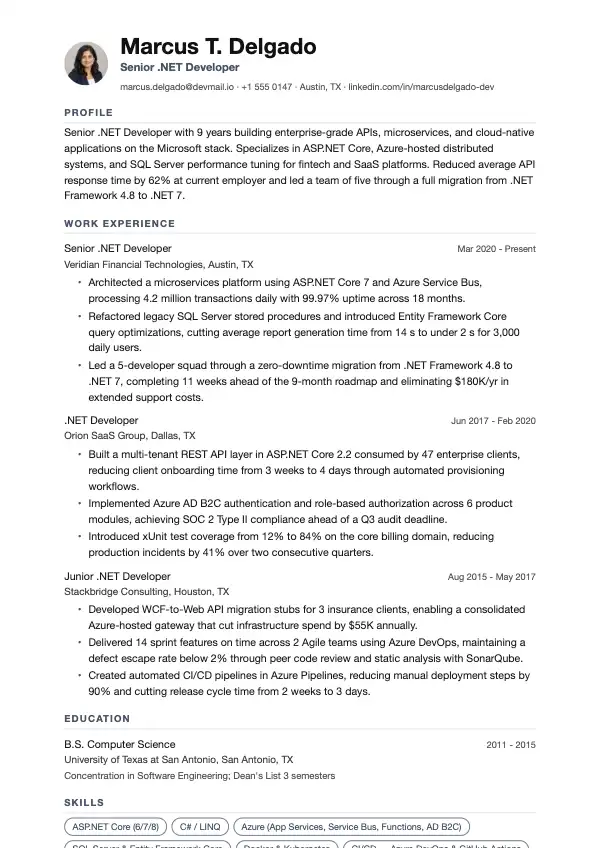
Template: Modern
Read this resume as text
Marcus T. Delgado
Senior .NET Developer
marcus.delgado@devmail.io · +1 555 0147 · Austin, TX · linkedin.com/in/marcusdelgado-dev
- Profile
- Senior .NET Developer with 9 years building enterprise-grade APIs, microservices, and cloud-native applications on the Microsoft stack. Specializes in ASP.NET Core, Azure-hosted distributed systems, and SQL Server performance tuning for fintech and SaaS platforms. Reduced average API response time by 62% at current employer and led a team of five through a full migration from .NET Framework 4.8 to .NET 7.
- Work Experience
Senior .NET Developer
Veridian Financial Technologies, Austin, TX · Mar 2020 - Present
- Architected a microservices platform using ASP.NET Core 7 and Azure Service Bus, processing 4.2 million transactions daily with 99.97% uptime across 18 months.
- Refactored legacy SQL Server stored procedures and introduced Entity Framework Core query optimizations, cutting average report generation time from 14 s to under 2 s for 3,000 daily users.
- Led a 5-developer squad through a zero-downtime migration from .NET Framework 4.8 to .NET 7, completing 11 weeks ahead of the 9-month roadmap and eliminating $180K/yr in extended support costs.
.NET Developer
Orion SaaS Group, Dallas, TX · Jun 2017 - Feb 2020
- Built a multi-tenant REST API layer in ASP.NET Core 2.2 consumed by 47 enterprise clients, reducing client onboarding time from 3 weeks to 4 days through automated provisioning workflows.
- Implemented Azure AD B2C authentication and role-based authorization across 6 product modules, achieving SOC 2 Type II compliance ahead of a Q3 audit deadline.
- Introduced xUnit test coverage from 12% to 84% on the core billing domain, reducing production incidents by 41% over two consecutive quarters.
Junior .NET Developer
Stackbridge Consulting, Houston, TX · Aug 2015 - May 2017
- Developed WCF-to-Web API migration stubs for 3 insurance clients, enabling a consolidated Azure-hosted gateway that cut infrastructure spend by $55K annually.
- Delivered 14 sprint features on time across 2 Agile teams using Azure DevOps, maintaining a defect escape rate below 2% through peer code review and static analysis with SonarQube.
- Created automated CI/CD pipelines in Azure Pipelines, reducing manual deployment steps by 90% and cutting release cycle time from 2 weeks to 3 days.
- Education
B.S. Computer Science
University of Texas at San Antonio, San Antonio, TX · 2011 - 2015
Concentration in Software Engineering; Dean's List 3 semesters
- Skills
- ASP.NET Core (6/7/8) · C# / LINQ · Azure (App Services, Service Bus, Functions, AD B2C) · SQL Server & Entity Framework Core · Docker & Kubernetes · CI/CD — Azure DevOps & GitHub Actions · Microservices & REST API Design · xUnit / NUnit / Moq · Microsoft Certified: Azure Developer Associate (AZ-204)
- Links
- LinkedIn: linkedin.com/in/marcusdelgado-dev · GitHub: github.com/mtdelgado · Portfolio: marcusdelgado.dev
What makes this resume work
- Every experience bullet names a specific technology alongside a measurable outcome — percentages, dollar figures, or time savings — so recruiters can immediately gauge scale and impact rather than inferring it from vague descriptions.
- The skills section uses exact ATS search terms recruiters enter ('ASP.NET Core', 'Entity Framework Core', 'Azure Developer Associate') rather than category labels like 'cloud' or 'backend frameworks', which improves keyword match rate in applicant tracking systems.
- The summary front-loads seniority level and years of experience in the first clause, then names two domain specialisms and one headline result, giving hiring managers a complete positioning statement before they read a single bullet point.
- The career arc — junior consulting → mid-level product SaaS → senior fintech — tells a coherent growth story, with each role showing expanded scope (team size, transaction volume, compliance stakes) that justifies the senior title without needing a separate career-objective section.
Keywords that help you pass the ATS
Work the ones that fit your experience into your resume, naturally, not stuffed.
How to write a .NET Developer resume
Choose the right format for a .NET Developer resume
Use a reverse-chronological format. Hiring managers and applicant tracking systems at companies like Microsoft, Accenture, and mid-market SaaS shops all expect it, and .NET roles almost always require demonstrated progression in C#, ASP.NET, or Azure — not just a skill list. A functional or hybrid format raises red flags for experienced developers.
Keep the resume to one page if you have under eight years of experience; two pages are acceptable for senior or principal engineers with deep project history. Use a clean single-column or mild two-column layout with consistent heading sizes, 10–12pt body font, and at least 0.5-inch margins. Save and submit as a PDF unless the job posting explicitly requests a Word file.
- Sections in order: Contact Info → Summary → Skills → Work Experience → Education → Certifications
- Include a LinkedIn URL and, if public, a GitHub profile link in your contact block
- Avoid tables and text boxes — many ATS parsers (Workday, Greenhouse, iCIMS) cannot read them
Write a professional summary that lands interviews
Your summary is three to four lines at the top of the resume. It should name your years of experience, your core stack, and one or two quantifiable outcomes. Skip vague phrases like 'passionate developer' or 'team player.' Recruiters spend about seven seconds on an initial scan (Ladders eye-tracking study, 2018) — give them a reason to keep reading.
Example: "Senior .NET Developer with 9 years building enterprise-grade web APIs and microservices in C# and ASP.NET Core. Reduced average API response time by 38% at a $200M SaaS company by migrating a monolithic WCF service layer to Azure Service Bus event-driven architecture. Holds AZ-204 certification; experienced with CI/CD pipelines in Azure DevOps and GitHub Actions."
Write work-experience bullets that prove impact
Each bullet should follow an action verb → technology or process → measurable result structure. Avoid listing job duties; describe what changed because of your work. Quantify with percentages, dollar figures, request volumes, deployment frequency, or user counts. If you lack exact numbers, use ranges or relative comparisons ('reduced from 4 hours to 20 minutes').
Pull metrics from sprint retrospectives, monitoring dashboards (Application Insights, Datadog, New Relic), or release notes. Recruiters and engineering managers both read these bullets — make them legible to both.
- Refactored a legacy ASP.NET Web Forms billing module to ASP.NET Core 7 MVC, cutting page load time by 52% and eliminating 14,000 lines of deprecated code across 6 sprints.
- Designed and deployed a multi-tenant REST API on Azure App Service handling 4.2M daily requests, achieving 99.97% uptime over 18 months using Azure SQL, Redis Cache, and Azure API Management.
Skills and certifications recruiters and ATS look for
List your skills in a dedicated section using exact keywords from job postings — ATS systems match on string literals. Separate languages, frameworks, cloud tools, databases, and practices into labeled groups rather than one long comma-separated line. Only list technologies you can discuss confidently in a technical screen.
Microsoft certifications carry real weight in .NET hiring. AZ-204 (Azure Developer Associate) is the most commonly requested; AZ-400 (DevOps Engineer Expert) matters for senior roles. Older MCSD credentials are largely obsolete but still appear in some enterprise job descriptions, so include them if you hold one.
- Languages: C#, VB.NET, TypeScript, SQL
- Frameworks: ASP.NET Core, Entity Framework Core, Blazor, SignalR, WPF, MAUI
- Cloud & DevOps: Azure (App Service, Functions, Service Bus, AKS), Azure DevOps, GitHub Actions, Docker, Kubernetes
- Databases: SQL Server, Azure SQL, PostgreSQL, Cosmos DB, Redis
- Certifications: AZ-204, AZ-400, AZ-900, AWS Certified Developer – Associate
Education, licenses, and extras that round out the resume
List your highest degree first with institution, degree name, and graduation year. A BS or MS in Computer Science, Software Engineering, or a related field is standard for .NET roles at large enterprises; bootcamp graduates should include the program name and graduation year in the same section. GPA is optional and only worth including if it is 3.5 or above and you graduated within the last three years.
Add a separate 'Projects' or 'Open Source' section if you have public GitHub repositories with meaningful commit history, especially if they demonstrate ASP.NET Core, Blazor, or Azure integrations. Speaking at .NET Conf, local user groups, or contributing to NuGet packages are differentiators worth a one-line mention under 'Activities' or 'Community.'
Mistakes to avoid
- Listing every .NET version you have ever touched (1.1 through 8.0) without context makes the skills section look padded and signals poor judgment about what is relevant.
- Writing bullets that describe responsibilities ('Responsible for maintaining APIs') instead of outcomes causes your resume to read like a job description, not an achievement record.
- Omitting Entity Framework Core, Dapper, or raw ADO.NET from your skills section when database access is central to every .NET role will cost you ATS matches on common search queries.
- Using the same resume for both cloud-native microservices roles and legacy WinForms maintenance contracts without tailoring the summary and skills order means you will be a weak match for both.
Frequently asked questions
- Should I list both .NET Framework and .NET Core / .NET 5+ separately on my resume?
- Yes, treat them as distinct skill entries because many enterprise employers still run .NET Framework 4.x on-premises and specifically search for it. Write '.NET Framework 4.x' and '.NET 6/7/8' as separate line items in your skills section so ATS systems and human reviewers can find both. If you have migrated projects from one to the other, call that out explicitly in a work-experience bullet.
- How important is a GitHub profile link on a .NET Developer resume?
- It is increasingly expected at the mid-to-senior level, particularly at product companies and startups. A profile with active, well-documented ASP.NET Core or Blazor repositories can compensate for a shorter employment history or a non-traditional background. If your repositories are sparse or contain only tutorial code, leave the link off rather than drawing attention to it.
- Do I need Azure certifications to get hired as a .NET Developer?
- They are not universally required, but AZ-204 has become a strong differentiator as most .NET shops have moved workloads to Azure. Job postings at companies like Cognizant, Infosys, and mid-size ISVs frequently list it as 'preferred.' If you are job searching without one, demonstrating hands-on Azure experience through project bullets and a GitHub portfolio can partially offset the gap.
Make it yours in minutes
Open this example in the builder, swap in your details, and export a clean, ATS-ready resume.
Once your resume is ready
More for this application
- Cover letter example
- Software Engineer Cover Letter Example
- Template style
- Software Engineer resume templates