Resume example
Firefighter resume example
By the Resumade team · About our content
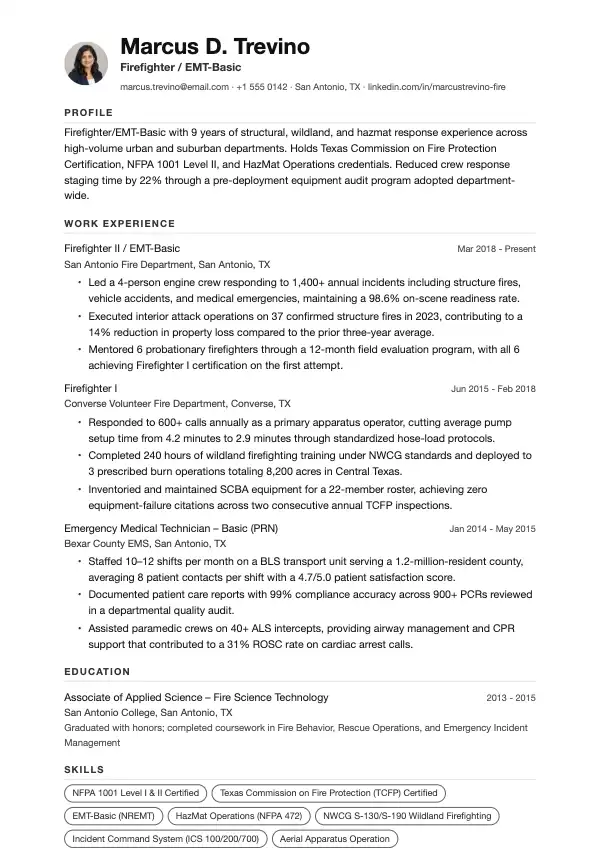
A Firefighter resume must clear department ATS filters loaded with certification codes and duty-specific terms, then prove operational value to a battalion chief at first glance. This example leads with credentials, quantifies incident load, and shows career progression from volunteer to career firefighter.
Template: Modern
Read this resume as text
Marcus D. Trevino
Firefighter / EMT-Basic
marcus.trevino@email.com · +1 555 0142 · San Antonio, TX · linkedin.com/in/marcustrevino-fire
- Profile
- Firefighter/EMT-Basic with 9 years of structural, wildland, and hazmat response experience across high-volume urban and suburban departments. Holds Texas Commission on Fire Protection Certification, NFPA 1001 Level II, and HazMat Operations credentials. Reduced crew response staging time by 22% through a pre-deployment equipment audit program adopted department-wide.
- Work Experience
Firefighter II / EMT-Basic
San Antonio Fire Department, San Antonio, TX · Mar 2018 - Present
- Led a 4-person engine crew responding to 1,400+ annual incidents including structure fires, vehicle accidents, and medical emergencies, maintaining a 98.6% on-scene readiness rate.
- Executed interior attack operations on 37 confirmed structure fires in 2023, contributing to a 14% reduction in property loss compared to the prior three-year average.
- Mentored 6 probationary firefighters through a 12-month field evaluation program, with all 6 achieving Firefighter I certification on the first attempt.
Firefighter I
Converse Volunteer Fire Department, Converse, TX · Jun 2015 - Feb 2018
- Responded to 600+ calls annually as a primary apparatus operator, cutting average pump setup time from 4.2 minutes to 2.9 minutes through standardized hose-load protocols.
- Completed 240 hours of wildland firefighting training under NWCG standards and deployed to 3 prescribed burn operations totaling 8,200 acres in Central Texas.
- Inventoried and maintained SCBA equipment for a 22-member roster, achieving zero equipment-failure citations across two consecutive annual TCFP inspections.
Emergency Medical Technician – Basic (PRN)
Bexar County EMS, San Antonio, TX · Jan 2014 - May 2015
- Staffed 10–12 shifts per month on a BLS transport unit serving a 1.2-million-resident county, averaging 8 patient contacts per shift with a 4.7/5.0 patient satisfaction score.
- Documented patient care reports with 99% compliance accuracy across 900+ PCRs reviewed in a departmental quality audit.
- Assisted paramedic crews on 40+ ALS intercepts, providing airway management and CPR support that contributed to a 31% ROSC rate on cardiac arrest calls.
- Education
Associate of Applied Science – Fire Science Technology
San Antonio College, San Antonio, TX · 2013 - 2015
Graduated with honors; completed coursework in Fire Behavior, Rescue Operations, and Emergency Incident Management
- Skills
- NFPA 1001 Level I & II Certified · Texas Commission on Fire Protection (TCFP) Certified · EMT-Basic (NREMT) · HazMat Operations (NFPA 472) · NWCG S-130/S-190 Wildland Firefighting · Incident Command System (ICS 100/200/700) · Aerial Apparatus Operation · SCBA Maintenance & Inspection · CPR/AED Instructor (AHA)
- Links
- LinkedIn: linkedin.com/in/marcustrevino-fire · Certification: Texas Commission on Fire Protection — Certification #TX-FF-084412
What makes this resume work
- The summary opens with certification names spelled out exactly as they appear in job postings — NFPA 1001 Level II, HazMat Operations — so ATS keyword matching fires before a human even reads it.
- Every bullet anchors to a countable outcome (incident volume, property loss reduction, pass rates) rather than listing duties, which distinguishes this resume from the majority of fire service applicants who write task-based bullets.
- The three-role arc — PRN EMT to volunteer firefighter to career Firefighter II — tells a deliberate development story that signals long-term commitment to the profession rather than a lateral job hop.
- Certifications are listed as a dedicated skills block using the exact acronyms (TCFP, NREMT, IS-700, NWCG S-130) that department HR systems and civil-service exam platforms index, maximizing automated scoring.
Keywords that help you pass the ATS
Work the ones that fit your experience into your resume, naturally, not stuffed.
How to write a Firefighter resume
Choose the right format for a Firefighter resume
Use a reverse-chronological format. Fire departments — career, combination, and volunteer — want to see your most recent station assignments and certifications up front. A functional format that buries your timeline raises red flags with civil service hiring boards and fire chiefs reviewing stacks of applications.
Keep your resume to one page if you have fewer than ten years of experience; two pages is acceptable for senior engineers, captains, or those with extensive incident command history. Use clean section headers, consistent font sizing (10–12 pt), and generous white space. PDF is the safest file format unless the department's online portal requires a Word document.
- Margins: 0.75–1 inch on all sides
- Font: Arial, Calibri, or Georgia — nothing decorative
- Section order: Contact info → Summary → Certifications → Experience → Education → Skills
- Avoid tables or text boxes if submitting through government applicant-tracking portals
Write a professional summary that passes the first scan
Your summary sits directly under your name and contact information. It should be three to four sentences that tell a hiring captain your certification level, years of experience, specialty areas, and one or two measurable accomplishments. Skip the phrase 'hardworking team player' entirely — it adds nothing.
Here is a strong example: "NREMT-certified Firefighter/EMT-B with 7 years of career service across urban and wildland environments. Responded to 1,400+ structure fires, vehicle accidents, and hazmat incidents with Engine Company 12 in Phoenix, AZ. IFSAC-accredited Firefighter II and HazMat Operations certified. Seeking a driver/engineer role where apparatus operation and crew mentorship are priorities."
Write work-experience bullets that show impact, not just duties
Every bullet under a past position should start with a strong action verb and include a number wherever possible — response times, incident volume, equipment maintained, personnel supervised, or training hours delivered. Fire departments respect measurable outcomes because the job is inherently outcome-driven.
Avoid writing 'Responded to emergency calls.' That describes the bare minimum. Show scope, frequency, and result instead.
- Operated a 2,000-GPM Pierce Arrow XT pumper and 105-ft aerial platform on 900+ calls annually, maintaining a sub-6-minute average response time across a 14-square-mile district.
- Trained 18 probationary firefighters in SCBA donning, hose advancement, and search-and-rescue protocols, reducing rookie evaluation failures by 40% over two recruit cycles.
Skills and certifications recruiters and ATS systems look for
Many municipalities and county fire agencies now route applications through NeoGov or similar civil service platforms that scan for keyword matches before a human ever reads your resume. List your certifications exactly as they appear on your certificate — abbreviations and full names both, where space allows. A dedicated 'Certifications' section near the top of the page performs better than burying credentials inside a skills list.
Include both hard technical skills and the apparatus or software you actually use. Dispatching platforms, RMS software like ESO or ImageTrend, and NFIRS reporting are relevant details that distinguish experienced candidates.
- Firefighter I & II (IFSAC or ProBoard accreditation — specify which)
- EMT, Advanced EMT (AEMT), or Paramedic (NREMT number on request)
- HazMat Operations or Technician (OSHA 29 CFR 1910.120)
- Wildland Firefighting: S-130/S-190, NWCG Red Card
- Incident Command System: ICS-100, ICS-200, ICS-300, NIMS IS-700
Education, licenses, and extras that strengthen your application
List your fire academy — name, location, and graduation year — under Education alongside any college degrees. An associate's or bachelor's in Fire Science, Emergency Management, or Public Administration is increasingly expected for promotion to lieutenant and above, so include it even if the degree is in progress. State your fire certification issuing authority (e.g., California State Fire Marshal, Texas Commission on Fire Protection) because reciprocity rules vary and hiring departments need to verify standing.
Add a separate line for your current driver's license class and any CDL endorsements, since most departments require a valid Class B or Class C license to operate apparatus. If you have commendations, rescue specialist credentials, technical rescue (rope, confined space, swift water), or fire investigation coursework, list them here — they differentiate you in competitive civil service pools.
Mistakes to avoid
- Listing certifications without the issuing authority (IFSAC vs. ProBoard vs. state-specific) forces hiring staff to make assumptions and can disqualify you if reciprocity is required.
- Using vague duty language like 'assisted with fire suppression' instead of specifying your role, apparatus, and incident volume makes it impossible for a captain to gauge your actual experience level.
- Omitting your NREMT certification number or EMT license expiration date when applying to combination departments that run EMS — many online portals flag incomplete applications automatically.
- Submitting a resume with a generic objective statement instead of a tailored summary wastes prime real estate and signals that you copied a template without reading the job announcement.
Frequently asked questions
- Should I include volunteer firefighting experience on a career fire department resume?
- Yes — always include it. Volunteer experience counts toward your total incident exposure, and many career departments actively value candidates who started as volunteers because it demonstrates self-motivated commitment to the profession. List it exactly as you would a paid position, with dates, apparatus operated, and call volume if you have it.
- Do I need a separate resume for every fire department I apply to?
- You need at least a tailored summary and a reviewed certifications section for each application, because departments in different states have different reciprocity requirements and may prioritize different specialties. The core of your resume — experience bullets and education — can stay consistent, but a summary written specifically for a driver/engineer posting differs meaningfully from one written for a Firefighter I entry-level position.
- How do I handle gaps in service — for example, time away from a department?
- Address gaps briefly and honestly in your cover letter rather than trying to hide them on the resume itself. If you were completing additional training, pursuing a degree, or serving in the military during that period, list those activities in the appropriate resume section. Hiring boards conduct thorough background checks, so unexplained gaps create more concern than a straightforward explanation does.
Make it yours in minutes
Open this example in the builder, swap in your details, and export a clean, ATS-ready resume.
Once your resume is ready
More for this application
- Template style
- Modern resume templates