Resume example
Food Service Worker resume example
By the Resumade team · About our content
A Food Service Worker resume must clear ATS keyword filters for safety certifications and volume metrics while showing a hiring manager you can sustain quality under pressure. This example does both by leading with credentials and quantified outcomes.
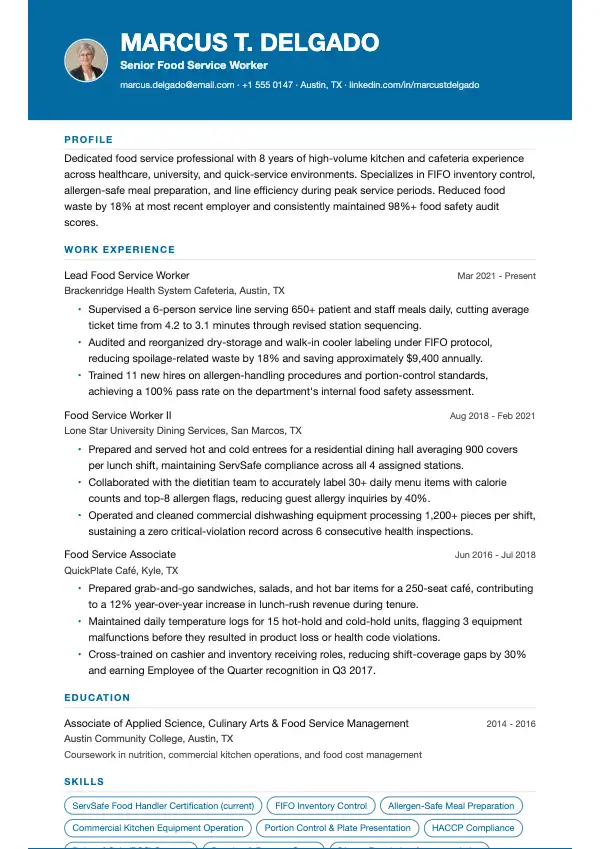
Template: Bold
Read this resume as text
Marcus T. Delgado
Senior Food Service Worker
marcus.delgado@email.com · +1 555 0147 · Austin, TX · linkedin.com/in/marcustdelgado
- Profile
- Dedicated food service professional with 8 years of high-volume kitchen and cafeteria experience across healthcare, university, and quick-service environments. Specializes in FIFO inventory control, allergen-safe meal preparation, and line efficiency during peak service periods. Reduced food waste by 18% at most recent employer and consistently maintained 98%+ food safety audit scores.
- Work Experience
Lead Food Service Worker
Brackenridge Health System Cafeteria, Austin, TX · Mar 2021 - Present
- Supervised a 6-person service line serving 650+ patient and staff meals daily, cutting average ticket time from 4.2 to 3.1 minutes through revised station sequencing.
- Audited and reorganized dry-storage and walk-in cooler labeling under FIFO protocol, reducing spoilage-related waste by 18% and saving approximately $9,400 annually.
- Trained 11 new hires on allergen-handling procedures and portion-control standards, achieving a 100% pass rate on the department's internal food safety assessment.
Food Service Worker II
Lone Star University Dining Services, San Marcos, TX · Aug 2018 - Feb 2021
- Prepared and served hot and cold entrees for a residential dining hall averaging 900 covers per lunch shift, maintaining ServSafe compliance across all 4 assigned stations.
- Collaborated with the dietitian team to accurately label 30+ daily menu items with calorie counts and top-8 allergen flags, reducing guest allergy inquiries by 40%.
- Operated and cleaned commercial dishwashing equipment processing 1,200+ pieces per shift, sustaining a zero critical-violation record across 6 consecutive health inspections.
Food Service Associate
QuickPlate Café, Kyle, TX · Jun 2016 - Jul 2018
- Prepared grab-and-go sandwiches, salads, and hot bar items for a 250-seat café, contributing to a 12% year-over-year increase in lunch-rush revenue during tenure.
- Maintained daily temperature logs for 15 hot-hold and cold-hold units, flagging 3 equipment malfunctions before they resulted in product loss or health code violations.
- Cross-trained on cashier and inventory receiving roles, reducing shift-coverage gaps by 30% and earning Employee of the Quarter recognition in Q3 2017.
- Education
Associate of Applied Science, Culinary Arts & Food Service Management
Austin Community College, Austin, TX · 2014 - 2016
Coursework in nutrition, commercial kitchen operations, and food cost management
- Skills
- ServSafe Food Handler Certification (current) · FIFO Inventory Control · Allergen-Safe Meal Preparation · Commercial Kitchen Equipment Operation · Portion Control & Plate Presentation · HACCP Compliance · Point-of-Sale (POS) Systems · Catering & Banquet Setup · Dietary Restriction Accommodation
- Links
- LinkedIn: linkedin.com/in/marcustdelgado · Certification: ServSafe Food Handler certificate #MX-447821 (verifiable via ServSafe)
What makes this resume work
- The summary names seniority, environment types, and two headline numbers — waste reduction and audit scores — so recruiters immediately see value without reading further.
- Every bullet opens with a strong action verb and closes with a specific figure (covers per shift, dollars saved, percentage improvement), making contributions concrete rather than descriptive.
- Hard skills are listed as exact phrases recruiters search — 'HACCP Compliance,' 'FIFO Inventory Control,' 'Allergen-Safe Meal Preparation' — rather than vague descriptors, which improves ATS match rates.
- The ServSafe certification appears in both the skills section and the links section with its certificate number, signaling to healthcare and institutional employers that the credential is current and legitimate.
Keywords that help you pass the ATS
Work the ones that fit your experience into your resume, naturally, not stuffed.
How to write a Food Service Worker resume
Choose the right format for a Food Service Worker resume
Most food service workers do best with a reverse-chronological format. Hiring managers in cafeterias, hospitals, school districts, and catering operations scan resumes fast, so a clean, single-page layout with clear section headers wins every time.
If you have less than two years of experience or are switching from retail or warehouse work, a combination format lets you lead with a skills section before your job history. Either way, keep the resume to one page unless you have 10-plus years in institutional or large-scale food service.
- Use standard fonts: Arial, Calibri, or Georgia at 10–12pt
- Include clear sections: Summary, Work Experience, Skills, Certifications, Education
- Avoid tables and text boxes — many applicant tracking systems used by hospital networks and school districts cannot parse them
- Save and submit as a PDF unless the job posting specifically requests a Word file
Write a professional summary that gets you past the first cut
Your summary sits at the top and does one job: convince the hiring manager to keep reading. Skip vague openers like 'hard-working team player.' Instead, name your experience level, the type of operation you know (hospital cafeteria, fast-casual, school nutrition program, catering), and one or two concrete strengths.
Here is a strong example you can adapt: "Food Service Worker with 4 years of experience in high-volume hospital cafeteria settings, including daily service to 600-plus patients and staff. ServSafe certified, skilled in HACCP documentation, tray line assembly, and operating Hobart commercial dishwashers. Consistent record of passing health department inspections with zero critical violations."
Write work-experience bullets that show output, not just duties
Recruiters already know food service workers serve food. Your bullets need to show scale, accuracy, and reliability. Lead each bullet with a strong action verb and attach a number whenever possible — portion sizes, meal counts, team size, inspection scores, or speed benchmarks. Avoid writing job descriptions copied from your employer's handbook.
Two examples of strong bullets you can model:
- Assembled and delivered 350+ patient meal trays per shift with 99% diet-order accuracy, using Computrition diet management software to verify allergen and texture requirements
- Reduced dish room backlog by 20% by reorganizing Hobart AM15 rack conveyor workflow, cutting average turnaround time from 12 minutes to under 9 minutes during peak lunch service
Include the skills and certifications recruiters and ATS systems look for
Large employers — school districts, healthcare systems, contract food management companies like Aramark, Sodexo, and Compass Group — run resumes through ATS before a human sees them. Mirror the language in the job posting and include the specific tools and credentials you actually hold.
Prioritize these in your skills and certifications section:
- ServSafe Food Handler or Food Manager certification (National Restaurant Association) — list expiration date
- HACCP (Hazard Analysis and Critical Control Points) knowledge and temperature logging
- Equipment: Hobart slicers, mixers, and dishwashers; Vulcan steam kettles; Alto-Shaam holding cabinets; Bunn coffee systems
- Diet management software: Computrition, CBORD, or Cerner Nutrition
- State or county food handler card if required in your location (e.g., California Food Handler Card)
Education, licenses, and extras that strengthen your application
A high school diploma or GED is the standard minimum for most food service worker positions. If you completed any coursework through a vocational program, community college culinary program, or workforce development center, list it — even if you did not finish a degree. School nutrition programs funded by the USDA often require documented training hours, so note those specifically.
Add any additional credentials that signal reliability and professionalism: CPR/First Aid certification, a valid driver's license if the role involves delivery or catering transport, bilingual ability if the kitchen or patient population requires it, and any employer-specific food safety training such as a hospital's internal HACCP program.
Mistakes to avoid
- Listing ServSafe as a skill rather than a certification with a credential number and expiration date makes it look unverified to hiring managers who require proof.
- Using generic phrases like 'responsible for food preparation' instead of specifying the volume, equipment, or dietary standards involved wastes the limited space you have to differentiate yourself.
- Omitting temperature control and food safety language is a critical error because HACCP compliance and proper holding temperatures are among the first things institutional employers screen for.
- Sending a one-size-fits-all resume to a hospital cafeteria and a catering company without adjusting terminology — patient tray service versus banquet setup — signals you did not read the posting.
Frequently asked questions
- Do I need a certification to get a food service worker job?
- Some states and local health departments require a food handler card, which you can often earn in a few hours online through programs like StateFoodSafety or the National Restaurant Association. Healthcare and school district employers often require ServSafe Food Handler certification before your first day, so get it before you apply if you do not already have it.
- How do I write a food service worker resume with no experience?
- Lead with transferable skills from any customer-facing or physically demanding job — cashier, stocker, childcare aide — and emphasize reliability metrics like attendance records or on-time delivery rates. Complete a free or low-cost food handler certification first, then list it prominently so you clear the basic screening requirement many employers enforce.
- Should a food service worker resume be one page or two pages?
- One page is standard and preferred for most food service worker roles, which are entry-level to mid-level positions with straightforward hiring processes. Only go to two pages if you have a decade or more of experience across multiple institutional settings, such as a progression from tray line worker to lead cook in a hospital or school nutrition program.
Make it yours in minutes
Open this example in the builder, swap in your details, and export a clean, ATS-ready resume.
Once your resume is ready
More for this application
- Template style
- Simple resume templates