Resume example
Investment Banker resume example
By the Resumade team · About our content
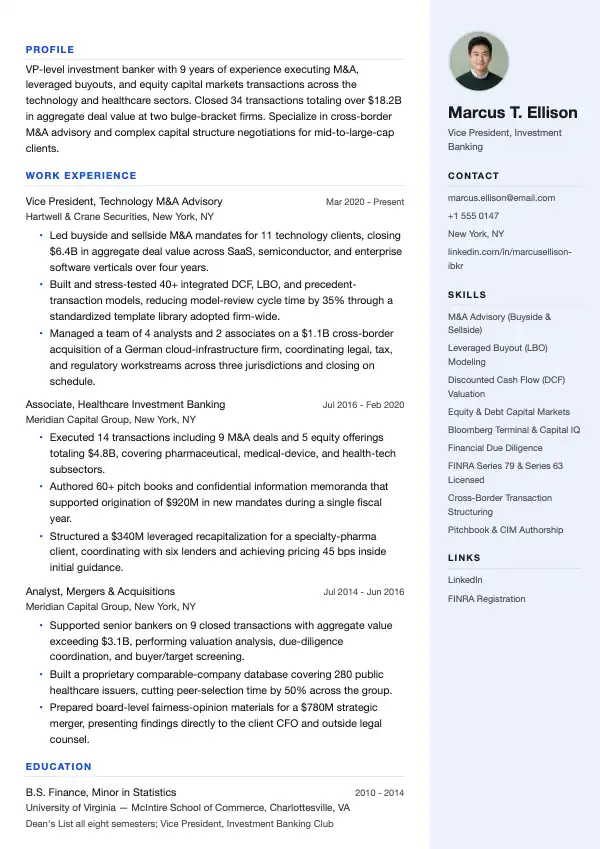
Investment banking recruiters screen first for deal types, sectors, and licenses, so the strongest resumes make all three obvious within a few lines. This example leads with aggregate deal value, licenses, and named transaction structures to do exactly that.
Template: Mist
Read this resume as text
Marcus T. Ellison
Vice President, Investment Banking
marcus.ellison@email.com · +1 555 0147 · New York, NY · linkedin.com/in/marcusellison-ibkr
- Profile
- VP-level investment banker with 9 years of experience executing M&A, leveraged buyouts, and equity capital markets transactions across the technology and healthcare sectors. Closed 34 transactions totaling over $18.2B in aggregate deal value at two bulge-bracket firms. Specialize in cross-border M&A advisory and complex capital structure negotiations for mid-to-large-cap clients.
- Work Experience
Vice President, Technology M&A Advisory
Hartwell & Crane Securities, New York, NY · Mar 2020 - Present
- Led buyside and sellside M&A mandates for 11 technology clients, closing $6.4B in aggregate deal value across SaaS, semiconductor, and enterprise software verticals over four years.
- Built and stress-tested 40+ integrated DCF, LBO, and precedent-transaction models, reducing model-review cycle time by 35% through a standardized template library adopted firm-wide.
- Managed a team of 4 analysts and 2 associates on a $1.1B cross-border acquisition of a German cloud-infrastructure firm, coordinating legal, tax, and regulatory workstreams across three jurisdictions and closing on schedule.
Associate, Healthcare Investment Banking
Meridian Capital Group, New York, NY · Jul 2016 - Feb 2020
- Executed 14 transactions including 9 M&A deals and 5 equity offerings totaling $4.8B, covering pharmaceutical, medical-device, and health-tech subsectors.
- Authored 60+ pitch books and confidential information memoranda that supported origination of $920M in new mandates during a single fiscal year.
- Structured a $340M leveraged recapitalization for a specialty-pharma client, coordinating with six lenders and achieving pricing 45 bps inside initial guidance.
Analyst, Mergers & Acquisitions
Meridian Capital Group, New York, NY · Jul 2014 - Jun 2016
- Supported senior bankers on 9 closed transactions with aggregate value exceeding $3.1B, performing valuation analysis, due-diligence coordination, and buyer/target screening.
- Built a proprietary comparable-company database covering 280 public healthcare issuers, cutting peer-selection time by 50% across the group.
- Prepared board-level fairness-opinion materials for a $780M strategic merger, presenting findings directly to the client CFO and outside legal counsel.
- Education
B.S. Finance, Minor in Statistics
University of Virginia — McIntire School of Commerce, Charlottesville, VA · 2010 - 2014
Dean's List all eight semesters; Vice President, Investment Banking Club
- Skills
- M&A Advisory (Buyside & Sellside) · Leveraged Buyout (LBO) Modeling · Discounted Cash Flow (DCF) Valuation · Equity & Debt Capital Markets · Bloomberg Terminal & Capital IQ · Financial Due Diligence · FINRA Series 79 & Series 63 Licensed · Cross-Border Transaction Structuring · Pitchbook & CIM Authorship
- Links
- LinkedIn · FINRA Registration
What makes this resume work
- The summary quantifies seniority immediately — '9 years,' '34 transactions,' and '$18.2B in deal value' give a hiring manager a calibration point before reading a single bullet.
- Each bullet names a specific deal type (LBO, leveraged recapitalization, cross-border acquisition) rather than generic 'financial analysis,' making the candidate's transaction experience searchable and concrete.
- Hard certifications (FINRA Series 79 & 63) appear in the skills section as a discrete line item, ensuring ATS systems that filter on license status return this resume in results.
- The analyst-to-VP career arc at two recognizable firm archetypes (bulge-bracket equivalent and mid-market) tells a clear story of deliberate progression without requiring the reader to infer it from dates alone.
Keywords that help you pass the ATS
Work the ones that fit your experience into your resume, naturally, not stuffed.
How to write an Investment Banker resume
Choose the right format for an Investment Banker resume
Use a reverse-chronological format. Investment banking recruiting is highly structured — analysts come from target schools, associates from MBA programs or internal promotions, and MDs carry deal sheets. Recruiters spend about seven seconds on a first pass (Ladders eye-tracking study, 2018), so your most recent and most impressive experience must appear above the fold on page one.
Keep the resume to one page if you have fewer than ten years of experience; two pages are acceptable for VPs and above with substantive deal history. Use a clean, single-column layout with consistent font sizing (10–12pt), no graphics, and standard section headers. PDF is the required submission format at virtually every bank.
- Margins: 0.5–0.75 inches on all sides to maximize white space without crowding
- Font: Garamond, Times New Roman, or Cambria — avoid sans-serif fonts, which read as non-traditional in banking
- Section order: Summary → Experience → Education → Skills & Certifications
- File name: LastName_FirstName_Resume.pdf — never 'MyResume_Final_v3.pdf'
Write a professional summary that signals deal experience immediately
Your summary is two to three sentences. It should name your coverage group or product vertical, your deal count or transaction volume, and one differentiating credential. Skip objective statements entirely — they signal inexperience. Recruiters want to know your lane: are you a healthcare M&A analyst, a leveraged finance associate, or a restructuring VP?
Example: "Investment Banking Associate with four years of experience in Technology M&A at a bulge-bracket firm, having supported 12 closed transactions totaling over $9B in aggregate deal value. Proficient in LBO modeling, DCF valuation, and precedent transaction analysis using Capital IQ and FactSet. Series 79 and Series 63 licensed."
Write work-experience bullets that lead with deal metrics
Every bullet should begin with an action verb and contain at least one hard number — deal size, number of transactions, revenue generated, or time saved. Vague bullets like 'assisted with financial analysis' are disqualifying at competitive firms. Name the deal type (sell-side M&A, IPO, leveraged buyout, debt capital markets) and the sector when you can do so without violating confidentiality. Quantify your modeling output, client deliverables, and any business development contributions.
Structure each bullet as: Action verb + specific task or deal type + measurable result or scale.
- Built fully integrated LBO models and 10-year DCF analyses for six buy-side mandates in the industrials sector, supporting $2.4B in aggregate transaction value closed over 18 months.
- Prepared and delivered 14 pitchbooks and management presentations for prospective healthcare clients, contributing to three new mandates representing $850M in potential deal fees.
Skills and certifications recruiters and ATS systems look for
Banking applicant tracking systems and human screeners both scan for specific technical terms. List your skills in a dedicated section rather than burying them in bullets. Separate hard technical skills from financial modeling competencies and software platforms. Do not list Microsoft Office as a skill — it is assumed. Do list Bloomberg Terminal, FactSet, Capital IQ, Refinitiv Eikon, and Pitchbook if you have used them professionally.
Certifications matter enormously at the licensed-professional level. The Series 79 (Investment Banking Representative), with the SIE as its corequisite, is required for most front-office investment banking roles in the US, analysts included. Many banks also require the Series 63. The CFA designation is valued most in equity research crossover roles and credit-focused groups; the CAIA is relevant for alternative investment coverage.
- SIE, Series 79, and Series 63 — list each one you hold
- CFA (Chartered Financial Analyst) — Levels I, II, or charterholder status all worth listing
- Financial modeling: LBO, DCF, merger consequences, accretion/dilution, credit analysis
- Software: Bloomberg Terminal, Capital IQ, FactSet, Refinitiv, Pitchbook, Tableau
- Excel (advanced): dynamic arrays, Power Query, VBA macros for model automation
Education, licenses, and additional sections
For analysts and associates, education sits prominently and includes GPA if 3.5 or above — banking recruiting is one of the few fields where GPA still filters candidates at the screening stage. List your degree, institution, graduation year, and relevant honors (Dean's List, Phi Beta Kappa, finance club leadership). If you attended a non-target school, emphasize relevant coursework, a high GPA, and any banking-specific extracurriculars such as an investment banking club or undergraduate finance competition.
Add a Transactions section or Deal Sheet as a separate block if you are at the VP level or above. List closed deals by type, sector, and approximate size without disclosing confidential client names where restricted. Include language proficiency if you cover cross-border deals — Mandarin, Spanish, German, and Arabic are particularly valued in international coverage groups.
- List GPA only if 3.5 or higher; drop it entirely after five years of work experience
- Relevant coursework (Corporate Finance, Financial Statement Analysis, Valuation) adds weight for recent graduates
- FINRA registrations: include your CRD number or simply 'Active' status — recruiters verify independently
Mistakes to avoid
- Listing deal experience without specifying transaction type, sector, or size makes your bullets indistinguishable from every other candidate's and signals that you may not have been meaningfully involved.
- If you already hold the Series 79, omitting it or its status on a lateral associate-level or above resume hides a registration recruiters screen for.
- Using a creative or graphic resume template signals unfamiliarity with banking culture — every major firm expects a plain, text-based document that parses cleanly through their applicant tracking system.
- Describing responsibilities instead of outcomes — writing 'responsible for financial modeling' instead of naming the model type, the deal it supported, and its size — wastes the most valuable real estate on your resume.
Frequently asked questions
- Should an investment banking resume be one page or two pages?
- One page is the standard for analysts and associates with fewer than ten years of experience — most bulge-bracket and elite boutique firms expect it and will flag a two-page resume from a junior candidate as a red flag for poor judgment. VPs and MDs with extensive deal histories can justify two pages, but only if every line carries substantive deal or client information.
- Do I need the Series 79 before applying to investment banking jobs?
- You do not need to hold the Series 79 before receiving an offer. It requires sponsorship by a FINRA member firm, so most new hires take it after joining, on a timeline their firm sets. You can take the SIE, its corequisite, on your own beforehand, and listing a passed SIE adds credibility. Lateral hires who already hold an active Series 79 should list it.
- How do I write an investment banking resume if I have no banking experience?
- Lead with your most relevant transferable experience: equity research, corporate finance, Big Four transaction advisory, or financial consulting all translate well. Emphasize technical skills — LBO modeling, DCF, financial statement analysis — and any deal-adjacent work such as due diligence support or valuation projects. A completed financial modeling certification from a program like Wall Street Prep or Breaking Into Wall Street adds credibility when direct deal experience is absent.
Make it yours in minutes
Open this example in the builder, swap in your details, and export a clean, ATS-ready resume.
Once your resume is ready
More for this application
- Template style
- Professional resume templates