Resume example
Line Cook resume example
By the Resumade team · About our content
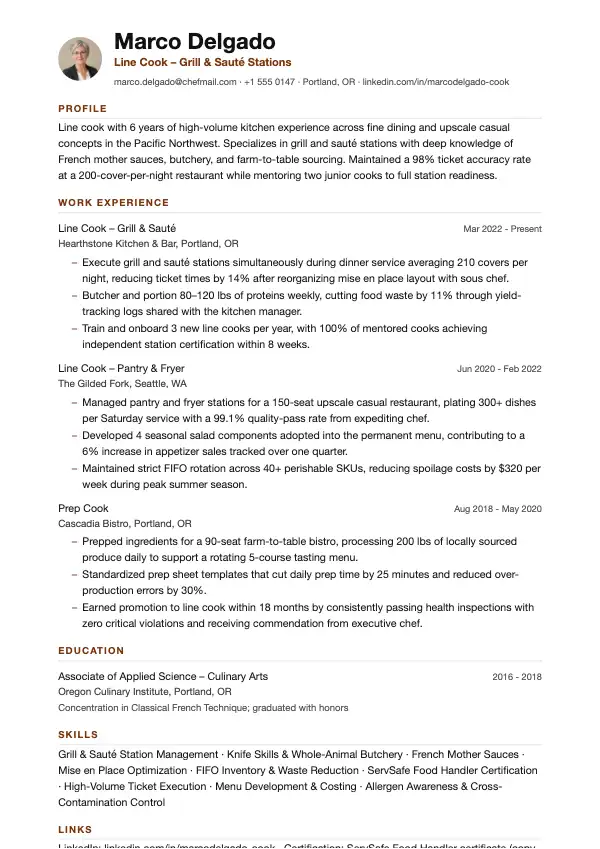
A line cook resume must clear keyword filters for station skills and certifications, then prove to a chef-owner that you can hold your station under pressure. This example does both with role-specific metrics and a focused skills block.
Template: Wren
Read this resume as text
Marco Delgado
Line Cook – Grill & Sauté Stations
marco.delgado@chefmail.com · +1 555 0147 · Portland, OR · linkedin.com/in/marcodelgado-cook
- Profile
- Line cook with 6 years of high-volume kitchen experience across fine dining and upscale casual concepts in the Pacific Northwest. Specializes in grill and sauté stations with deep knowledge of French mother sauces, butchery, and farm-to-table sourcing. Maintained a 98% ticket accuracy rate at a 200-cover-per-night restaurant while mentoring two junior cooks to full station readiness.
- Work Experience
Line Cook – Grill & Sauté
Hearthstone Kitchen & Bar, Portland, OR · Mar 2022 - Present
- Execute grill and sauté stations simultaneously during dinner service averaging 210 covers per night, reducing ticket times by 14% after reorganizing mise en place layout with sous chef.
- Butcher and portion 80–120 lbs of proteins weekly, cutting food waste by 11% through yield-tracking logs shared with the kitchen manager.
- Train and onboard 3 new line cooks per year, with 100% of mentored cooks achieving independent station certification within 8 weeks.
Line Cook – Pantry & Fryer
The Gilded Fork, Seattle, WA · Jun 2020 - Feb 2022
- Managed pantry and fryer stations for a 150-seat upscale casual restaurant, plating 300+ dishes per Saturday service with a 99.1% quality-pass rate from expediting chef.
- Developed 4 seasonal salad components adopted into the permanent menu, contributing to a 6% increase in appetizer sales tracked over one quarter.
- Maintained strict FIFO rotation across 40+ perishable SKUs, reducing spoilage costs by $320 per week during peak summer season.
Prep Cook
Cascadia Bistro, Portland, OR · Aug 2018 - May 2020
- Prepped ingredients for a 90-seat farm-to-table bistro, processing 200 lbs of locally sourced produce daily to support a rotating 5-course tasting menu.
- Standardized prep sheet templates that cut daily prep time by 25 minutes and reduced over-production errors by 30%.
- Earned promotion to line cook within 18 months by consistently passing health inspections with zero critical violations and receiving commendation from executive chef.
- Education
Associate of Applied Science – Culinary Arts
Oregon Culinary Institute, Portland, OR · 2016 - 2018
Concentration in Classical French Technique; graduated with honors
- Skills
- Grill & Sauté Station Management · Knife Skills & Whole-Animal Butchery · French Mother Sauces · Mise en Place Optimization · FIFO Inventory & Waste Reduction · ServSafe Food Handler Certification · High-Volume Ticket Execution · Menu Development & Costing · Allergen Awareness & Cross-Contamination Control
- Links
- LinkedIn: linkedin.com/in/marcodelgado-cook · Certification: ServSafe Food Handler certificate (copy on request)
What makes this resume work
- The job title names specific stations — 'Grill & Sauté' — so the resume matches filtered searches by chefs hiring for those exact positions rather than generic line cook postings.
- Every bullet opens with a strong action verb and closes with a number — cover counts, waste percentages, dollar savings — giving a hiring chef concrete proof of performance rather than vague claims.
- The skills section front-loads certifications and station-specific techniques that kitchen management software and job-board ATS tools scan for before a human ever reads the document.
- The progression from Prep Cook to dual-station Line Cook is explicit and dated, showing a chef-owner a clear growth trajectory and reducing the need to guess at the candidate's seniority level.
Keywords that help you pass the ATS
Work the ones that fit your experience into your resume, naturally, not stuffed.
How to write a Line Cook resume
Choose the right format for a Line Cook resume
Use a reverse-chronological format. Kitchens hire fast and chef-managers scan resumes quickly, so your most recent employer needs to appear at the top. A functional or hybrid format buries your actual kitchen experience and raises red flags with experienced hiring managers.
Keep the resume to one page unless you have more than ten years of continuous kitchen experience. Use clean section headers, a readable font like Calibri or Arial at 10–12pt, and consistent spacing. Skip photos, graphics, and columns — many restaurant groups use an applicant tracking system, and those elements parse badly.
- One page for under 10 years of experience; two pages maximum after that
- Sections in order: contact info, summary, work experience, skills, certifications, education
- No tables or text boxes — they break ATS parsing
- Save and send as a PDF unless the job posting specifically asks for .docx
Write a professional summary that gets you past the first scan
Your summary sits directly under your contact information and should be three to four sentences that tell a chef-manager your station expertise, years of experience, and one or two concrete strengths. Do not open with 'I am a passionate cook.' Open with your role, your specialty, and a result.
Example: "Line cook with 5 years of high-volume experience across sauté and grill stations in full-service restaurants doing 300-plus covers per night. Trained in classical French technique and proficient in butchery, scratch sauce production, and daily prep management. ServSafe certified. Comfortable onboarding new cooks and maintaining ticket times under 8 minutes during peak service."
Write work-experience bullets that show output, not just tasks
List each job with employer name, city and state, your title, and the dates you worked there (month and year). Under each job, write three to six bullets that describe what you actually produced — not a generic list of duties. Quantify wherever you can: covers per night, prep volume, ticket times, team size, or cost-reduction results. Hiring managers in busy kitchens respond to specificity because it signals you understand the pace and scale of real service.
Avoid vague phrases like 'assisted with food preparation' or 'maintained a clean workspace.' Every line cook maintains a clean workspace — that is a baseline expectation, not an accomplishment.
- Executed sauté station for a 180-seat Italian concept averaging 400 covers on Friday and Saturday service, maintaining an average ticket time of 7 minutes.
- Reduced daily protein waste by 18% over three months by standardizing butchery portion weights and updating prep par sheets in coordination with the sous chef.
Skills and certifications recruiters and ATS systems look for
List hard skills by station and technique, not generic adjectives. Applicant tracking systems used by restaurant groups and hotel food-and-beverage departments search for specific terms. Include equipment you actually operate and any certifications you hold. A food handler card or food manager certificate (such as ServSafe) is required in some states and localities and requested by many employers; some require it before your first shift.
Soft skills like 'team player' waste space. Replace them with specifics like 'cross-trained on cold and hot line' or 'experience training junior cooks on knife skills and station setup.'
- ServSafe Food Manager Certification (ANSI-accredited)
- Station skills: sauté, grill, fry, garde manger, pantry, expo
- Equipment: Rational combi oven, Hobart mixer, immersion circulator, Cryovac chamber sealer, Vulcan range
- Techniques: butchery, stock and sauce production, pasta fabrication, charcuterie
- Allergen awareness and HACCP temperature logging
Education, licenses, and extras that strengthen your application
A culinary degree from an accredited program — ACF-accredited schools, CIA, Johnson & Wales, or a community college culinary arts program — is worth listing, but it does not outweigh hands-on experience for most line cook roles. List the school, the credential (AOS, certificate, diploma), and the year you graduated or expect to graduate. If you did not finish a formal program, list any culinary workshops, apprenticeships, or stage experience instead.
Additional items worth including: a current food handler card if your state requires one separately from ServSafe, TIPS or (in Pennsylvania) RAMP server training if you work in a full-service environment, any ACF certification levels (CC, CPC), and fluency in a second language if the kitchen operates bilingually. A brief 'Additional' section can hold these without cluttering your skills block.
- List culinary school credentials above any unrelated college coursework
- Include ACF certification level if you have one — it signals professional development
- Note any stage or extern experience with a named chef or notable restaurant
Mistakes to avoid
- Listing every station as a skill without specifying your actual proficiency level or the volume you handled leads hiring managers to discount your entire skills section.
- Using employment gaps without a brief explanation — culinary school, travel, injury — makes chef-managers assume you were fired or unreliable, so address gaps directly in your summary or a short note.
- Omitting your ServSafe status forces the hiring manager to ask about it in the interview, which wastes time and signals you did not read the job posting carefully.
- Writing one generic resume for every application instead of swapping in the specific cuisine type, station focus, or volume numbers mentioned in each job posting leaves your resume short of the keywords a kitchen manager or recruiter searches for.
Frequently asked questions
- Do I need a culinary degree to get a line cook job?
- No. Most independent restaurants and many hotel kitchens hire based on demonstrated station skills and verifiable experience, not a degree. A culinary degree can help you move into sous chef roles faster, but for line positions, a strong work history with specific volume numbers and a valid ServSafe certificate carries more weight.
- How far back should my work history go on a line cook resume?
- Go back 7 to 10 years, or to your first kitchen job if you have fewer than 10 years of experience. If you worked in unrelated industries before cooking, list only the culinary roles unless a non-kitchen job taught a directly relevant skill, such as butchery at a meat counter or inventory management in food retail.
- Should I include references or a portfolio on my line cook resume?
- Do not list references on the resume itself — 'references available upon request' is also unnecessary filler. A portfolio is not standard for line cook applications, but if you have photos of plated dishes or a documented tasting menu you contributed to, you can mention a link to an online portfolio in your contact section. Keep it optional and only include it if the work is genuinely strong.
Make it yours in minutes
Open this example in the builder, swap in your details, and export a clean, ATS-ready resume.
Once your resume is ready
More for this application
- Template style
- Simple resume templates