Resume example
Mental Health Counselor resume example
By the Resumade team · About our content
A Mental Health Counselor resume must satisfy ATS filters for licensure and clinical modalities while giving hiring managers concrete evidence of client outcomes. This example does both by leading with credential-rich language and quantified results in every bullet.
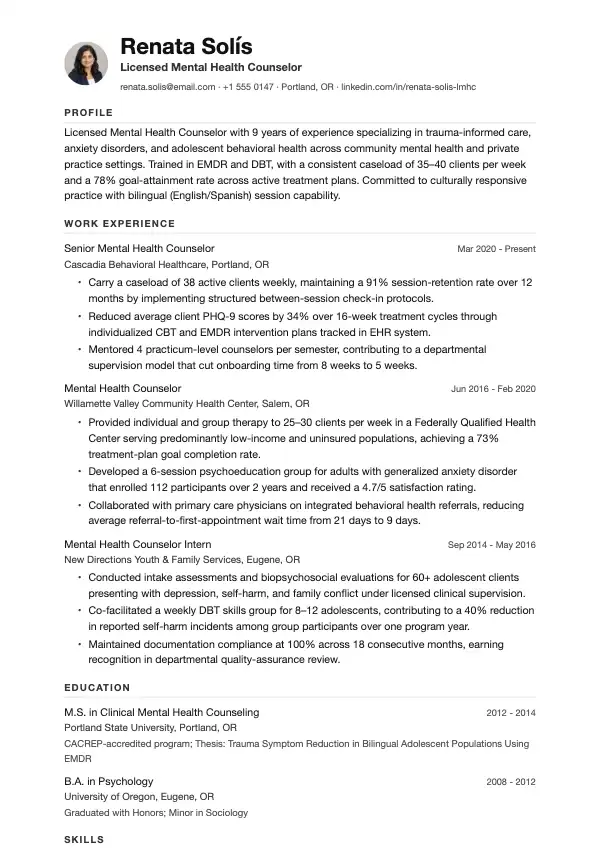
Template: Modern
Read this resume as text
Renata Solís
Licensed Mental Health Counselor
renata.solis@email.com · +1 555 0147 · Portland, OR · linkedin.com/in/renata-solis-lmhc
- Profile
- Licensed Mental Health Counselor with 9 years of experience specializing in trauma-informed care, anxiety disorders, and adolescent behavioral health across community mental health and private practice settings. Trained in EMDR and DBT, with a consistent caseload of 35–40 clients per week and a 78% goal-attainment rate across active treatment plans. Committed to culturally responsive practice with bilingual (English/Spanish) session capability.
- Work Experience
Senior Mental Health Counselor
Cascadia Behavioral Healthcare, Portland, OR · Mar 2020 - Present
- Carry a caseload of 38 active clients weekly, maintaining a 91% session-retention rate over 12 months by implementing structured between-session check-in protocols.
- Reduced average client PHQ-9 scores by 34% over 16-week treatment cycles through individualized CBT and EMDR intervention plans tracked in EHR system.
- Mentored 4 practicum-level counselors per semester, contributing to a departmental supervision model that cut onboarding time from 8 weeks to 5 weeks.
Mental Health Counselor
Willamette Valley Community Health Center, Salem, OR · Jun 2016 - Feb 2020
- Provided individual and group therapy to 25–30 clients per week in a Federally Qualified Health Center serving predominantly low-income and uninsured populations, achieving a 73% treatment-plan goal completion rate.
- Developed a 6-session psychoeducation group for adults with generalized anxiety disorder that enrolled 112 participants over 2 years and received a 4.7/5 satisfaction rating.
- Collaborated with primary care physicians on integrated behavioral health referrals, reducing average referral-to-first-appointment wait time from 21 days to 9 days.
Mental Health Counselor Intern
New Directions Youth & Family Services, Eugene, OR · Sep 2014 - May 2016
- Conducted intake assessments and biopsychosocial evaluations for 60+ adolescent clients presenting with depression, self-harm, and family conflict under licensed clinical supervision.
- Co-facilitated a weekly DBT skills group for 8–12 adolescents, contributing to a 40% reduction in reported self-harm incidents among group participants over one program year.
- Maintained documentation compliance at 100% across 18 consecutive months, earning recognition in departmental quality-assurance review.
- Education
M.S. in Clinical Mental Health Counseling
Portland State University, Portland, OR · 2012 - 2014
CACREP-accredited program; Thesis: Trauma Symptom Reduction in Bilingual Adolescent Populations Using EMDR
B.A. in Psychology
University of Oregon, Eugene, OR · 2008 - 2012
Graduated with Honors; Minor in Sociology
- Skills
- EMDR (Eye Movement Desensitization and Reprocessing) · Dialectical Behavior Therapy (DBT) · Cognitive Behavioral Therapy (CBT) · Electronic Health Records — Credible EHR & SimplePractice · PHQ-9 / GAD-7 Outcome Measurement · Crisis Intervention & Safety Planning · Licensed Mental Health Counselor (LMHC) — Oregon #C4821 · Bilingual Counseling (English/Spanish) · Integrated Behavioral Health & Primary Care Collaboration
- Links
- LinkedIn: linkedin.com/in/renata-solis-lmhc · License: Oregon Counselor License #C4821 (verifiable via state board)
What makes this resume work
- Every experience bullet ends with a specific number — retention rates, PHQ-9 score changes, wait-time reductions — giving reviewers proof of clinical effectiveness rather than vague claims of 'providing quality care.'
- The summary front-loads licensure status, years of experience, and two high-signal specializations (EMDR and DBT) in the first sentence, ensuring ATS systems and speed-reading managers capture key qualifiers immediately.
- Skills are written out in full clinical terminology (e.g., 'Dialectical Behavior Therapy (DBT)' rather than just 'DBT') so the resume matches both abbreviated and spelled-out search strings used by recruiters and ATS platforms.
- The education note references the CACREP accreditation of the graduate program, a detail credentialing committees and hospital HR departments actively screen for when verifying counselor qualifications.
Keywords that help you pass the ATS
Work the ones that fit your experience into your resume, naturally, not stuffed.
How to write a Mental Health Counselor resume
Choose the right format for a Mental Health Counselor resume
Use a reverse-chronological format. Hiring managers at community mental health centers, private practices, and hospital systems want to see your most recent clinical experience first, not a skills-heavy functional layout that buries where and when you actually worked.
Keep the resume to one page if you have fewer than eight years of experience; two pages are acceptable for licensed clinicians with multiple placements, supervisory roles, or published work. Use clean section headers, 10–12pt font, and at least 0.5-inch margins. Avoid graphics, photos, or columns — many applicant tracking systems used by large health networks parse single-column documents more reliably.
- Standard sections: Contact Info, Professional Summary, Licensure, Work Experience, Education, Skills
- List your active license (LPC, LCSW, LMHC, etc.) prominently — near the top, not buried in Education
- If you hold NPI registration, include the number; it signals readiness for credentialing
- Save the file as a PDF unless the job posting explicitly requests a Word document
Write a professional summary that leads with your license and specialty
Your summary should be three to four sentences and front-load your credential, years of experience, and clinical specialty. Vague openers like 'compassionate professional seeking to make a difference' waste the recruiter's first look. Be specific about the population you treat and the modalities you use.
Example: "Licensed Professional Counselor (LPC) with six years of outpatient experience providing individual and group therapy to adults managing depression, anxiety, and co-occurring substance use disorders. Trained in CBT, DBT, and Motivational Interviewing; proficient in completing biopsychosocial assessments and treatment plans within an EHR environment (SimplePractice, Credible). Experienced in coordinating care with psychiatrists and case managers in a CCBHC-funded setting."
Write work-experience bullets that show clinical impact with numbers
Every bullet should follow an action-result structure. Quantify caseload size, outcomes, wait-time reductions, group sizes, or audit scores whenever you can. Reviewers at larger agencies want to know you can manage realistic caseloads and document accurately — vague bullets about 'providing therapy' do not differentiate you.
Pull numbers from your performance reviews, program reports, or EHR dashboards. Even approximate figures ('approximately 40 active clients') are more credible than no figures at all.
- Managed a caseload of 45 active clients weekly, maintaining a 92% treatment-plan completion rate and zero documentation deficiencies across two consecutive CARF audit cycles.
- Facilitated a 10-week DBT skills group for 12 adults with borderline personality disorder, with 83% of participants reporting reduced self-harm incidents on standardized PHQ-9 and BSL-23 follow-up measures.
Skills and certifications recruiters and ATS systems look for
Mental health recruiters search applicants by credential abbreviation and clinical term. Include your exact license abbreviation, state of licensure, and expiration or renewal year. List evidence-based modalities by their common abbreviations (CBT, EMDR, MI, CPP, TF-CBT) and name the EHR platforms you have used.
Certifications that add real value in this field include CCTP (Certified Clinical Trauma Professional), NCC (National Certified Counselor), CADC or CSAC for co-occurring work, and QPR or ASIST for suicide intervention. If you provide telehealth, note the platforms (Zoom for Healthcare, Doxy.me, SimplePractice) and any state compact participation.
- EHR platforms: SimplePractice, Credible, Kipu, Therapy Brands, Epic Behavioral Health
- Assessment tools: PHQ-9, GAD-7, Columbia Suicide Severity Rating Scale (C-SSRS), PCL-5, AUDIT-C
- Modalities: CBT, DBT, EMDR, Motivational Interviewing, TF-CBT, CPP, ACT
- Certifications: NCC, CCTP, CADC, CSAC, CIMHP, CPR/First Aid
- Compliance knowledge: HIPAA, 42 CFR Part 2 (substance use records), mandatory reporting laws
Education, licenses, and extras that close the deal
List your master's degree first — MSW, MS in Clinical Mental Health Counseling, MA in Marriage and Family Therapy, or equivalent. Include the institution, degree, and graduation year. If your program was CACREP-accredited, note that; a growing number of state boards require it for licensure eligibility, and some employers prefer it.
Below education, add a dedicated Licensure section that lists each active credential with state, license number, and expiration date. If you completed post-master's supervised hours toward full licensure, note the supervising credential and hours logged. Optional but useful extras: bilingual fluency (specify language and proficiency level), lived-experience disclosures you choose to share, publications, conference presentations, or adjunct teaching that demonstrates subject-matter depth.
Mistakes to avoid
- Listing your license only in the Education section instead of near the top of the resume causes ATS filters and rushed recruiters to miss your credential entirely.
- Using vague clinical language like 'provided therapeutic services' without naming the modality, population, or setting tells the reader almost nothing about your actual scope of practice.
- Omitting your EHR experience is a significant oversight because most outpatient and agency employers screen for platform familiarity to reduce onboarding time.
- Failing to tailor your listed licensure state to the job location — or neglecting to mention compact membership — creates credentialing confusion that can disqualify you before an interview is scheduled.
Frequently asked questions
- Should I include my license number on my Mental Health Counselor resume?
- Yes, including your license number is standard practice in behavioral health hiring and speeds up the credentialing verification process. List the number alongside your license type, issuing state, and expiration date. Employers and credentialing departments will verify it anyway, so including it upfront signals transparency and readiness.
- How do I write a Mental Health Counselor resume if I am still working toward full licensure?
- List your current credential accurately — for example, 'Licensed Professional Counselor Associate (LPC Associate), Texas, supervised by Jane Smith, LPC-S' — and note the supervised hours you have accrued toward full licensure. Many agencies actively hire pre-licensed counselors and budget for supervision, so do not hide your status; frame it with the hours completed and your anticipated licensure timeline.
- What caseload size should I put on a Mental Health Counselor resume?
- Use the actual average weekly caseload you carried, not a peak or inflated number, because interviewers will ask follow-up questions and discrepancies damage credibility. If your caseload varied by setting — for example, 30 clients in a school-based role versus 50 in a community health center — list each figure with its corresponding position. Accurate numbers demonstrate self-awareness about productivity and documentation capacity.
Make it yours in minutes
Open this example in the builder, swap in your details, and export a clean, ATS-ready resume.
Once your resume is ready
More for this application
- Template style
- Modern resume templates