Resume example
Personal Trainer resume example
By the Resumade team · About our content
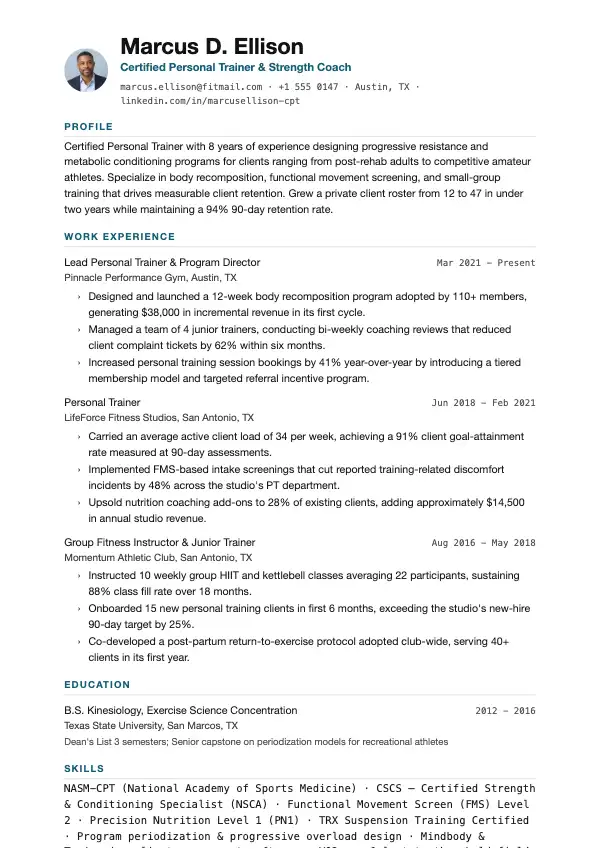
Gyms and studios check a personal trainer resume for certifications and specialisms first, then look for client outcomes backed by hard numbers. This example does both by leading with stacked credentials and metric-anchored bullets throughout.
Template: Circuit
Read this resume as text
Marcus D. Ellison
Certified Personal Trainer & Strength Coach
marcus.ellison@fitmail.com · +1 555 0147 · Austin, TX · linkedin.com/in/marcusellison-cpt
- Profile
- Certified Personal Trainer with 8 years of experience designing progressive resistance and metabolic conditioning programs for clients ranging from post-rehab adults to competitive amateur athletes. Specialize in body recomposition, functional movement screening, and small-group training that drives measurable client retention. Grew a private client roster from 12 to 47 in under two years while maintaining a 94% 90-day retention rate.
- Work Experience
Lead Personal Trainer & Program Director
Pinnacle Performance Gym, Austin, TX · Mar 2021 - Present
- Designed and launched a 12-week body recomposition program adopted by 110+ members, generating $38,000 in incremental revenue in its first cycle.
- Managed a team of 4 junior trainers, conducting bi-weekly coaching reviews that reduced client complaint tickets by 62% within six months.
- Increased personal training session bookings by 41% year-over-year by introducing a tiered membership model and targeted referral incentive program.
Personal Trainer
LifeForce Fitness Studios, San Antonio, TX · Jun 2018 - Feb 2021
- Carried an average active client load of 34 per week, achieving a 91% client goal-attainment rate measured at 90-day assessments.
- Implemented FMS-based intake screenings that cut reported training-related discomfort incidents by 48% across the studio's PT department.
- Upsold nutrition coaching add-ons to 28% of existing clients, adding approximately $14,500 in annual studio revenue.
Group Fitness Instructor & Junior Trainer
Momentum Athletic Club, San Antonio, TX · Aug 2016 - May 2018
- Instructed 10 weekly group HIIT and kettlebell classes averaging 22 participants, sustaining 88% class fill rate over 18 months.
- Onboarded 15 new personal training clients in first 6 months, exceeding the studio's new-hire 90-day target by 25%.
- Co-developed a post-partum return-to-exercise protocol adopted club-wide, serving 40+ clients in its first year.
- Education
B.S. Kinesiology, Exercise Science Concentration
Texas State University, San Marcos, TX · 2012 - 2016
Dean's List 3 semesters; Senior capstone on periodization models for recreational athletes
- Skills
- NASM-CPT (National Academy of Sports Medicine) · CSCS – Certified Strength & Conditioning Specialist (NSCA) · Functional Movement Screen (FMS) Level 2 · Precision Nutrition Level 1 (PN1) · TRX Suspension Training Certified · Program periodization & progressive overload design · Mindbody & Trainerize client management software · VO2 max & lactate threshold field testing · CPR/AED Certified (American Red Cross)
- Links
- LinkedIn: linkedin.com/in/marcusellison-cpt · Portfolio: marcusellison.com/training-portfolio
What makes this resume work
- The summary front-loads seniority, a clear specialism (body recomposition and functional movement), and a retention rate — giving a hiring manager three reasons to keep reading before reaching the experience section.
- Each bullet opens with a distinct action verb (Designed, Managed, Implemented) and closes with a dollar figure, percentage, or client count, so the impact is impossible to skim past.
- Certifications are listed as full, searchable credential names (NASM-CPT, CSCS, FMS Level 2) rather than acronyms alone, which satisfies both ATS keyword matching and recruiter verification at a glance.
- The progression from group instructor to junior trainer to program director tells a coherent career story that justifies the senior title without requiring a cover letter to explain the trajectory.
Keywords that help you pass the ATS
Work the ones that fit your experience into your resume, naturally, not stuffed.
How to write a Personal Trainer resume
Choose the right format for a Personal Trainer resume
Use a reverse-chronological format unless you are switching into personal training from an unrelated field, in which case a combination format lets you lead with a skills section before listing jobs. Either way, keep the resume to one page if you have fewer than ten years of experience; two pages only if you hold multiple certifications and have managed a large client roster or a team of trainers.
Stick to clean, single-column layouts. Gym hiring managers and fitness studio owners often skim resumes on mobile devices or print them out, so avoid tables, graphics, and multiple columns that break when exported to PDF.
- Standard margins: 0.75–1 inch on all sides
- Font size 10–12 pt in a readable face such as Calibri, Georgia, or Arial
- Section order: Contact info → Summary → Certifications → Experience → Skills → Education
- File format: PDF unless the job posting specifically requests a Word document
Write a professional summary that hooks the hiring manager
Your summary sits directly under your name and contact info and should be three to four sentences that cover your certification credentials, years of experience, training specialties, and one concrete outcome. Skip objectives like 'seeking a challenging role' — state what you bring, not what you want.
Example: "NASM-CPT and Precision Nutrition Level 1 certified personal trainer with 6 years of experience at commercial and boutique fitness facilities. Specialize in strength and conditioning for adults over 40 and post-physical-therapy return-to-fitness programming. Maintained a 90% client retention rate over three years at FitLife Chicago and grew a personal roster from 12 to 38 active weekly clients within 18 months."
Write work-experience bullets that show real impact
Each bullet should follow an action verb → task → measurable result structure. Vague bullets like 'helped clients reach their goals' tell a hiring manager nothing. Quantify client load, retention, revenue generated, class sizes, and program outcomes wherever possible. If you worked at a franchise gym such as LA Fitness, Equinox, or Anytime Fitness, name it — brand recognition matters.
Pull metrics from your session-tracking software (Trainerize, PT Distinction, My PT Hub) or your facility's CRM. Even approximate figures are better than none.
- Designed and delivered 1-on-1 and semi-private strength programs for a roster of 45 weekly clients, generating $72,000 in personal training revenue in 2023 — 18% above the studio's trainer average.
- Reduced client no-show rate from 22% to 8% over six months by introducing automated session reminders through Trainerize and implementing a 24-hour cancellation policy.
Skills and certifications recruiters and ATS systems look for
List certifications by their exact acronym and issuing body — ATS filters search for strings like 'NASM-CPT,' 'ACE-CPT,' 'CSCS,' and 'ACSM-EP.' Spell out the full name once and put the acronym in parentheses if space allows. Include expiration or renewal dates in your certifications section, not in the skills list.
Hard skills and tools belong in a dedicated skills section. Soft skills such as 'good communicator' are filler — cut them unless you can demonstrate them in a bullet.
- Certifications: NASM-CPT, ACE-CPT, NSCA-CSCS, ACSM-EP, ISSA-CPT, Precision Nutrition Level 1 or 2, FMS Level 1 or 2
- Specialty credentials: Pre/postnatal fitness (BIRTHFIT), corrective exercise (NASM-CES), behavior change (ACE Behavior Change Specialist)
- Software: Trainerize, PT Distinction, My PT Hub, Mindbody, ClubReady
- Hard skills: program periodization, movement screening, body composition assessment (DEXA, InBody, skinfold), CPR/AED
Education, licenses, and extras that round out your resume
A bachelor's degree in kinesiology, exercise science, or a related field strengthens your candidacy, especially for corporate wellness, hospital-based fitness, or university recreation center roles. List your degree, institution, and graduation year. If you did not finish a degree, list completed coursework or your associate's degree without drawing attention to incompletion.
Add a brief extras section for relevant continuing education, such as NASM's Optimum Performance Training (OPT) model workshops, USA Weightlifting coaching credentials, or kettlebell certifications (StrongFirst SFG, RKC). If you train clients online, note that — remote coaching is a distinct skill set that many employers now value.
- Current CPR/AED certification (Red Cross or American Heart Association) is non-negotiable — list it
- State or facility-specific liability insurance is worth mentioning if you are applying as an independent contractor
- Professional memberships such as NSCA or ACSM signal ongoing engagement with the field
Mistakes to avoid
- Listing certifications without the issuing organization or expiration date makes it impossible for a hiring manager to verify credentials quickly.
- Using the same generic bullet — 'motivated clients to achieve fitness goals' — across every job gives no information about your actual client load, specialties, or results.
- Omitting software tools like Trainerize or Mindbody signals to commercial gym operators that you may need extra onboarding time for systems they rely on daily.
- Burying your primary certification below your work history instead of placing it near the top of the resume, where time-pressed fitness directors will see it immediately.
Frequently asked questions
- Do I need a degree to be taken seriously as a personal trainer on a resume?
- A degree in exercise science or kinesiology helps for hospital-based or corporate wellness roles, but most commercial gyms and boutique studios prioritize your primary certification (NASM, ACE, NSCA) and your client results over a diploma. If you have a strong certification, solid metrics, and relevant specialty credentials, you can compete effectively without a four-year degree.
- How do I write a personal trainer resume if I only have gym floor or group fitness experience?
- Frame group fitness classes as evidence of coaching volume — note class sizes, attendance growth, and any formats you are certified to teach (Les Mills, TRX, spin). Highlight any informal one-on-one coaching, fitness assessments, or program design you did even outside a formal personal training role. Pair that experience with your certification and a summary that signals you are ready to transition to individual client programming.
- Should I include online coaching clients on my personal trainer resume?
- Yes — list online coaching as its own role or as part of an existing role if you ran it alongside in-person training. Specify the platform you used (Trainerize, TrueCoach, Google Sheets), the number of remote clients you managed, and any measurable outcomes such as client retention or revenue. Remote coaching competency is increasingly valued as gyms expand hybrid service offerings.
Make it yours in minutes
Open this example in the builder, swap in your details, and export a clean, ATS-ready resume.
Once your resume is ready
More for this application
- Template style
- ATS-Friendly resume templates