Resume example
Physician resume example
By the Resumade team · About our content
A physician resume must clear ATS filters loaded with specialty keywords while giving a hiring committee immediate proof of clinical volume, outcomes, and leadership. This example does both by opening with board certification, quantified readmission data, and a defined scope of practice.
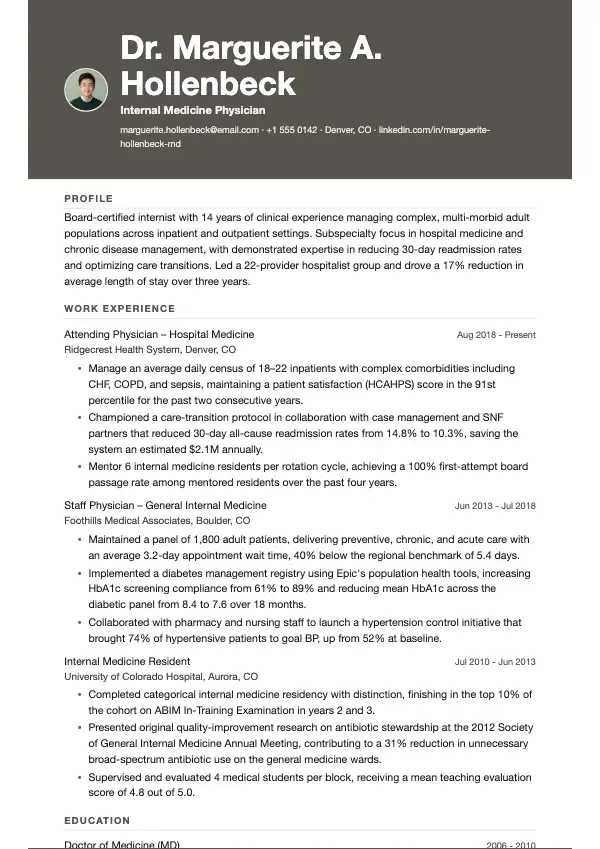
Template: Aurora
Read this resume as text
Dr. Marguerite A. Hollenbeck
Internal Medicine Physician
marguerite.hollenbeck@email.com · +1 555 0142 · Denver, CO · linkedin.com/in/marguerite-hollenbeck-md
- Profile
- Board-certified internist with 14 years of clinical experience managing complex, multi-morbid adult populations across inpatient and outpatient settings. Subspecialty focus in hospital medicine and chronic disease management, with demonstrated expertise in reducing 30-day readmission rates and optimizing care transitions. Led a 22-provider hospitalist group and drove a 17% reduction in average length of stay over three years.
- Work Experience
Attending Physician – Hospital Medicine
Ridgecrest Health System, Denver, CO · Aug 2018 - Present
- Manage an average daily census of 18–22 inpatients with complex comorbidities including CHF, COPD, and sepsis, maintaining a patient satisfaction (HCAHPS) score in the 91st percentile for the past two consecutive years.
- Championed a care-transition protocol in collaboration with case management and SNF partners that reduced 30-day all-cause readmission rates from 14.8% to 10.3%, saving the system an estimated $2.1M annually.
- Mentor 6 internal medicine residents per rotation cycle, achieving a 100% first-attempt board passage rate among mentored residents over the past four years.
Staff Physician – General Internal Medicine
Foothills Medical Associates, Boulder, CO · Jun 2013 - Jul 2018
- Maintained a panel of 1,800 adult patients, delivering preventive, chronic, and acute care with an average 3.2-day appointment wait time, 40% below the regional benchmark of 5.4 days.
- Implemented a diabetes management registry using Epic's population health tools, increasing HbA1c screening compliance from 61% to 89% and reducing mean HbA1c across the diabetic panel from 8.4 to 7.6 over 18 months.
- Collaborated with pharmacy and nursing staff to launch a hypertension control initiative that brought 74% of hypertensive patients to goal BP, up from 52% at baseline.
Internal Medicine Resident
University of Colorado Hospital, Aurora, CO · Jul 2010 - Jun 2013
- Completed categorical internal medicine residency with distinction, finishing in the top 10% of the cohort on ABIM In-Training Examination in years 2 and 3.
- Presented original quality-improvement research on antibiotic stewardship at the 2012 Society of General Internal Medicine Annual Meeting, contributing to a 31% reduction in unnecessary broad-spectrum antibiotic use on the general medicine wards.
- Supervised and evaluated 4 medical students per block, receiving a mean teaching evaluation score of 4.8 out of 5.0.
- Education
Doctor of Medicine (MD)
University of Colorado School of Medicine, Aurora, CO · 2006 - 2010
Alpha Omega Alpha Honor Society; Research Award in Clinical Medicine, 2010
Bachelor of Science, Biochemistry
University of Michigan, Ann Arbor, MI · 2002 - 2006
Summa Cum Laude; Phi Beta Kappa
- Skills
- ABIM Board Certification – Internal Medicine · Epic EMR (Proficient) · Hospital Medicine & Inpatient Care Management · Chronic Disease Management (CHF, DM, COPD, HTN) · Population Health & Registry-Based Care · Antibiotic Stewardship · ICD-10 Coding & Clinical Documentation · ACLS & BLS Certified · Care Transitions & SNF Coordination
- Links
- LinkedIn: linkedin.com/in/marguerite-hollenbeck-md · License: Colorado Medical License #CO2010-34821 (verifiable via state board)
What makes this resume work
- The summary names the specialty, years of experience, and two headline numbers — readmission rate reduction and length-of-stay improvement — so a CMO on a quick first scan gets the value proposition immediately.
- Every bullet follows a strict action-verb → context → measurable-result structure (e.g., 'reduced 30-day readmission rates from 14.8% to 10.3%'), which mirrors how quality-focused health systems evaluate clinical performance.
- Hard skills are listed as discrete, searchable terms — 'ABIM Board Certification,' 'Epic EMR,' 'ICD-10 Coding' — rather than vague phrases, ensuring the resume surfaces in recruiter database searches filtered by credential or system.
- Education includes honor society membership and a research award, signaling academic credibility without padding length, which matters for academic medical centers and teaching hospitals reviewing faculty-track candidates.
Keywords that help you pass the ATS
Work the ones that fit your experience into your resume, naturally, not stuffed.
How to write a Physician resume
Choose the right format for a Physician resume
Most physicians use a chronological or hybrid format. Chronological works best if you have a continuous clinical career; hybrid suits those returning from fellowship, transitioning specialties, or moving from academic to private practice. Either way, keep the document to two pages for early-career physicians and up to three pages for attendings with extensive publications or leadership roles.
Use clean, single-column layouts with clear section headers. Recruiters at health systems and physician staffing firms scan quickly, and cluttered formatting buries credentials. Margins of 0.75–1 inch, 10–12 pt font (Calibri, Georgia, or Arial), and consistent date formatting (MM/YYYY) are standard expectations.
- Lead with your name, MD/DO credential, and specialty in the header — not a generic title like 'Healthcare Professional'
- Order sections: Summary → Licensure & Certifications → Clinical Experience → Education → Publications/Research (if applicable)
- Use reverse-chronological order within each section
- Avoid photos, graphics, and tables — many hospital ATS platforms parse plain text only
Write a professional summary that earns a second look
Your summary is three to four sentences that answer: what specialty, how many years of clinical experience, what patient population, and what distinguishes you. Skip objectives like 'seeking a challenging position.' Recruiters filling hospitalist, outpatient, or surgical roles read dozens of physician CVs weekly — specificity is what stops them.
Here is a strong example for a board-certified internist: "Board-certified Internal Medicine physician with 9 years of experience in high-volume academic hospital settings, managing complex inpatient cases including sepsis, COPD exacerbations, and decompensated heart failure. Consistently maintained patient satisfaction scores in the 90th percentile and reduced 30-day readmission rates by 14% through evidence-based discharge protocols. Seeking a teaching hospitalist role with resident education responsibilities."
Write work-experience bullets that show clinical and operational impact
Each bullet should combine an action verb, a clinical or operational task, and a measurable outcome. Avoid vague statements like 'provided excellent patient care.' Hiring committees and credentialing departments want to see volume, scope, and results. Pull data from your quality dashboards, department reports, or peer review summaries.
Use the same specificity for leadership and administrative contributions — committee work, protocol development, and EMR optimization all belong here if they had measurable outcomes.
- Managed a panel of 2,400+ primary care patients in a Federally Qualified Health Center, achieving an HbA1c control rate of 68% among diabetic patients — 11 points above the regional benchmark
- Performed an average of 320 laparoscopic cholecystectomies annually with a complication rate of 1.2%
Skills and certifications recruiters and ATS systems look for
Hospital ATS platforms — including Taleo, iCIMS, and Workday — scan for licensure, board certification, and procedural keywords. Include your state medical license number and DEA registration status. Specialty-specific certifications should appear in a dedicated section, not buried in a paragraph.
Beyond clinical skills, health systems increasingly weight EMR proficiency, value-based care experience, and quality improvement credentials. Listing Epic, Cerner, or Meditech by name matters more than writing 'proficient in electronic health records.'
- Board certifications: ABIM, ABFM, ABS, ABP, ABOG, or equivalent specialty board
- ACLS, BLS, ATLS, NRP — list current expiration dates
- EMR platforms: Epic, Cerner, Meditech, eClinicalWorks, Athenahealth
- Procedural competencies specific to your specialty (e.g., central line placement, upper endoscopy, joint injection)
- Quality improvement: Lean Six Sigma, IHI Open School Basic Certificate in Quality and Safety, leading a practice through NCQA PCMH recognition
Education, licenses, and extras that complete your resume
List your MD or DO degree, medical school, and graduation year. Follow with residency and fellowship training, including program name, institution, and dates. You do not need to list undergraduate GPA or USMLE scores unless you are applying for academic positions that specifically request them.
A publications section is appropriate if you have peer-reviewed work; use abbreviated AMA citation format and limit to your ten most relevant. For most community or private practice roles, omit publications entirely and use that space for clinical volume data or leadership roles. Always include your NPI number and note whether your DEA registration is active and in which schedules.
- State medical license(s): list each state with license number and expiration date
- DEA registration: note active status and controlled substance schedules
- Hospital privileges: list current and recent facilities where you hold or held privileges
- Malpractice history note: not required on a resume, but be prepared to address it in credentialing paperwork
Mistakes to avoid
- Using a CV format for every application — a traditional academic CV running 8–12 pages is inappropriate for community hospital, locum tenens, or private practice postings that expect a two-to-three page resume.
- Omitting board certification status or listing it without the certifying board name, which forces recruiters to verify manually and slows credentialing.
- Writing procedure lists without volume data — stating 'experienced in colonoscopy' tells a hiring committee nothing; '500+ colonoscopies with adenoma detection rate of 32%' does.
- Leaving off DEA registration status and state license numbers, which are required fields in most physician credentialing workflows and their absence signals an incomplete application.
Frequently asked questions
- Should a physician use a resume or a CV when applying for jobs?
- It depends on the role. Academic medical centers, research institutions, and teaching hospitals typically expect a full curriculum vitae with publications, grants, and presentations. Community hospitals, private practices, and locum tenens agencies prefer a focused two-to-three page resume. Read the job posting carefully — if it says 'CV,' submit a CV; if it says 'resume,' trim accordingly.
- How do I list my residency and fellowship on a physician resume?
- Place residency and fellowship under a 'Training' or 'Graduate Medical Education' section, separate from your medical school entry. Include the full program name, sponsoring institution, city and state, and start-to-end dates in MM/YYYY format. If you completed a chief resident year or received a specific award during training, add a single line noting it beneath that entry.
- What metrics should a physician include on a resume if they don't have access to formal quality data?
- Start with volume figures you can verify: average weekly patient encounters, annual procedure counts, or panel size. Patient satisfaction data from Press Ganey or CAHPS reports is often available through your department administrator upon request. If quality dashboards are inaccessible, cite process improvements you led — such as reducing no-show rates or implementing a chronic disease registry — and describe the outcome even without a precise percentage.
Make it yours in minutes
Open this example in the builder, swap in your details, and export a clean, ATS-ready resume.
Once your resume is ready
More for this application
- Template style
- Creative resume templates