Resume example
Quality Assurance Manager resume example
By the Resumade team · About our content
A QA Manager resume must prove regulatory fluency, measurable defect reduction, and team leadership — not just list certifications. This example does all three with specific numbers and named frameworks recruiters search for.
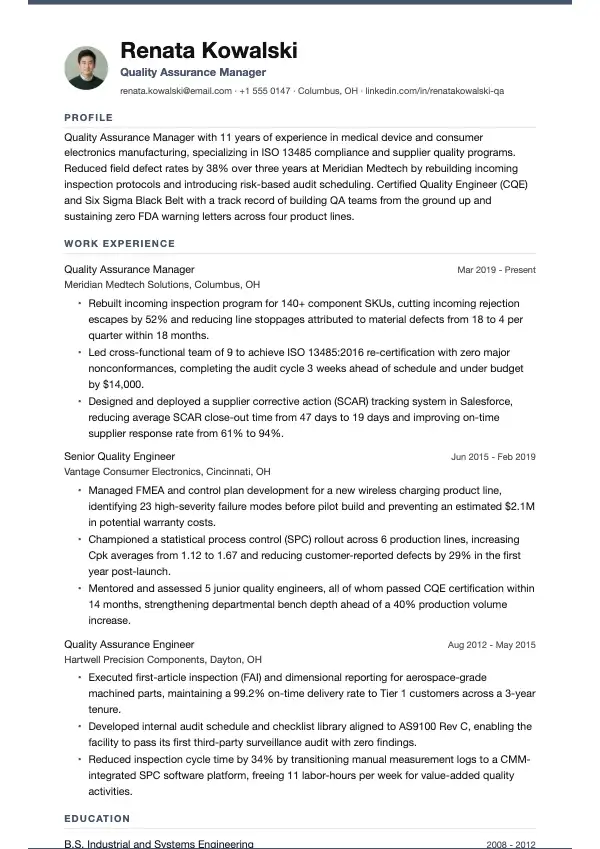
Template: Ribbon
Read this resume as text
Renata Kowalski
Quality Assurance Manager
renata.kowalski@email.com · +1 555 0147 · Columbus, OH · linkedin.com/in/renatakowalski-qa
- Profile
- Quality Assurance Manager with 11 years of experience in medical device and consumer electronics manufacturing, specializing in ISO 13485 compliance and supplier quality programs. Reduced field defect rates by 38% over three years at Meridian Medtech by rebuilding incoming inspection protocols and introducing risk-based audit scheduling. Certified Quality Engineer (CQE) and Six Sigma Black Belt with a track record of building QA teams from the ground up and sustaining zero FDA warning letters across four product lines.
- Work Experience
Quality Assurance Manager
Meridian Medtech Solutions, Columbus, OH · Mar 2019 - Present
- Rebuilt incoming inspection program for 140+ component SKUs, cutting incoming rejection escapes by 52% and reducing line stoppages attributed to material defects from 18 to 4 per quarter within 18 months.
- Led cross-functional team of 9 to achieve ISO 13485:2016 re-certification with zero major nonconformances, completing the audit cycle 3 weeks ahead of schedule and under budget by $14,000.
- Designed and deployed a supplier corrective action (SCAR) tracking system in Salesforce, reducing average SCAR close-out time from 47 days to 19 days and improving on-time supplier response rate from 61% to 94%.
Senior Quality Engineer
Vantage Consumer Electronics, Cincinnati, OH · Jun 2015 - Feb 2019
- Managed FMEA and control plan development for a new wireless charging product line, identifying 23 high-severity failure modes before pilot build and preventing an estimated $2.1M in potential warranty costs.
- Championed a statistical process control (SPC) rollout across 6 production lines, increasing Cpk averages from 1.12 to 1.67 and reducing customer-reported defects by 29% in the first year post-launch.
- Mentored and assessed 5 junior quality engineers, all of whom passed CQE certification within 14 months, strengthening departmental bench depth ahead of a 40% production volume increase.
Quality Assurance Engineer
Hartwell Precision Components, Dayton, OH · Aug 2012 - May 2015
- Executed first-article inspection (FAI) and dimensional reporting for aerospace-grade machined parts, maintaining a 99.2% on-time delivery rate to Tier 1 customers across a 3-year tenure.
- Developed internal audit schedule and checklist library aligned to AS9100 Rev C, enabling the facility to pass its first third-party surveillance audit with zero findings.
- Reduced inspection cycle time by 34% by transitioning manual measurement logs to a CMM-integrated SPC software platform, freeing 11 labor-hours per week for value-added quality activities.
- Education
B.S. Industrial and Systems Engineering
Ohio State University, Columbus, OH · 2008 - 2012
Minor in Statistics; Dean's List 4 semesters
- Skills
- ISO 13485 & ISO 9001 Compliance · Six Sigma Black Belt (CSSBB) · Certified Quality Engineer (CQE — ASQ) · FMEA & Control Plan Development · Statistical Process Control (SPC / Minitab) · Supplier Quality Management & SCAR · CMM Operation & GD&T Interpretation · FDA 21 CFR Part 820 (QSR) · Root Cause Analysis (8D, Fishbone, 5-Why)
- Links
- LinkedIn: linkedin.com/in/renatakowalski-qa
What makes this resume work
- Every bullet opens with a strong action verb (Rebuilt, Led, Designed, Championed) and closes with a quantified outcome — percentages, dollar figures, or time savings — so hiring managers immediately see business impact rather than job duties.
- The summary front-loads seniority (11 years), two distinct industries, and two headline certifications in the first sentence, giving both ATS parsers and human readers an instant qualification snapshot before they read a single bullet.
- Hard skills are written exactly as recruiters type them into applicant tracking systems — 'ISO 13485,' 'FDA 21 CFR Part 820,' 'FMEA' — rather than paraphrased, which prevents keyword-match failures on automated screens.
- The career arc across three roles (engineer → senior engineer → manager) tells a deliberate progression story, and the earlier roles still include metrics so the resume doesn't thin out toward the bottom and undermine overall credibility.
Keywords that help you pass the ATS
Work the ones that fit your experience into your resume, naturally, not stuffed.
How to write a Quality Assurance Manager resume
Choose the right format for a Quality Assurance Manager resume
Use a reverse-chronological format. Hiring managers in manufacturing, pharma, medical devices, and software expect to see your most recent role first and want a clear progression from individual contributor to supervisory or managerial responsibility. A functional or hybrid format raises red flags unless you are making a significant industry pivot.
Keep the resume to two pages maximum. One page works only if you have fewer than eight years of experience. Use 0.75-inch margins, a clean sans-serif font like Calibri or Arial at 10–11pt, and clear section headers. ATS systems used by companies like Workday, Taleo, and iCIMS parse standard headers reliably, so avoid text boxes or tables for your main content.
- Place your name, city/state, phone, LinkedIn URL, and a professional email in the header — no full street address required
- Use consistent date formatting: Month YYYY – Month YYYY
- Keep section order: Summary → Work Experience → Skills → Certifications → Education
Write a professional summary that frames your QA expertise immediately
Your summary is three to four lines at the top of the resume. It should name your years of experience, the industries you've worked in, the quality systems you manage, and one or two measurable outcomes. Generic phrases like 'detail-oriented professional' waste prime real estate.
Example: "Quality Assurance Manager with 11 years of experience in FDA-regulated medical device manufacturing. Oversees a 14-person QA team and maintains ISO 13485 and 21 CFR Part 820 compliance across three production facilities. Reduced customer complaint rate by 34% over two years by implementing a corrective and preventive action (CAPA) tracking system in ETQ Reliance. Experienced in supplier qualification, internal auditing, and NPI quality planning."
Write work-experience bullets that show impact, not just duties
Every bullet should follow an action verb → task → measurable result structure. QA managers have access to concrete data — defect rates, audit findings, CAPA closure times, yield percentages, cost of poor quality (COPQ) — so use them. Recruiters in this field are skeptical of bullets that describe responsibilities without outcomes.
Avoid listing software or standards in isolation inside bullets; instead, show what you did with them and what changed as a result.
- Reduced incoming inspection rejection rate from 8.2% to 1.9% over 18 months by redesigning supplier scorecards and conducting quarterly on-site audits at the top 12 vendors
- Led preparation for a zero-finding FDA 483 inspection across two sites by closing 47 open CAPA items and retraining 200+ employees on updated SOPs within a 90-day remediation window
Include the skills and certifications recruiters and ATS systems look for
Quality assurance job postings are heavily keyword-driven. A dedicated Skills section lets ATS parse your competencies before a human reads the document. Separate hard skills from soft skills, and list certifications in their own subsection with the issuing body and year obtained.
Prioritize the tools and frameworks that appear most often in postings for your target industry: pharma and medical devices weight regulatory knowledge heavily, while software QA roles emphasize test management platforms and agile methodology.
- Certifications: ASQ Certified Quality Manager (CQM/OE), ASQ Certified Quality Auditor (CQA), Six Sigma Black Belt (CSSBB), ISO 9001/13485 Lead Auditor (BSI, Bureau Veritas, or DEKRA), PMP if managing large quality projects
- Quality systems & standards: ISO 9001, ISO 13485, IATF 16949, 21 CFR Part 820, AS9100, cGMP, GLP
- Tools & software: ETQ Reliance, MasterControl, Veeva Vault QMS, SAP QM, Minitab, JIRA (for software QA), TestRail, FMEA, SPC, MSA
- Core competencies: CAPA management, root cause analysis (RCA), supplier quality management, internal and third-party auditing, risk management (ISO 14971), NPI quality planning, SOP development
Education, licenses, and additional sections that strengthen the resume
Most QA Manager roles require a bachelor's degree in engineering, life sciences, chemistry, or a related technical field. An MBA or master's in quality management can differentiate you for director-level roles but is rarely required. List your degree, institution, and graduation year; GPA is optional and only worth including if above 3.5 and within the last five years.
Add a brief Professional Development or Training section if you have completed relevant coursework through ASQ, RAPS (for regulatory affairs overlap), or IAQG. If you hold an active FDA inspector credential or have served as a notified body auditor, list that explicitly — it is rare and highly valued. A Publications or Conference Presentations section is appropriate if you have presented at ASQ World Conference or similar events.
- List ASQ membership and any section leadership roles — it signals active engagement with the profession
- Include language proficiency if you audit international suppliers
- Omit references, headshots, and unrelated certifications
Mistakes to avoid
- Listing quality standards like ISO 9001 or 21 CFR Part 820 without explaining the scope of your involvement — recruiters need to know whether you built the system, maintained it, or simply worked within it.
- Using vague audit language such as 'participated in audits' instead of specifying your role as lead auditor, auditee liaison, or CAPA owner and stating how many audits you conducted per year.
- Omitting metrics entirely, which is a credibility problem in QA because the entire discipline is measurement-driven — every role generates data on defect rates, yield, CAPA cycle time, or cost of poor quality.
- Failing to tailor the resume to the industry vertical — a resume optimized for automotive IATF 16949 will underperform for a pharma cGMP role if you do not reframe your experience around FDA regulatory language and validation protocols.
Frequently asked questions
- Do I need a Six Sigma certification to get a Quality Assurance Manager job?
- It depends on the industry and company. Manufacturing, automotive, and aerospace employers frequently list Six Sigma Green Belt or Black Belt as preferred or required, while software QA and smaller companies rarely require it. If you lack the certification but have applied the methodology — running DMAIC projects, using Minitab for SPC — describe that experience explicitly in your bullets and note any in-progress training.
- How do I show QA leadership experience if I managed a small team or no direct reports?
- Emphasize cross-functional leadership: audit teams you led, corrective action councils you chaired, supplier qualification projects you owned, or training programs you developed and delivered. Quantify the scope — number of employees trained, number of suppliers qualified, number of audit findings resolved — to demonstrate influence beyond a formal headcount.
- Should I include every quality standard I have ever been exposed to in my skills section?
- No. List only standards where you can speak to specific responsibilities in an interview — auditors and hiring managers will probe your depth on anything you claim. If you are applying for a role that requires IATF 16949 experience and you only have peripheral exposure, note it honestly as 'familiarity' or leave it off rather than risk a credibility problem in the screening call.
Make it yours in minutes
Open this example in the builder, swap in your details, and export a clean, ATS-ready resume.
Once your resume is ready
More for this application
- Template style
- Creative resume templates