Resume example
Roofer resume example
By the Resumade team · About our content
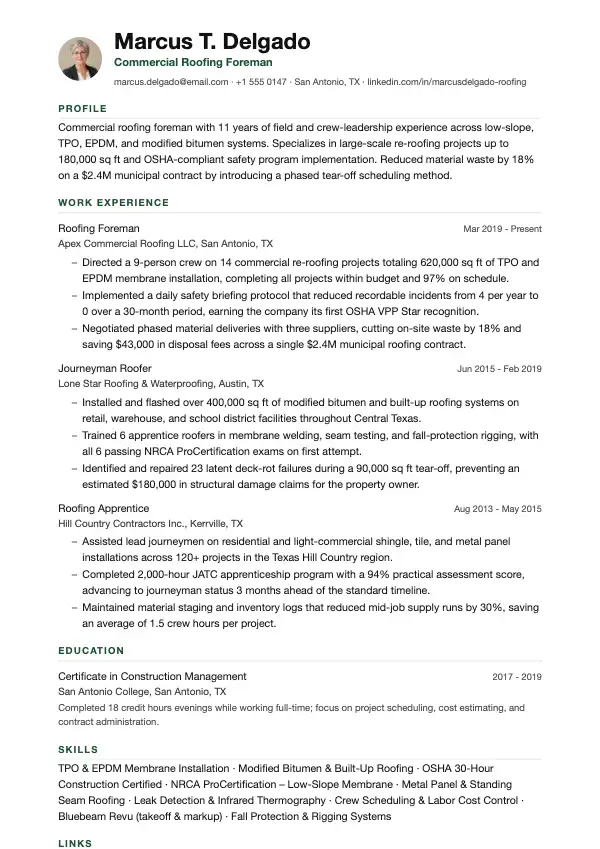
A strong Roofer resume must clear ATS filters loaded with trade-specific membrane types and certifications, then prove to a hiring manager that you deliver projects safely and on budget. This example does both by leading every bullet with a quantified outcome and placing credentials above the fold.
Template: Wren
Read this resume as text
Marcus T. Delgado
Commercial Roofing Foreman
marcus.delgado@email.com · +1 555 0147 · San Antonio, TX · linkedin.com/in/marcusdelgado-roofing
- Profile
- Commercial roofing foreman with 11 years of field and crew-leadership experience across low-slope, TPO, EPDM, and modified bitumen systems. Specializes in large-scale re-roofing projects up to 180,000 sq ft and OSHA-compliant safety program implementation. Reduced material waste by 18% on a $2.4M municipal contract by introducing a phased tear-off scheduling method.
- Work Experience
Roofing Foreman
Apex Commercial Roofing LLC, San Antonio, TX · Mar 2019 - Present
- Directed a 9-person crew on 14 commercial re-roofing projects totaling 620,000 sq ft of TPO and EPDM membrane installation, completing all projects within budget and 97% on schedule.
- Implemented a daily safety briefing protocol that reduced recordable incidents from 4 per year to 0 over a 30-month period, earning the company its first OSHA VPP Star recognition.
- Negotiated phased material deliveries with three suppliers, cutting on-site waste by 18% and saving $43,000 in disposal fees across a single $2.4M municipal roofing contract.
Journeyman Roofer
Lone Star Roofing & Waterproofing, Austin, TX · Jun 2015 - Feb 2019
- Installed and flashed over 400,000 sq ft of modified bitumen and built-up roofing systems on retail, warehouse, and school district facilities throughout Central Texas.
- Trained 6 apprentice roofers in membrane welding, seam testing, and fall-protection rigging, with all 6 passing NRCA ProCertification exams on first attempt.
- Identified and repaired 23 latent deck-rot failures during a 90,000 sq ft tear-off, preventing an estimated $180,000 in structural damage claims for the property owner.
Roofing Apprentice
Hill Country Contractors Inc., Kerrville, TX · Aug 2013 - May 2015
- Assisted lead journeymen on residential and light-commercial shingle, tile, and metal panel installations across 120+ projects in the Texas Hill Country region.
- Completed 2,000-hour JATC apprenticeship program with a 94% practical assessment score, advancing to journeyman status 3 months ahead of the standard timeline.
- Maintained material staging and inventory logs that reduced mid-job supply runs by 30%, saving an average of 1.5 crew hours per project.
- Education
Certificate in Construction Management
San Antonio College, San Antonio, TX · 2017 - 2019
Completed 18 credit hours evenings while working full-time; focus on project scheduling, cost estimating, and contract administration.
- Skills
- TPO & EPDM Membrane Installation · Modified Bitumen & Built-Up Roofing · OSHA 30-Hour Construction Certified · NRCA ProCertification – Low-Slope Membrane · Metal Panel & Standing Seam Roofing · Leak Detection & Infrared Thermography · Crew Scheduling & Labor Cost Control · Bluebeam Revu (takeoff & markup) · Fall Protection & Rigging Systems
- Links
- LinkedIn: linkedin.com/in/marcusdelgado-roofing
What makes this resume work
- The summary names three specific roofing systems — TPO, EPDM, and modified bitumen — in the first sentence, ensuring the resume matches the exact membrane-type keywords recruiters filter for in commercial roofing searches.
- Every experience bullet opens with an action verb and closes with a dollar figure, percentage, or count, giving hiring managers concrete evidence of scale and impact rather than a list of duties.
- The OSHA 30-Hour certification and NRCA ProCertification appear in the Skills section as standalone line items, making them immediately visible to both ATS parsers and human reviewers scanning for compliance credentials.
- Including the apprentice role with its JATC hours and a measurable advancement timeline shows a clear, credible career progression from ground level to foreman — a narrative that builds trust with contractors who promote from within.
Keywords that help you pass the ATS
Work the ones that fit your experience into your resume, naturally, not stuffed.
How to write a Roofer resume
Choose the right format for a Roofer resume
Use a reverse-chronological format. Roofing is a trade where employers want to see your most recent jobsite experience first, not a skills-based layout that buries your work history. Keep the resume to one page if you have fewer than ten years in the trade; two pages are acceptable for lead roofers or foremen with extensive project histories.
Use clear section headers, a readable font like Calibri or Arial at 10–12 pt, and consistent margins of 0.75–1 inch. Avoid tables and text boxes — many applicant tracking systems used by larger roofing contractors and commercial GCs strip that formatting and scramble your content.
- Sections in order: Contact Info, Summary, Work Experience, Skills, Certifications, Education
- File format: save and send as a PDF unless the job posting specifically requests a Word document
- No headshot, no objective statement — both are outdated in US roofing hiring
Write a professional summary that lands you the interview
Your summary sits at the top and gives a hiring manager a reason to keep reading. It should state your years of experience, the roofing systems you know best, and one concrete achievement or credential. Three to four sentences maximum.
Example: "Journeyman roofer with 9 years of residential and light-commercial experience specializing in asphalt shingle, TPO membrane, and modified bitumen systems. Installed and repaired over 400 roofs across the Denver metro area with a zero-OSHA-recordable safety record over the past five years. Holds an OSHA 30 card and has installed systems for an Owens Corning Preferred Contractor. Available for travel within a 75-mile radius and experienced leading three-person crews on tight turnaround projects."
Write work-experience bullets that show real output
Each bullet should start with a strong action verb and include a number wherever possible — square footage, number of roofs, crew size, project value, or safety metrics. Generic phrases like 'responsible for roofing tasks' tell a hiring manager nothing. Be specific about the systems, materials, and tools you worked with.
Mention brand-name materials and equipment you used regularly: GAF Timberline shingles, Carlisle or Firestone TPO, Henry or Polyglass membranes, Makita or Milwaukee cordless nailers, Roofmaster kettles for hot-tar work, or Soprema torch-down systems. These details help your resume pass keyword filters and prove hands-on familiarity.
- Installed and completed 180+ asphalt shingle roofs annually averaging 22 squares per job, maintaining a crew productivity rate 12% above company benchmark
- Led a 4-person crew on a $340,000 commercial TPO re-roofing project for a 60,000 sq ft warehouse, finishing 3 days ahead of schedule with zero safety incidents
Skills and certifications recruiters and ATS look for
List both hard technical skills and safety credentials. Commercial contractors and insurance restoration companies run resumes through ATS software that scans for specific terms before a human ever sees the document. Include the exact names of systems, tools, and certifications rather than paraphrasing them.
Manufacturer credentials — GAF Master Elite, Owens Corning Preferred, CertainTeed SELECT ShingleMaster — are awarded to contracting companies, so list your experience installing for a certified contractor and any manufacturer training you completed yourself. These credentials directly affect which jobs a contractor can bid, so employers value installers who know those systems.
- Roofing systems: asphalt shingle, TPO, EPDM, modified bitumen, metal panel, built-up roofing (BUR), slate, cedar shake
- Tools: pneumatic and cordless nail guns, roofing shovels, pry bars, chalk lines, roofing kettles, heat welders, seam rollers
- Safety: OSHA 10, OSHA 30, fall protection (1926.502), ladder safety
- Manufacturer experience: work for GAF Master Elite, Owens Corning Preferred, or CertainTeed SELECT ShingleMaster contractors, plus any manufacturer training you completed
- Other: Xactimate estimating software (for restoration-focused roles), blueprint reading, flashing and valley installation
Education, licenses, and extras that strengthen your resume
A high school diploma or GED is the standard minimum in residential roofing. If you completed a union apprenticeship — United Union of Roofers, Waterproofers and Allied Workers (RWAW) — list the local number, completion year, and total apprenticeship hours. This carries significant weight with commercial and union signatory contractors.
Include your state contractor license number if you hold one, your driver's license class if you regularly tow trailers or operate company vehicles, and any first aid or CPR certifications. If you speak Spanish fluently, note it — bilingual roofers are in high demand for crew communication on diverse jobsites across the South and Southwest.
- State roofing contractor license (include license number and issuing state)
- RWAW apprenticeship completion — list local union number and graduation year
- Valid driver's license; Class A or B CDL if applicable
- CPR/First Aid certification with issuing organization and expiration date
Mistakes to avoid
- Listing roofing systems you have only watched others install rather than personally worked with — experienced foremen will catch the gap in a five-minute interview.
- Omitting your OSHA 10 or 30 card entirely, which immediately flags you as a liability risk to safety-conscious commercial contractors.
- Using vague language like 'assisted with roofing projects' instead of specifying your actual role, the system type, and the scope of work you owned.
- Failing to update your resume with manufacturer training you have completed and the manufacturer-certified contractors you have installed for, since those credentials are often the deciding factor in competitive bids.
Frequently asked questions
- Do I need a license to put it on my Roofer resume?
- Licensing requirements vary by state — some states require a contractor license to pull permits, while others regulate at the county level or not at all. If you hold a state or local roofing license, always list it with the license number because it immediately signals to employers that you can legally lead permitted work. If you don't hold one but your employer does, you can note that you worked under a licensed contractor.
- How do I write a Roofer resume with no formal experience?
- Lead with any hands-on work you've done, including informal jobs, helping family members, or labor positions where you worked on a roof crew even briefly. List any relevant certifications like OSHA 10, and emphasize physical fitness, comfort with heights, and willingness to train on specific systems. Entry-level roofing candidates are largely evaluated on reliability and safety awareness, so address both directly in your summary.
- Should a Roofer include a cover letter?
- For residential roofing jobs posted online, a short cover letter — three paragraphs maximum — helps you stand out, especially if you're targeting a specific company known for a particular system like metal roofing or green roof installation. For walk-in applications or jobs found through word of mouth, a polished resume alone is usually sufficient. Always follow whatever instructions the job posting gives.
Make it yours in minutes
Open this example in the builder, swap in your details, and export a clean, ATS-ready resume.
Once your resume is ready
More for this application
- Template style
- Simple resume templates