Resume example
Software Architect resume example
By the Resumade team · About our content
A Software Architect resume must prove system-level thinking and measurable business impact at first glance — this example does both with domain-specific metrics and a clean information hierarchy that ATS parsers and hiring managers can navigate instantly.
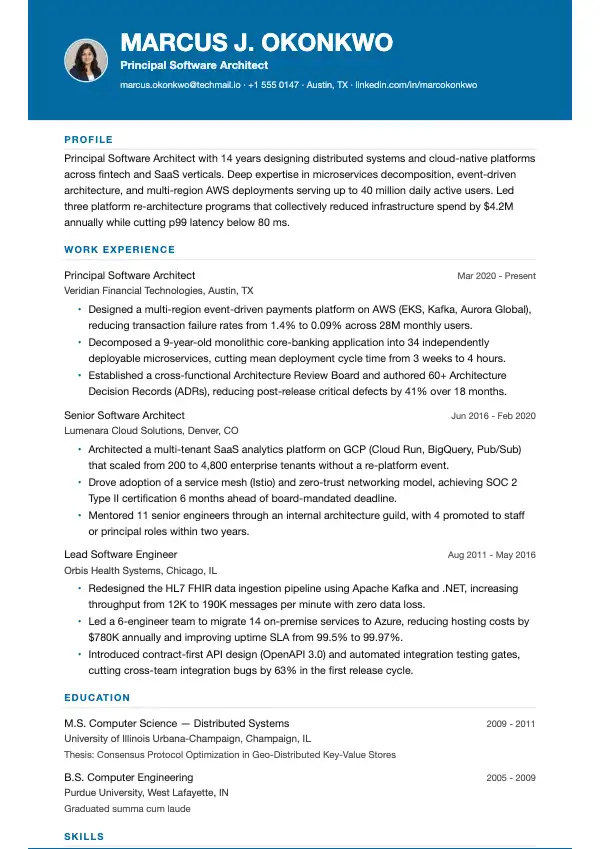
Template: Vermilion
Read this resume as text
Marcus J. Okonkwo
Principal Software Architect
marcus.okonkwo@techmail.io · +1 555 0147 · Austin, TX · linkedin.com/in/marcokonkwo
- Profile
- Principal Software Architect with 14 years designing distributed systems and cloud-native platforms across fintech and SaaS verticals. Deep expertise in microservices decomposition, event-driven architecture, and multi-region AWS deployments serving up to 40 million daily active users. Led three platform re-architecture programs that collectively reduced infrastructure spend by $4.2M annually while cutting p99 latency below 80 ms.
- Work Experience
Principal Software Architect
Veridian Financial Technologies, Austin, TX · Mar 2020 - Present
- Designed a multi-region event-driven payments platform on AWS (EKS, Kafka, Aurora Global), reducing transaction failure rates from 1.4% to 0.09% across 28M monthly users.
- Decomposed a 9-year-old monolithic core-banking application into 34 independently deployable microservices, cutting mean deployment cycle time from 3 weeks to 4 hours.
- Established a cross-functional Architecture Review Board and authored 60+ Architecture Decision Records (ADRs), reducing post-release critical defects by 41% over 18 months.
Senior Software Architect
Lumenara Cloud Solutions, Denver, CO · Jun 2016 - Feb 2020
- Architected a multi-tenant SaaS analytics platform on GCP (Cloud Run, BigQuery, Pub/Sub) that scaled from 200 to 4,800 enterprise tenants without a re-platform event.
- Drove adoption of a service mesh (Istio) and zero-trust networking model, achieving SOC 2 Type II certification 6 months ahead of board-mandated deadline.
- Mentored 11 senior engineers through an internal architecture guild, with 4 promoted to staff or principal roles within two years.
Lead Software Engineer
Orbis Health Systems, Chicago, IL · Aug 2011 - May 2016
- Redesigned the HL7 FHIR data ingestion pipeline using Apache Kafka and .NET, increasing throughput from 12K to 190K messages per minute with zero data loss.
- Led a 6-engineer team to migrate 14 on-premise services to Azure, reducing hosting costs by $780K annually and improving uptime SLA from 99.5% to 99.97%.
- Introduced contract-first API design (OpenAPI 3.0) and automated integration testing gates, cutting cross-team integration bugs by 63% in the first release cycle.
- Education
M.S. Computer Science — Distributed Systems
University of Illinois Urbana-Champaign, Champaign, IL · 2009 - 2011
Thesis: Consensus Protocol Optimization in Geo-Distributed Key-Value Stores
B.S. Computer Engineering
Purdue University, West Lafayette, IN · 2005 - 2009
Graduated summa cum laude
- Skills
- Microservices & Event-Driven Architecture · AWS (EKS, Lambda, Aurora, MSK) · GCP (BigQuery, Cloud Run) · Apache Kafka · gRPC · GraphQL · OpenAPI 3.0 · Domain-Driven Design (DDD) · CQRS · Saga Pattern · Kubernetes · Istio Service Mesh · Terraform · ArgoCD · Java / Spring Boot · Go · Python · .NET 8 · Architecture Decision Records (ADRs) · C4 Model Diagramming · AWS Certified Solutions Architect – Professional · SOC 2 · HIPAA · PCI-DSS Compliance Architecture
- Links
- LinkedIn: linkedin.com/in/marcokonkwo · GitHub: github.com/mjokonkwo · Portfolio: marcokonkwo.dev/architecture
What makes this resume work
- Every bullet opens with a strong action verb tied to architectural scope — 'Designed,' 'Decomposed,' 'Architected' — signaling seniority rather than execution-level contribution.
- Metrics are layered: cost savings ($4.2M, $780K), scale (40M DAU, 4,800 tenants), and reliability (p99 latency, SLA percentages) so that any reader finds a number that resonates with their priority.
- The skills section groups related tools on single lines (e.g., AWS services together, patterns together) to satisfy ATS keyword matching while remaining readable to a human reviewer scanning for depth.
- The summary front-loads years of experience, domain specialization, and one flagship result in three sentences — giving a recruiter a complete picture before they read a single bullet.
Keywords that help you pass the ATS
Work the ones that fit your experience into your resume, naturally, not stuffed.
How to write a Software Architect resume
Choose the right format for a Software Architect resume
Use a reverse-chronological format. Hiring managers and ATS systems both expect it, and for a Software Architect role—where your progression from senior engineer to architect signals credibility—the timeline matters. Keep the document to two pages maximum; one page is acceptable only if you have fewer than eight years of experience.
Set margins to 0.75–1 inch, use a clean sans-serif font (Calibri, Inter, or Arial at 10–11pt), and avoid tables, text boxes, or columns. Many enterprise ATS platforms—Workday, Taleo, iCIMS—parse single-column layouts far more reliably than multi-column designs.
- Header: name, city/state, LinkedIn URL, GitHub or portfolio link, phone, professional email
- Sections in order: Summary → Core Skills → Work Experience → Certifications → Education
- Use consistent date formatting: 'Jan 2019 – Mar 2023' or 'January 2019 – March 2023' throughout
- Save and submit as a text-based PDF; send .docx only if the posting asks for Word
Write a professional summary that positions you as an architect, not a developer
Your summary should establish your architectural scope—system scale, team size, business domains—within three to four sentences. Recruiters spend about seven seconds on a first scan (Ladders eye-tracking study, 2018); lead with your specialty (cloud-native, enterprise integration, data-intensive systems) and a concrete outcome. Avoid phrases like 'results-driven' or 'passionate technologist.'
Example: "Software Architect with 12 years of experience designing distributed, cloud-native systems on AWS and Azure for fintech and healthcare clients. Led end-to-end architecture for a real-time payments platform processing $4B in annual transactions, reducing system latency by 38%. Certified AWS Solutions Architect – Professional and TOGAF 9 Certified. Comfortable owning architecture review boards, mentoring teams of 8–15 engineers, and translating business requirements into domain-driven design."
Write work-experience bullets that prove architectural impact
Each bullet should follow the pattern: action verb → what you designed or decided → measurable outcome. Avoid bullets that describe responsibilities ('Responsible for cloud infrastructure'); write bullets that describe decisions and results. Quantify with latency, uptime, cost reduction, team size, request volume, or deployment frequency. Two strong bullets are worth more than six vague ones.
- Redesigned microservices architecture for a B2B SaaS platform using Kubernetes, Istio, and Apache Kafka, cutting infrastructure costs by $1.2M annually while improving p99 latency from 840ms to 210ms.
- Established architecture governance framework—including ADRs, RFC templates, and quarterly architecture reviews—across 6 engineering squads, reducing production incidents caused by design drift by 47% year-over-year.
Include the skills and certifications recruiters and ATS systems look for
Software Architect job descriptions pull from a specific vocabulary. Your skills section should mirror that vocabulary exactly—not paraphrased versions of it. Group skills by category: cloud platforms, architectural patterns, languages, tools, and soft skills. Certifications carry significant weight at the senior level and should appear in a dedicated section with issuer, credential ID if available, and expiration date.
List skills and certifications that are genuinely current. If your AWS certification expired two years ago, either renew it or omit it.
- Cloud: AWS (Solutions Architect Professional, SAP-C02), Azure (AZ-305), GCP Professional Cloud Architect
- Patterns & frameworks: microservices, event-driven architecture, CQRS, hexagonal architecture, domain-driven design (DDD), TOGAF 9
- Tools: Terraform, Helm, ArgoCD, Apache Kafka, RabbitMQ, Istio, Envoy, OpenTelemetry, Datadog, Confluence (Architecture Decision Records)
- Languages: Java, Go, Python, TypeScript — list only languages you can discuss in a technical interview
- Certifications: TOGAF 9 Foundation & Practitioner, AWS SAP-C02, CKAD or CKA (Kubernetes), IASA CITA-F
Education, licenses, and extras that strengthen a Software Architect resume
A bachelor's degree in Computer Science, Software Engineering, or a related field is the baseline expectation at most companies. An MS or MBA is a differentiator, particularly at principal or distinguished architect levels. List your degree, institution, and graduation year—GPA only if above 3.7 and within five years of graduation.
Add an 'Additional' or 'Speaking & Publications' section if you have conference talks (QCon, AWS re:Invent, GOTO), published RFCs or architecture blog posts, open-source maintainer credits, or patents. These signal thought leadership that a title alone cannot. Omit hobbies unless directly relevant.
Mistakes to avoid
- Writing bullets that describe duties rather than architectural decisions—'Worked on microservices' tells a hiring manager nothing about your design authority or the outcome.
- Listing every technology you have ever touched instead of the 12–18 tools you actually use at an architect level, which dilutes credibility and confuses ATS keyword matching.
- Omitting the business context of your systems—scale (requests per second, users, data volume) and domain (fintech, healthcare, e-commerce) are how interviewers benchmark your experience.
- Burying certifications in the education section or leaving out expiration dates, which causes recruiters to assume credentials are lapsed or fabricated.
Frequently asked questions
- How long should a Software Architect resume be?
- Two pages is the standard for anyone with more than eight years of experience, which covers most architects. Use the space to cover your three or four most relevant roles in depth rather than listing every job back to your first developer position. A third page is rarely justified and signals poor editing.
- Do I need TOGAF or AWS certifications on my Software Architect resume?
- Not strictly required, but they are strong differentiators—especially TOGAF 9 for enterprise roles and AWS Solutions Architect Professional or GCP Professional Cloud Architect for cloud-heavy positions. Many job postings list them as 'preferred,' and ATS systems are often configured to score resumes that include them higher. If you lack them, prioritize the one most aligned to your target role.
- Should a Software Architect resume include coding languages?
- Yes, but be selective. List only languages you can defend in a technical interview at an architect level—typically two to four. Architects are expected to read and review code, contribute to critical path decisions, and guide implementation; listing ten languages suggests you are padding rather than curating.
Make it yours in minutes
Open this example in the builder, swap in your details, and export a clean, ATS-ready resume.
Once your resume is ready
More for this application
- Template style
- Software Engineer resume templates