Resume example
Accounts Receivable Specialist resume example
By the Resumade team · About our content
An AR Specialist resume must prove cash-flow ownership with hard numbers and surface ERP keywords that ATS systems flag. This example does both — leading every bullet with a measurable outcome and front-loading the summary with DSO and recovery figures hiring managers care about most.
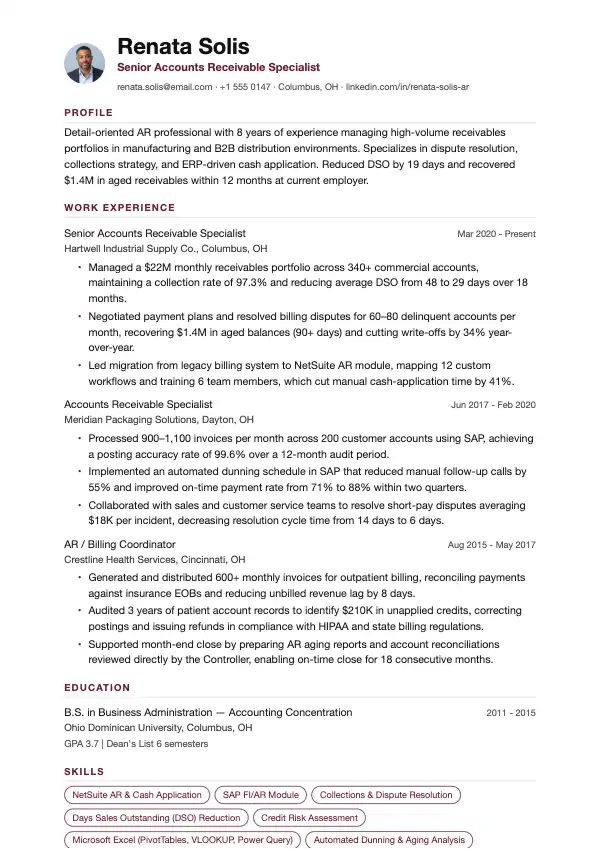
Template: Signet
Read this resume as text
Renata Solis
Senior Accounts Receivable Specialist
renata.solis@email.com · +1 555 0147 · Columbus, OH · linkedin.com/in/renata-solis-ar
- Profile
- Detail-oriented AR professional with 8 years of experience managing high-volume receivables portfolios in manufacturing and B2B distribution environments. Specializes in dispute resolution, collections strategy, and ERP-driven cash application. Reduced DSO by 19 days and recovered $1.4M in aged receivables within 12 months at current employer.
- Work Experience
Senior Accounts Receivable Specialist
Hartwell Industrial Supply Co., Columbus, OH · Mar 2020 - Present
- Managed a $22M monthly receivables portfolio across 340+ commercial accounts, maintaining a collection rate of 97.3% and reducing average DSO from 48 to 29 days over 18 months.
- Negotiated payment plans and resolved billing disputes for 60–80 delinquent accounts per month, recovering $1.4M in aged balances (90+ days) and cutting write-offs by 34% year-over-year.
- Led migration from legacy billing system to NetSuite AR module, mapping 12 custom workflows and training 6 team members, which cut manual cash-application time by 41%.
Accounts Receivable Specialist
Meridian Packaging Solutions, Dayton, OH · Jun 2017 - Feb 2020
- Processed 900–1,100 invoices per month across 200 customer accounts using SAP, achieving a posting accuracy rate of 99.6% over a 12-month audit period.
- Implemented an automated dunning schedule in SAP that reduced manual follow-up calls by 55% and improved on-time payment rate from 71% to 88% within two quarters.
- Collaborated with sales and customer service teams to resolve short-pay disputes averaging $18K per incident, decreasing resolution cycle time from 14 days to 6 days.
AR / Billing Coordinator
Crestline Health Services, Cincinnati, OH · Aug 2015 - May 2017
- Generated and distributed 600+ monthly invoices for outpatient billing, reconciling payments against insurance EOBs and reducing unbilled revenue lag by 8 days.
- Audited 3 years of patient account records to identify $210K in unapplied credits, correcting postings and issuing refunds in compliance with HIPAA and state billing regulations.
- Supported month-end close by preparing AR aging reports and account reconciliations reviewed directly by the Controller, enabling on-time close for 18 consecutive months.
- Education
B.S. in Business Administration — Accounting Concentration
Ohio Dominican University, Columbus, OH · 2011 - 2015
GPA 3.7 | Dean's List 6 semesters
- Skills
- NetSuite AR & Cash Application · SAP FI/AR Module · Collections & Dispute Resolution · Days Sales Outstanding (DSO) Reduction · Credit Risk Assessment · Microsoft Excel (PivotTables, VLOOKUP, Power Query) · Automated Dunning & Aging Analysis · GAAP Revenue Recognition Principles · Certified Credit and Collection Professional (CCCP)
- Links
- LinkedIn: linkedin.com/in/renata-solis-ar
What makes this resume work
- Every bullet opens with a strong action verb and closes with a specific dollar amount, percentage, or time metric — giving hiring managers instant proof of impact rather than a list of duties.
- The skills section names actual software platforms (NetSuite, SAP FI/AR) and AR-specific KPIs (DSO, dunning) rather than generic terms, which directly matches the search strings recruiters use in ATS filters.
- The summary is structured as seniority → domain specialty → two headline results, so a hiring manager who reads only the top third of the page still understands Renata's value proposition.
- Three roles across 8 years show career progression from coordinator to specialist to senior specialist, demonstrating growth in portfolio size and complexity without gaps or unexplained jumps.
Keywords that help you pass the ATS
Work the ones that fit your experience into your resume, naturally, not stuffed.
How to write an Accounts Receivable Specialist resume
Choose the right format for an Accounts Receivable Specialist resume
Use a reverse-chronological format unless you have fewer than two years of experience, in which case a hybrid format that leads with a skills section works better. AR roles are process-driven and deadline-heavy, so hiring managers scan quickly — keep your resume to one page if you have under ten years of experience, two pages maximum after that.
Set margins to 0.75–1 inch, use a clean sans-serif font like Calibri or Arial at 10–11pt, and group information into clearly labeled sections. ATS systems used by most mid-size and enterprise employers — Workday, Taleo, iCIMS — parse resumes by section headers, so avoid tables, text boxes, or columns that break parsing.
- Reverse-chronological for most candidates; hybrid only if you're career-changing or entry-level
- One page under 10 years, two pages maximum — never three
- Label sections exactly: Summary, Work Experience, Skills, Education — avoid creative headers like 'My Journey'
- Save and submit as a .docx or PDF per the job posting instructions; PDF is safer when format isn't specified
Write a professional summary that gets past the first scan
Your summary is three to four lines that tell a hiring manager your specialty, the scale you've worked at, and one or two outcomes you've driven. Skip objectives and generic phrases like 'detail-oriented team player.' Instead, name the systems you know and attach a number to your impact.
Example: "Accounts Receivable Specialist with 6 years of experience managing high-volume B2B billing cycles for a $200M manufacturer. Proficient in NetSuite, SAP AR, and Microsoft Excel pivot tables. Reduced DSO from 48 to 31 days over 18 months by implementing automated payment reminders and tightening credit review workflows. Skilled in collections escalation, dispute resolution, and month-end close support."
Write work-experience bullets that show impact, not just duties
Every bullet should follow an action verb + task + measurable result structure. AR is a metrics-rich function — Days Sales Outstanding (DSO), collection rates, invoice volume, aging bucket percentages, and cash application accuracy are all quantifiable. If you don't have exact figures, use ranges or percentages you can defend in an interview.
Avoid vague bullets like 'responsible for invoicing.' Recruiters hiring for AR roles want to see the scale of your portfolio, the tools you used, and what changed because of your work.
- Managed a $4.2M open AR portfolio across 180 commercial accounts in NetSuite, maintaining a current-bucket rate above 87% and reducing 90+ day aging by 34% within one fiscal year
- Processed an average of 650 invoices per month in SAP, achieving a 99.2% cash application accuracy rate and cutting payment posting time by 22% after redesigning the remittance matching workflow
Skills and certifications recruiters and ATS systems look for
Include a dedicated skills section with both hard and soft skills. Hard skills should name specific software and processes; soft skills should be limited to two or three that are genuinely relevant to AR, such as negotiation and cross-functional communication. Certifications are a differentiator — the Certified Credit and Risk Analyst (CCRA) from NACM and the Accredited Receivables Manager (ARM) designation signal professional commitment and often appear in senior job postings as preferred qualifications.
Tailor your skills list to each job posting. If a posting mentions Salesforce, Billtrust, or HighRadius and you've used them, list them explicitly — don't assume the ATS will infer it.
- Software: NetSuite, SAP FI/AR, Oracle AR, QuickBooks, Microsoft Dynamics 365, Billtrust, HighRadius, Salesforce
- Processes: cash application, credit limit review, dunning, dispute resolution, collections escalation, month-end close, intercompany reconciliation
- Metrics: DSO calculation, aging report analysis, bad debt reserve analysis, write-off processing
- Certifications: NACM Credit Business Associate (CBA), Credit Business Fellow (CBF), Accredited Receivables Manager (ARM), CCRA
- Tools: Excel (VLOOKUP, pivot tables, Power Query), Power BI for AR dashboards, DocuSign for credit agreements
Education, licenses, and extras that round out your resume
Most AR Specialist roles require a high school diploma minimum, but an associate's or bachelor's degree in accounting, finance, or business administration is the norm at companies with formal AP/AR departments. List your highest degree, the institution, and graduation year — GPA is optional and only worth including if it's above 3.5 and you graduated within the last three years.
Add a separate 'Professional Development' or 'Affiliations' line if you're active in NACM (National Association of Credit Management) chapters or have completed relevant continuing education through IOFM (Institute of Finance and Management). These signal that you stay current on credit law changes, GAAP updates, and collections compliance — all of which matter to senior hiring managers.
- Preferred degrees: Associate's or Bachelor's in Accounting, Finance, or Business Administration
- NACM membership and chapter involvement are recognized credentials in credit and AR hiring
- IOFM's Accounts Receivable Certification Program (ARC) is well-regarded for specialists without a four-year degree
- List any ERP implementation experience (e.g., 'Participated in NetSuite AR module migration, 2022') — this is highly valued
Mistakes to avoid
- Listing software like SAP or NetSuite in a skills section without demonstrating how you used it in your work-experience bullets, which makes the claim unverifiable to a skeptical recruiter.
- Omitting DSO, collection rates, or invoice volume figures when they exist — AR is a numbers function and a resume without metrics reads as entry-level regardless of your actual experience.
- Using the same generic resume for every application instead of swapping in the specific ERP system, industry, or billing model (B2B vs. B2C) mentioned in each job posting.
- Burying collections experience under vague language like 'followed up on past-due accounts' instead of specifying the aging bucket, dollar threshold, and escalation method you used.
Frequently asked questions
- Do I need a certification to get an Accounts Receivable Specialist job?
- Certifications are not required for most AR Specialist roles, but they help — especially the NACM's Credit Business Associate (CBA) or IOFM's Accounts Receivable Certification (ARC) if you lack a four-year degree. At the senior or AR Manager level, certifications like the ARM or CCRA appear as preferred qualifications more frequently and can move your resume ahead of equally experienced candidates.
- How do I write an AR resume if I'm coming from a bookkeeping or AP background?
- Lead with transferable skills: cash application, reconciliation, ERP system proficiency, and vendor or customer communication all translate directly. In your summary, acknowledge the transition and frame it as a deliberate move toward collections and credit management. Highlight any AR-adjacent tasks you performed in your AP or bookkeeping roles, such as resolving payment discrepancies or preparing aging reports.
- What DSO number should I put on my resume if my employer considers it confidential?
- Use the improvement delta rather than the absolute figure — for example, 'reduced DSO by 17 days over 12 months' reveals your impact without disclosing a proprietary baseline. You can also express it as a percentage reduction, such as 'improved DSO by 28%,' which is equally compelling to a hiring manager and avoids any confidentiality concerns.
Make it yours in minutes
Open this example in the builder, swap in your details, and export a clean, ATS-ready resume.
Once your resume is ready
More for this application
- Template style
- Professional resume templates