Resume example
Data Entry Clerk resume example
By the Resumade team · About our content
A Data Entry Clerk resume must clear ATS keyword filters and then prove accuracy and volume to a hiring manager at first glance. This example does both by anchoring every bullet to a measurable result and front-loading the most searchable tools.
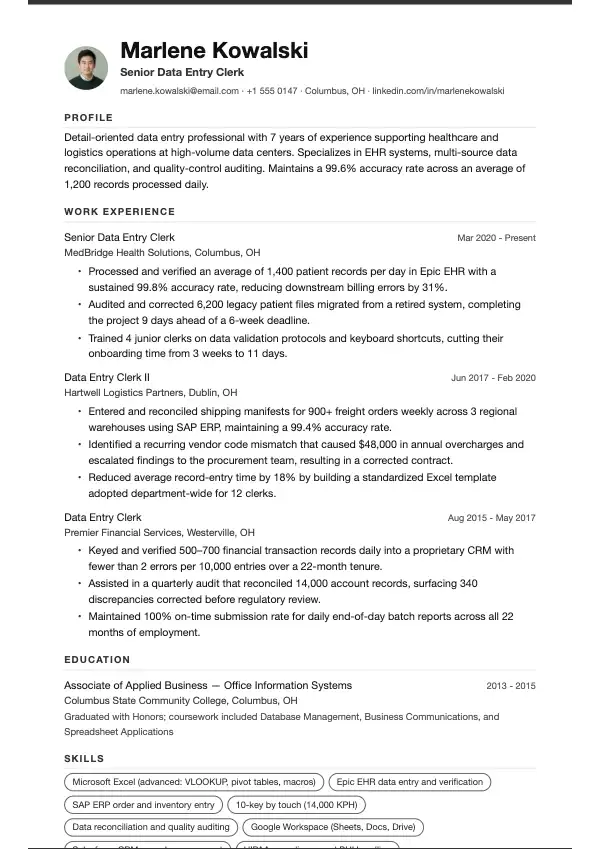
Template: Ribbon
Read this resume as text
Marlene Kowalski
Senior Data Entry Clerk
marlene.kowalski@email.com · +1 555 0147 · Columbus, OH · linkedin.com/in/marlenekowalski
- Profile
- Detail-oriented data entry professional with 7 years of experience supporting healthcare and logistics operations at high-volume data centers. Specializes in EHR systems, multi-source data reconciliation, and quality-control auditing. Maintains a 99.6% accuracy rate across an average of 1,200 records processed daily.
- Work Experience
Senior Data Entry Clerk
MedBridge Health Solutions, Columbus, OH · Mar 2020 - Present
- Processed and verified an average of 1,400 patient records per day in Epic EHR with a sustained 99.8% accuracy rate, reducing downstream billing errors by 31%.
- Audited and corrected 6,200 legacy patient files migrated from a retired system, completing the project 9 days ahead of a 6-week deadline.
- Trained 4 junior clerks on data validation protocols and keyboard shortcuts, cutting their onboarding time from 3 weeks to 11 days.
Data Entry Clerk II
Hartwell Logistics Partners, Dublin, OH · Jun 2017 - Feb 2020
- Entered and reconciled shipping manifests for 900+ freight orders weekly across 3 regional warehouses using SAP ERP, maintaining a 99.4% accuracy rate.
- Identified a recurring vendor code mismatch that caused $48,000 in annual overcharges and escalated findings to the procurement team, resulting in a corrected contract.
- Reduced average record-entry time by 18% by building a standardized Excel template adopted department-wide for 12 clerks.
Data Entry Clerk
Premier Financial Services, Westerville, OH · Aug 2015 - May 2017
- Keyed and verified 500–700 financial transaction records daily into a proprietary CRM with fewer than 2 errors per 10,000 entries over a 22-month tenure.
- Assisted in a quarterly audit that reconciled 14,000 account records, surfacing 340 discrepancies corrected before regulatory review.
- Maintained 100% on-time submission rate for daily end-of-day batch reports across all 22 months of employment.
- Education
Associate of Applied Business — Office Information Systems
Columbus State Community College, Columbus, OH · 2013 - 2015
Graduated with Honors; coursework included Database Management, Business Communications, and Spreadsheet Applications
- Skills
- Microsoft Excel (advanced: VLOOKUP, pivot tables, macros) · Epic EHR data entry and verification · SAP ERP order and inventory entry · 10-key by touch (14,000 KPH) · Data reconciliation and quality auditing · Google Workspace (Sheets, Docs, Drive) · Salesforce CRM record management · HIPAA compliance and PHI handling · Optical character recognition (OCR) software
- Links
- LinkedIn: linkedin.com/in/marlenekowalski
What makes this resume work
- Every bullet opens with a strong action verb and closes with a specific number — accuracy percentages, record counts, or time saved — so the hiring manager immediately sees output, not just duties.
- The skills section lists the exact software names recruiters search (Epic, SAP, Salesforce) alongside a quantified typing speed, giving ATS parsers concrete, matchable tokens.
- The summary names seniority level, industry domains, and a single headline metric in three sentences, letting a quick skim convey the candidate's full value proposition.
- The mid-career role at Hartwell includes a cost-impact bullet ($48,000 in recovered overcharges), demonstrating that data entry work directly connects to business outcomes — a differentiator most clerks miss.
Keywords that help you pass the ATS
Work the ones that fit your experience into your resume, naturally, not stuffed.
How to write a Data Entry Clerk resume
Choose the right format for a Data Entry Clerk resume
Use a reverse-chronological format unless you have fewer than six months of total work history, in which case a functional or combination layout lets you lead with skills. Data entry hiring managers scan resumes in seconds, so keep yours to one page if you have under ten years of experience, and strip out anything that doesn't speak directly to speed, accuracy, or software proficiency.
Set margins to 0.75–1 inch, use a clean sans-serif font like Calibri or Arial at 10–12 pt, and group information into clearly labeled sections. Avoid tables and text boxes — many applicant tracking systems (ATS) used by staffing agencies like Robert Half or Kelly Services cannot parse them, and data entry roles are heavily filled through these channels.
- Sections to include: Contact Info, Summary, Work Experience, Skills, Education
- File format: save as a text-based PDF unless the job posting asks for .docx
- Length: one page for most candidates; two pages only with 10+ years of relevant experience
- Use consistent date formatting (MM/YYYY) throughout
Write a professional summary that leads with your value
Your summary sits at the top and does one job: convince a recruiter to keep reading. State your years of experience, your typing speed, your accuracy rate, and the environments you've worked in — all in two to three sentences. Skip objectives like 'seeking a challenging position'; they waste space.
Here is a concrete example you can adapt: "Detail-oriented Data Entry Clerk with 4 years of experience processing high-volume records in healthcare and financial services environments. Types 75 WPM with a 99.8% accuracy rate verified through regular quality audits. Proficient in Salesforce, Microsoft Excel (VLOOKUP, PivotTables), and 10-key by touch; experienced with HIPAA-compliant data handling."
Write work-experience bullets that show output, not just duties
Replace vague task descriptions with accomplishment statements that include volume, speed, accuracy, or business impact. Hiring managers want to know how much data you handled, how fast, and how well — not just that you 'entered data into a database.' Start each bullet with a strong action verb: processed, verified, audited, reconciled, migrated, flagged.
Every bullet should answer: what did you do, at what scale, and with what result? If you reduced errors, say by how much. If you processed invoices, say how many per day or week.
- Processed 1,200+ insurance claim records daily in Epic EHR with a documented error rate below 0.5%, reducing claim rejections by 18% over six months.
- Migrated 45,000 legacy customer records from Access to Salesforce CRM ahead of a 3-week deadline, reconciling duplicate entries and improving database integrity by 22%.
Skills and certifications recruiters and ATS systems look for
Data entry job postings consistently filter on specific software and measurable competencies. Build a dedicated Skills section and mirror the exact terminology from the job description — ATS tools like Taleo and Workday match keywords literally. Separate hard skills from soft skills, and list certifications on their own line with the issuing body.
The Microsoft Office Specialist (MOS) certification for Excel or Word is the most recognized credential in this field and is offered through Certiport. If you work in healthcare data, a Registered Health Information Technician (RHIT) credential from AHIMA adds significant weight. Typing certifications from Ratatype or TypingTest.com are worth listing only if they verify 60+ WPM.
- Software: Microsoft Excel, Google Sheets, SAP, Salesforce, QuickBooks, Epic, Cerner, Oracle
- Core skills: 10-key by touch, alpha-numeric data entry, data validation, records management
- Certifications: Microsoft Office Specialist (MOS), RHIT (AHIMA), Certified Administrative Professional (CAP)
- Compliance knowledge: HIPAA, SOX data handling, GDPR basics for roles with international data
- Typing speed: always list WPM with an accuracy percentage — '72 WPM / 99% accuracy'
Education, licenses, and extras that round out your resume
A high school diploma or GED meets the minimum requirement for most data entry roles. If you have an associate's or bachelor's degree, list it, but don't inflate its importance — employers in this field prioritize demonstrated speed and accuracy over academic credentials. List your degree, school name, and graduation year; omit GPA unless it's above 3.5 and you graduated within the last three years.
Add a brief Additional section for relevant extras: bilingual data entry ability (Spanish/English is frequently requested in healthcare and logistics), notary public license if applicable, or completed coursework in database management or medical terminology. Volunteer data work for nonprofits counts as experience if your paid history is thin.
- List any completed coursework in database administration, medical coding, or records management
- Include language skills only if you can work in that language professionally
- Notary Public license is a differentiator for legal or financial data entry roles
Mistakes to avoid
- Listing typing speed without an accuracy rate makes the stat meaningless — employers care about both, and omitting accuracy signals you may not track errors.
- Using a table-based resume layout causes ATS systems to scramble your contact information and job titles, which can leave the recruiter looking at an application with no usable contact details.
- Writing bullets like 'responsible for entering data into the system' tells a recruiter nothing about volume, software, or impact — always quantify your output.
- Skipping relevant software names and instead writing 'proficient in various database programs' means your resume will fail keyword matching in ATS for tools like SAP, Epic, or Salesforce that the job requires.
Frequently asked questions
- Should I list my typing speed on a data entry resume?
- Yes — always include your typing speed in WPM alongside your accuracy percentage, either in your summary or your skills section. Most data entry roles expect a minimum of 45–60 WPM, and listing a verified figure (from a site like TypingTest.com or through a prior employer's assessment) makes the claim credible. If your speed is below 50 WPM, focus on accuracy and software proficiency instead.
- Do I need a college degree to get a data entry job?
- No — the vast majority of data entry positions require only a high school diploma or GED. Employers prioritize your typing speed, accuracy rate, and familiarity with relevant software over academic credentials. That said, an associate's degree in business administration or a medical coding certificate can help you qualify for higher-paying specialized roles in healthcare or finance.
- How do I write a data entry resume with no experience?
- Lead with a skills-based summary that highlights your typing speed, accuracy, and any software you know from school or personal use. Add a Skills section with tools like Excel and Google Sheets, and create an experience section that includes volunteer work, freelance data projects, or relevant coursework. Taking a free or low-cost data entry course through platforms like Coursera or your local community college gives you something concrete to list while you build paid experience.
Make it yours in minutes
Open this example in the builder, swap in your details, and export a clean, ATS-ready resume.
Once your resume is ready
More for this application
- Template style
- Creative resume templates