Resume example
Billing Specialist resume example
By the Resumade team · About our content
A Billing Specialist resume must prove coding accuracy, denial recovery results, and payer fluency before a recruiter reads past the summary. This example does all three with quantified bullets and ATS-ready skill terms.
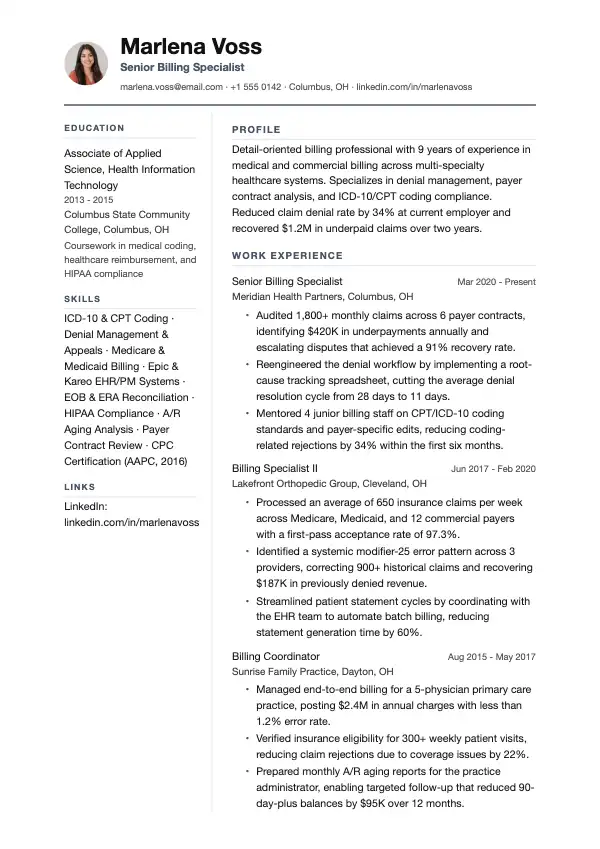
Template: Quadrant
Read this resume as text
Marlena Voss
Senior Billing Specialist
marlena.voss@email.com · +1 555 0142 · Columbus, OH · linkedin.com/in/marlenavoss
- Profile
- Detail-oriented billing professional with 9 years of experience in medical and commercial billing across multi-specialty healthcare systems. Specializes in denial management, payer contract analysis, and ICD-10/CPT coding compliance. Reduced claim denial rate by 34% at current employer and recovered $1.2M in underpaid claims over two years.
- Work Experience
Senior Billing Specialist
Meridian Health Partners, Columbus, OH · Mar 2020 - Present
- Audited 1,800+ monthly claims across 6 payer contracts, identifying $420K in underpayments annually and escalating disputes that achieved a 91% recovery rate.
- Reengineered the denial workflow by implementing a root-cause tracking spreadsheet, cutting the average denial resolution cycle from 28 days to 11 days.
- Mentored 4 junior billing staff on CPT/ICD-10 coding standards and payer-specific edits, reducing coding-related rejections by 34% within the first six months.
Billing Specialist II
Lakefront Orthopedic Group, Cleveland, OH · Jun 2017 - Feb 2020
- Processed an average of 650 insurance claims per week across Medicare, Medicaid, and 12 commercial payers with a first-pass acceptance rate of 97.3%.
- Identified a systemic modifier-25 error pattern across 3 providers, correcting 900+ historical claims and recovering $187K in previously denied revenue.
- Streamlined patient statement cycles by coordinating with the EHR team to automate batch billing, reducing statement generation time by 60%.
Billing Coordinator
Sunrise Family Practice, Dayton, OH · Aug 2015 - May 2017
- Managed end-to-end billing for a 5-physician primary care practice, posting $2.4M in annual charges with less than 1.2% error rate.
- Verified insurance eligibility for 300+ weekly patient visits, reducing claim rejections due to coverage issues by 22%.
- Prepared monthly A/R aging reports for the practice administrator, enabling targeted follow-up that reduced 90-day-plus balances by $95K over 12 months.
- Education
Associate of Applied Science, Health Information Technology
Columbus State Community College, Columbus, OH · 2013 - 2015
Coursework in medical coding, healthcare reimbursement, and HIPAA compliance
- Skills
- ICD-10 & CPT Coding · Denial Management & Appeals · Medicare & Medicaid Billing · Epic & Kareo EHR/PM Systems · EOB & ERA Reconciliation · HIPAA Compliance · A/R Aging Analysis · Payer Contract Review · CPC Certification (AAPC, 2016)
- Links
- LinkedIn: linkedin.com/in/marlenavoss
What makes this resume work
- The summary leads with years of experience and two hard numbers — a 34% denial reduction and $1.2M in recovered revenue — giving hiring managers an immediate ROI signal before they scan the body.
- Each bullet opens with a strong action verb (Audited, Reengineered, Identified) and closes with a dollar figure, percentage, or time metric, making impact concrete and comparable across candidates.
- Hard skills are listed as discrete, searchable terms — 'ICD-10 & CPT Coding,' 'EOB & ERA Reconciliation,' 'Epic & Kareo' — matching the exact language payer-side and provider-side ATS systems parse for.
- The CPC certification is embedded in the skills block rather than buried in education, ensuring it surfaces immediately in keyword scans and signals professional credentialing at a glance.
Keywords that help you pass the ATS
Work the ones that fit your experience into your resume, naturally, not stuffed.
How to write a Billing Specialist resume
Choose the right format for a Billing Specialist resume
Use a reverse-chronological format. Billing roles are heavily process- and compliance-driven, so hiring managers want to see a clear progression of responsibility across employers. A functional or hybrid format raises red flags in this field because it obscures tenure and gaps.
Keep the resume to one page if you have fewer than ten years of experience; two pages are acceptable for senior specialists managing large AR portfolios or multi-system environments. Use clean section headers, consistent font sizing (10–12pt body, 14pt name), and at least 0.5-inch margins. Save and submit as a PDF unless the job posting explicitly requests a Word file.
- Sections in order: contact info, summary, work experience, skills, education/certifications
- Include a LinkedIn URL only if the profile is complete and current
- Avoid tables and text boxes — many ATS platforms misread them
Write a professional summary that passes the first scan
Your summary should be three to four sentences that name your specialty (medical billing, insurance billing, B2B invoicing), years of experience, and one or two quantifiable wins. Skip objectives and generic phrases like 'detail-oriented professional.'
Example: "Billing Specialist with 7 years of experience in high-volume medical billing for multi-specialty physician groups. Proficient in ICD-10, CPT coding, and Epic, with a consistent first-pass claim acceptance rate above 97%. Reduced average days in AR from 52 to 34 days at a 200-provider practice by restructuring denial workflows. AAPC-certified (CPC) and experienced working directly with Medicare, Medicaid, and commercial payers."
Write work-experience bullets that show impact, not just duties
Every bullet should follow an action-verb + task + result structure. Billing is a metrics-rich job — denial rates, days in AR, collection rates, invoice volumes, and error rates are all fair game. If you processed claims manually, say how many per day. If you reduced write-offs, give the dollar figure or percentage.
Avoid vague language like 'responsible for billing tasks.' Recruiters in healthcare revenue cycle and corporate billing both expect numbers. Use past tense for previous roles and present tense for your current one.
- Processed and submitted 350+ insurance claims daily in Kareo, maintaining a 98.4% clean-claim rate and reducing denial volume by 22% over 12 months.
- Recovered $410,000 in outstanding AR within 90 days by implementing a structured follow-up schedule and escalating aged accounts to the collections team.
Skills and certifications recruiters and ATS systems look for
Billing job postings are keyword-heavy. Pull exact terms from the job description and mirror them in your skills section. Separate hard skills (software, coding systems, payer knowledge) from soft skills, and list certifications in their own line or subsection so they are not buried.
For medical billing roles, AAPC's Certified Professional Coder (CPC) and AHIMA's Certified Coding Specialist (CCS) are the most recognized credentials. For corporate or B2B billing, familiarity with ERP systems and GAAP basics matters more than coding credentials.
- Software: Epic, Meditech, Kareo, AdvancedMD, QuickBooks, Salesforce Billing, SAP
- Coding and compliance: ICD-10-CM, CPT, HCPCS Level II, HIPAA, Medicare/Medicaid billing rules
- Core skills: accounts receivable, denial management, EOB reconciliation, charge entry, cash posting, payer contract interpretation
- Certifications: CPC (AAPC), CCS (AHIMA), CPMA, Certified Revenue Cycle Specialist (CRCS-I)
- Soft skills worth listing: dispute resolution, cross-department communication, deadline management under volume pressure
Education, licenses, and extras that round out the resume
Most Billing Specialist positions require a high school diploma or GED at minimum; an associate or bachelor's degree in health information management, accounting, or business administration strengthens your candidacy for senior or supervisory roles. List your highest degree, the institution, and graduation year — omit GPA unless it is above 3.5 and you graduated within the last three years.
If you hold a CPC, CCS, or CRCS, list it under a dedicated Certifications section with the issuing body and expiration or renewal date. Add any relevant continuing education, such as AAPC workshops on payer-specific billing rules or denial management. A brief 'Additional' section can include bilingual ability (valuable in patient-facing billing roles), notary commission, or experience with a specific payer portal like Availity or Navicure.
Mistakes to avoid
- Listing software names without context — stating you used Epic means little without noting the module (Professional Billing, Hospital Billing) and the scale of the environment.
- Using denial rate and days-in-AR interchangeably or incorrectly, which signals to revenue cycle managers that you do not fully understand the metrics.
- Omitting the payer mix you worked with — Medicare, Medicaid, commercial, workers' comp, and self-pay each have distinct rules, and hiring managers want to know your specific exposure.
- Leaving certifications off the skills section or burying them at the bottom after education, causing ATS keyword scans to miss them entirely.
Frequently asked questions
- Do I need a certification to get a Billing Specialist job?
- Not always, but a CPC or CCS credential significantly improves your chances, especially in medical billing where payer audits and compliance requirements are strict. Many employers list certification as preferred rather than required, meaning a strong track record with measurable results can substitute — but you will compete against certified candidates for the same roles.
- How do I write a Billing Specialist resume with no experience?
- Lead with any coursework in medical billing, health information technology, or accounting, and highlight any internship, practicum, or volunteer work involving data entry, invoicing, or patient accounts. Earn an entry-level credential like the AAPC's Certified Professional Biller (CPB) to signal commitment, and emphasize transferable skills such as accuracy under volume, software proficiency, and customer communication from any prior role.
- What is the average salary for a Billing Specialist and should I include salary expectations on my resume?
- The closest Bureau of Labor Statistics category, billing and posting clerks, had a median annual wage of $48,500 in May 2025 (Occupational Outlook Handbook); pay varies with certification, specialty, and region. Never include salary expectations on your resume — that conversation belongs in the interview or application form if the employer specifically requests it.
Make it yours in minutes
Open this example in the builder, swap in your details, and export a clean, ATS-ready resume.
Once your resume is ready
More for this application
- Template style
- Professional resume templates