Resume example
Aerospace Engineer resume example
By the Resumade team · About our content
An Aerospace Engineer resume should speak the language of propulsion and structures, because those are the terms recruiters search and engineers expect. This example loads domain terminology into every section and pairs each claim with a hard number so reviewers can benchmark impact immediately.
Template: Journal
Read this resume as text
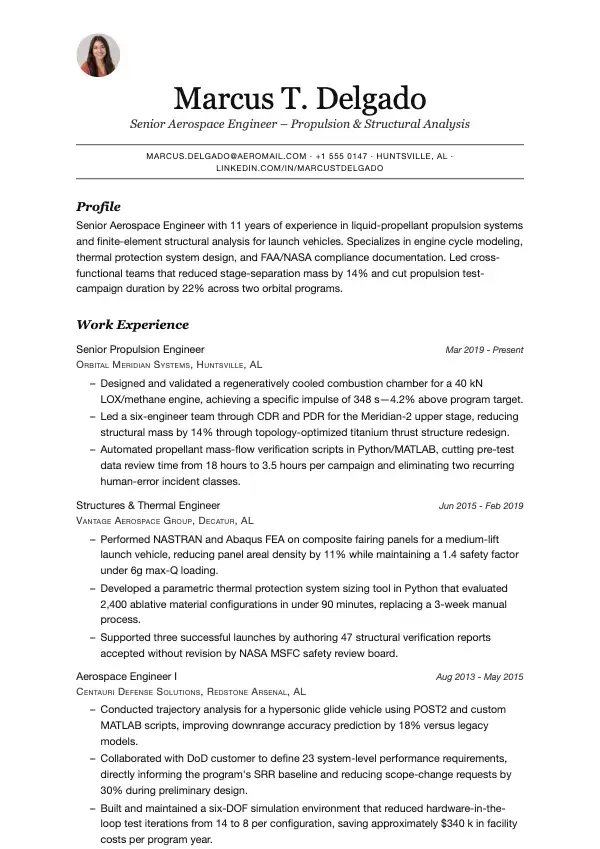
Marcus T. Delgado
Senior Aerospace Engineer – Propulsion & Structural Analysis
marcus.delgado@aeromail.com · +1 555 0147 · Huntsville, AL · linkedin.com/in/marcustdelgado
- Profile
- Senior Aerospace Engineer with 11 years of experience in liquid-propellant propulsion systems and finite-element structural analysis for launch vehicles. Specializes in engine cycle modeling, thermal protection system design, and FAA/NASA compliance documentation. Led cross-functional teams that reduced stage-separation mass by 14% and cut propulsion test-campaign duration by 22% across two orbital programs.
- Work Experience
Senior Propulsion Engineer
Orbital Meridian Systems, Huntsville, AL · Mar 2019 - Present
- Designed and validated a regeneratively cooled combustion chamber for a 40 kN LOX/methane engine, achieving a specific impulse of 348 s—4.2% above program target.
- Led a six-engineer team through CDR and PDR for the Meridian-2 upper stage, reducing structural mass by 14% through topology-optimized titanium thrust structure redesign.
- Automated propellant mass-flow verification scripts in Python/MATLAB, cutting pre-test data review time from 18 hours to 3.5 hours per campaign and eliminating two recurring human-error incident classes.
Structures & Thermal Engineer
Vantage Aerospace Group, Decatur, AL · Jun 2015 - Feb 2019
- Performed NASTRAN and Abaqus FEA on composite fairing panels for a medium-lift launch vehicle, reducing panel areal density by 11% while maintaining a 1.4 safety factor under 6g max-Q loading.
- Developed a parametric thermal protection system sizing tool in Python that evaluated 2,400 ablative material configurations in under 90 minutes, replacing a 3-week manual process.
- Supported three successful launches by authoring 47 structural verification reports accepted without revision by NASA MSFC safety review board.
Aerospace Engineer I
Centauri Defense Solutions, Redstone Arsenal, AL · Aug 2013 - May 2015
- Conducted trajectory analysis for a hypersonic glide vehicle using POST2 and custom MATLAB scripts, improving downrange accuracy prediction by 18% versus legacy models.
- Collaborated with DoD customer to define 23 system-level performance requirements, directly informing the program's SRR baseline and reducing scope-change requests by 30% during preliminary design.
- Built and maintained a six-DOF simulation environment that reduced hardware-in-the-loop test iterations from 14 to 8 per configuration, saving approximately $340 k in facility costs per program year.
- Education
M.S. Aerospace Engineering – Propulsion Concentration
Georgia Institute of Technology, Atlanta, GA · 2011 - 2013
Thesis: Injector Coaxial Element Optimization for LOX/LH2 Combustion Stability
B.S. Aerospace Engineering
University of Alabama in Huntsville, Huntsville, AL · 2007 - 2011
Summa Cum Laude; Minor in Mechanical Engineering
- Skills
- Liquid Propulsion System Design (LOX/LH2, LOX/CH4) · Finite Element Analysis – NASTRAN, Abaqus · Trajectory & Performance Analysis – POST2, MATLAB · Thermal Protection System Sizing · Python Scripting & Automation · GD&T and Structural Verification Documentation · NASA-STD-5001 / AIAA S-110 Structural Standards · CFD Post-Processing – Fluent, CEA · ITAR-Cleared (Active Secret Clearance)
- Links
- LinkedIn: linkedin.com/in/marcustdelgado · Portfolio: marcustdelgado.github.io/propulsion-projects
What makes this resume work
- The summary names the exact subdisciplines—LOX/methane propulsion and FEA—so keyword-matching ATS tools rank it highly before a human even opens the file.
- Every bullet opens with a distinct action verb (Designed, Led, Automated, Performed, Developed) and closes with a quantified outcome, giving hiring managers a concrete performance baseline rather than a list of duties.
- The skills section mirrors language from real job postings—NASA-STD-5001, NASTRAN, POST2—rather than generic terms, which increases match rate against aerospace-specific requisitions.
- Listing an active Secret clearance and ITAR status in the skills block surfaces a critical screening criterion early, so a recruiter checking clearance eligibility has the answer before reaching the experience section.
Keywords that help you pass the ATS
Work the ones that fit your experience into your resume, naturally, not stuffed.
How to write an Aerospace Engineer resume
Choose the right format for an Aerospace Engineer resume
Use a reverse-chronological format in almost every case. Aerospace hiring managers at contractors like Lockheed Martin, Raytheon, Boeing, and SpaceX expect to scan your most recent role immediately — they are not looking for a creative layout. Keep your resume to one page if you have fewer than ten years of experience; two pages is acceptable for senior engineers with extensive program history.
Use clean section headers, a single readable font such as Calibri or Arial at 10–12 pt, and consistent margin widths of 0.75–1 inch. Avoid tables, text boxes, and graphics — many defense contractor applicant tracking systems parse plain text and will scramble formatted elements.
- One page for early-career (0–9 years), two pages for mid-to-senior level
- Standard sections: Summary, Work Experience, Skills, Education, Certifications
- Save as a PDF unless the job posting specifically requests a Word document
- File name format: LastName_FirstName_AerospaceEngineer.pdf
Write a professional summary that lands interviews
Your summary should be three to four sentences that front-load your discipline (propulsion, structures, avionics, flight dynamics), years of experience, and one or two signature accomplishments. Skip phrases like 'results-driven' or 'team player' — they waste the recruiter's first look.
Example: "Aerospace Engineer with 8 years of experience in structural analysis and composite manufacturing for commercial and defense platforms. Led stress analysis on the empennage assembly for a next-generation regional jet, reducing component weight by 11% while meeting FAR Part 25 certification requirements. Proficient in NASTRAN, CATIA V5, and MATLAB. Active Secret clearance holder."
Write work-experience bullets that show impact
Every bullet should follow an action-verb + task + quantified result structure. Aerospace roles generate measurable outcomes — use them. Reference specific programs, aircraft designations, or mission types where your NDA allows. Avoid vague verbs like 'assisted' or 'supported'; use 'designed,' 'validated,' 'modeled,' 'integrated,' or 'qualified.'
Recruiters for government and defense programs also look for evidence of working within DO-178C, MIL-STD-810, or AS9100 quality frameworks, so name the standard alongside the result.
- Performed CFD analysis using ANSYS Fluent on a hypersonic inlet geometry, reducing drag coefficient by 7.3% and cutting wind-tunnel test iterations from 12 to 4 across a 14-month development cycle.
- Led failure modes and effects analysis (FMEA) for a satellite reaction control subsystem under MIL-STD-1629A, identifying 3 critical failure modes that were resolved before CDR and preventing an estimated $2.1M in redesign costs.
Skills and certifications recruiters and ATS systems look for
Aerospace ATS filters are heavily keyword-driven, especially on government contract positions posted through USAJOBS or Cleared Jobs. Mirror the exact terminology from the job posting — write 'finite element analysis' and 'FEA,' not just one or the other. Group your skills into logical clusters: analysis software, CAD/CAM tools, standards and methodologies, and programming languages.
Certifications matter significantly in this field. An active security clearance (Secret or Top Secret/SCI) is often a hard filter, not a preference — list clearance level and adjudication date. Professional Engineer (PE) licensure in mechanical or aerospace engineering signals independent technical authority and is valued for senior roles.
- Analysis tools: NASTRAN, ANSYS, ABAQUS, MATLAB/Simulink, STK (Systems Tool Kit)
- CAD/PLM: CATIA V5/V6, SolidWorks, Siemens NX, Windchill, Teamcenter
- Standards: AS9100D, DO-178C, DO-254, MIL-STD-810, FAR/JAR Part 25
- Certifications: PE License, FAA Airframe & Powerplant (A&P), PMI-PMP, Six Sigma Green/Black Belt
- Programming: Python, MATLAB, C++, Fortran (legacy code environments)
Education, licenses, and extras that close the deal
List your highest degree first: degree name, major, university, and graduation year. For aerospace roles, a BS or MS in Aerospace, Mechanical, or Electrical Engineering from an ABET-accredited program is the baseline expectation. GPA is worth including if it is 3.5 or above and you graduated within the last five years. Omit high school entirely.
Below education, add a short section for publications, patents, or thesis titles if they are relevant to the role — a published paper on combustion instability is a differentiator for a propulsion position. List any active professional memberships such as AIAA or SAE, especially if you have held a committee or leadership role. If you hold an active security clearance, list it prominently — either in your summary and in a dedicated 'Clearance' line near the top of the resume.
- Include thesis or capstone project title if it aligns with the target role
- List AIAA, SAE, or AHS International membership with any officer positions
- Note relevant coursework only for new graduates with limited work history
Mistakes to avoid
- Listing security clearance only in the body of a work bullet instead of calling it out in the summary and a dedicated line, causing ATS filters to miss it entirely.
- Using generic action verbs like 'helped' or 'worked on' instead of specific engineering verbs — 'modeled,' 'validated,' 'qualified,' or 'integrated' — which signals junior thinking regardless of actual experience level.
- Omitting the specific aircraft program, spacecraft platform, or missile system you worked on when it is publicly disclosed information, which makes your experience sound theoretical rather than program-proven.
- Applying a single resume to both commercial aviation and defense positions without tailoring the standards cited — FAR Part 25 and DO-178C signal very different domain expertise to hiring managers in each sector.
Frequently asked questions
- Do I need a security clearance listed on my aerospace resume?
- Yes, if you hold one, list it prominently — in your summary and in a standalone line such as 'Clearance: Secret (Active, 2022).' Many defense contractor applications ask about clearance eligibility up front, and that answer can decide whether the application goes any further. If you held a clearance that has lapsed, note it as 'Secret (Expired 2021, eligible for reinstatement)' so recruiters can assess reinvestigation timelines.
- How do I write an aerospace resume with no professional experience?
- Lead with your education section and include your senior capstone or thesis project as if it were a work experience entry, with bullets that quantify results — weight targets met, simulation accuracy achieved, or test milestones completed. Internships, co-ops, NASA Pathways positions, and university research assistantships all belong in a Work Experience section and should be written with the same action-verb and metric structure as any professional role.
- Should an aerospace engineer include a portfolio or GitHub link on their resume?
- Include a GitHub link if it contains relevant simulation scripts, MATLAB models, or documented personal projects — label it clearly and make sure the repositories are public and well-documented before submitting. A portfolio link is appropriate for roles in UAV design or space systems startups where showing hardware or CAD work adds context. For classified defense roles, never include any project artifacts that touch on restricted programs, even indirectly.
Make it yours in minutes
Open this example in the builder, swap in your details, and export a clean, ATS-ready resume.
Once your resume is ready
More for this application
- Template style
- ATS-Friendly resume templates