Resume example
Environmental Engineer resume example
By the Resumade team · About our content
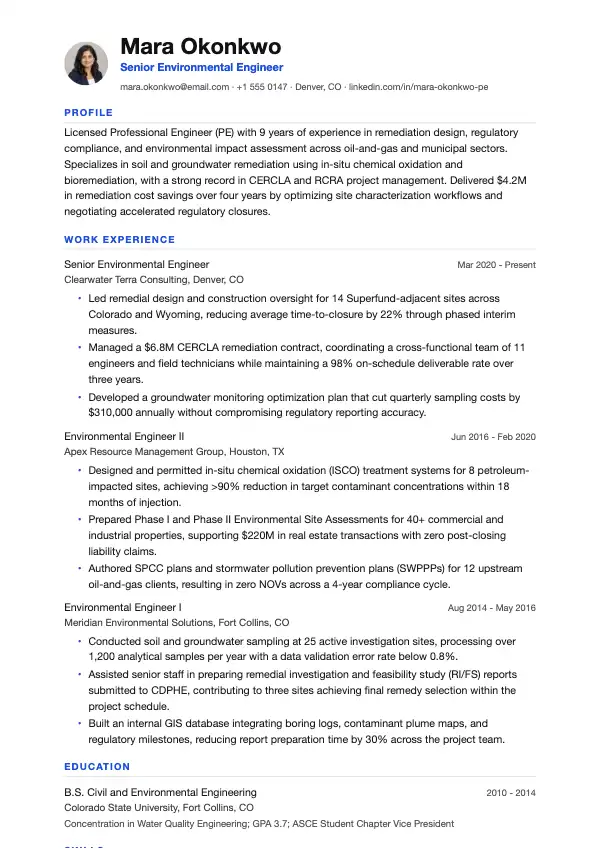
An Environmental Engineer resume must clear ATS keyword filters built around regulatory frameworks and technical methods, then prove to a hiring manager that you reduce liability and cost. This example does both by leading with PE licensure, quantifying remediation outcomes, and naming specific methodologies.
Template: Modern
Read this resume as text
Mara Okonkwo
Senior Environmental Engineer
mara.okonkwo@email.com · +1 555 0147 · Denver, CO · linkedin.com/in/mara-okonkwo-pe
- Profile
- Licensed Professional Engineer (PE) with 9 years of experience in remediation design, regulatory compliance, and environmental impact assessment across oil-and-gas and municipal sectors. Specializes in soil and groundwater remediation using in-situ chemical oxidation and bioremediation, with a strong record in CERCLA and RCRA project management. Delivered $4.2M in remediation cost savings over four years by optimizing site characterization workflows and negotiating accelerated regulatory closures.
- Work Experience
Senior Environmental Engineer
Clearwater Terra Consulting, Denver, CO · Mar 2020 - Present
- Led remedial design and construction oversight for 14 Superfund-adjacent sites across Colorado and Wyoming, reducing average time-to-closure by 22% through phased interim measures.
- Managed a $6.8M CERCLA remediation contract, coordinating a cross-functional team of 11 engineers and field technicians while maintaining a 98% on-schedule deliverable rate over three years.
- Developed a groundwater monitoring optimization plan that cut quarterly sampling costs by $310,000 annually without compromising regulatory reporting accuracy.
Environmental Engineer II
Apex Resource Management Group, Houston, TX · Jun 2016 - Feb 2020
- Designed and permitted in-situ chemical oxidation (ISCO) treatment systems for 8 petroleum-impacted sites, achieving >90% reduction in target contaminant concentrations within 18 months of injection.
- Prepared Phase I and Phase II Environmental Site Assessments for 40+ commercial and industrial properties, supporting $220M in real estate transactions with zero post-closing liability claims.
- Authored SPCC plans and stormwater pollution prevention plans (SWPPPs) for 12 upstream oil-and-gas clients, resulting in zero NOVs across a 4-year compliance cycle.
Environmental Engineer I
Meridian Environmental Solutions, Fort Collins, CO · Aug 2014 - May 2016
- Conducted soil and groundwater sampling at 25 active investigation sites, processing over 1,200 analytical samples per year with a data validation error rate below 0.8%.
- Assisted senior staff in preparing remedial investigation and feasibility study (RI/FS) reports submitted to CDPHE, contributing to three sites achieving final remedy selection within the project schedule.
- Built an internal GIS database integrating boring logs, contaminant plume maps, and regulatory milestones, reducing report preparation time by 30% across the project team.
- Education
B.S. Civil and Environmental Engineering
Colorado State University, Fort Collins, CO · 2010 - 2014
Concentration in Water Quality Engineering; GPA 3.7; ASCE Student Chapter Vice President
- Skills
- PE License – Colorado (Civil, #47821) · CERCLA & RCRA Remediation · In-Situ Chemical Oxidation (ISCO) Design · Groundwater Modeling (MODFLOW, MT3D) · Phase I & II ESA (ASTM E1527-21) · SPCC & SWPPP Compliance · GIS / ArcGIS Pro · 40-Hour HAZWOPER Certified · Environmental Impact Assessment (NEPA)
- Links
- LinkedIn: linkedin.com/in/mara-okonkwo-pe · PE License: Colorado Professional Engineer License #47821 (verifiable via state board)
What makes this resume work
- PE licensure appears in the skills section and the LinkedIn URL simultaneously, signaling credential credibility to both automated parsers and human reviewers before they read a single bullet.
- Every bullet pairs a named technical method—ISCO, CERCLA, MODFLOW—with a concrete outcome (%, $, or count), giving ATS systems exact match terms while showing managers real-world impact rather than task lists.
- The summary front-loads seniority, domain focus, and a dollar figure in three sentences, letting a recruiter qualify the candidate at a glance without reading the full experience section.
- The education note includes GPA, a relevant concentration, and a leadership role, extracting maximum signal from a single degree line without inflating the section or adding a separate activities block.
Keywords that help you pass the ATS
Work the ones that fit your experience into your resume, naturally, not stuffed.
How to write an Environmental Engineer resume
Choose the right format for an Environmental Engineer resume
Use a reverse-chronological format unless you are making a significant industry pivot. Environmental engineering hiring managers at consulting firms, government agencies, and industrial companies expect to scan project history quickly, so a clear timeline matters more than a functional layout.
Keep the resume to one page if you have fewer than ten years of experience; two pages are acceptable for senior engineers with extensive project portfolios or publications. Use standard section headers — Summary, Experience, Skills, Education, Certifications — so applicant tracking systems (ATS) used by firms like AECOM, Tetra Tech, and CDM Smith parse your file correctly. Submit as a PDF unless the job posting specifies otherwise.
- Margins: 0.75–1 inch; font: 10–12 pt Arial, Calibri, or Garamond
- File name: FirstLast_EnvEngineer_Resume.pdf
- Avoid tables and text boxes — ATS often misread them
- List your PE license or EIT status prominently near your name if you hold one
Write a professional summary that earns a second look
Your summary should be three to four lines that tell a hiring manager your specialty, years of experience, and the measurable value you bring. Skip objectives and generic phrases like 'results-driven professional.' Name the specific media you work in — soil, groundwater, air, stormwater — and the regulatory frameworks you know cold.
Example: "Licensed Professional Engineer with 8 years of experience in Phase I/II ESAs, RCRA corrective action, and groundwater remediation design. Managed a $4.2M superfund site closure in EPA Region 5, reducing remediation timeline by 14 months through in-situ chemical oxidation. Proficient in ArcGIS, MODFLOW, and USEPA SWMM; experienced in preparing CERCLA documentation and NPDES permit applications."
Write work-experience bullets that prove impact
Each bullet should follow an action verb + task + quantified result structure. Reviewers at environmental consulting firms expect to see project scale (dollar value, acreage, volume of contaminant), regulatory outcomes, and client context. Vague bullets like 'assisted with remediation projects' will not move you forward.
Pull numbers from project invoices, monitoring reports, and performance metrics you tracked. If a number is confidential, use a range or percentage rather than omitting it entirely.
- Designed a pump-and-treat system for a 23-acre chlorinated solvent plume, reducing TCE concentrations from 4,200 µg/L to below MCL within 18 months and achieving regulatory closure under Illinois TACO.
- Prepared SPCC plans and stormwater pollution prevention plans (SWPPPs) for 11 manufacturing clients across Ohio and Indiana, achieving zero NOVs across three consecutive annual inspections.
Skills and certifications recruiters and ATS look for
Environmental engineering job postings cluster around specific technical keywords. Mirror the language from the posting in your skills section, but only list what you can defend in an interview. Separate hard technical skills from software tools so recruiters can skim both categories quickly.
Certifications carry real weight in this field. A PE license in your state is often a hard requirement for project management roles. CHMM and LEED credentials signal regulatory and sustainability depth, respectively. List the issuing body and expiration or renewal date for any active certification.
- Regulatory frameworks: CERCLA, RCRA, TSCA, Clean Water Act, Clean Air Act, NEPA, NPDES
- Software: ArcGIS, AutoCAD Civil 3D, MODFLOW/MODPATH, USEPA SWMM, HEC-RAS, EQuIS, Trimble GPS
- Field skills: soil boring logging, groundwater sampling (low-flow purging), air quality monitoring (PID/FID), Phase I/II ESA
- Certifications: PE (state-specific), EIT/FE, CHMM, LEED AP, OSHA 40-hr HAZWOPER, Stormwater Inspector
- Soft skills worth listing: technical report writing, stakeholder communication, regulatory agency negotiation
Education, licenses, and extras that close the deal
List your degree, institution, graduation year, and GPA if it was 3.5 or above and you graduated within the last five years. An ABET-accredited BS in Environmental Engineering, Civil Engineering, or a closely related discipline is the standard baseline. A master's degree in environmental engineering, hydrogeology, or environmental science is a differentiator for regulatory and research-heavy roles.
Place your PE license directly under your name or in the Education section with the license number and state — recruiters verify this through the state licensing board. Include relevant thesis topics, senior capstone projects, or published reports if they directly relate to the role. Professional affiliations with AWMA, WEF, ASCE, or NAEM signal active engagement in the field and are worth a short line at the bottom.
- Format licenses as: Professional Engineer (PE), Illinois #062-123456, active
- List HAZWOPER and other safety training with completion dates — many site roles require current 8-hr refreshers
- Include relevant field school completions: e.g., USACE Wetland Delineation Training
Mistakes to avoid
- Listing regulatory acronyms (CERCLA, NPDES, RCRA) without describing what you actually did under those frameworks leaves hiring managers unable to gauge your depth of experience.
- Omitting project dollar values and site acreage makes your experience look smaller than it is — environmental consulting firms evaluate candidates partly by the scale of projects they have managed or supported.
- Putting a PE license or HAZWOPER certification only in a certifications table rather than also near your name means ATS systems and quick-scanning recruiters may miss your most important credential.
- Using generic action verbs like 'assisted' or 'supported' instead of 'designed,' 'authored,' 'negotiated,' or 'led' understates your contribution and raises questions about your actual role on project teams.
Frequently asked questions
- Do I need a PE license to get an environmental engineering job?
- A PE license is not required for entry-level or staff engineer positions, but it becomes a practical requirement for roles where you sign and seal reports, manage client relationships, or serve as project manager at most consulting firms. Passing the FE exam and listing your EIT status shows hiring managers you are on the licensure track, which matters for firms that bill clients under a licensed engineer's seal.
- How do I show environmental engineering experience if most of my work is confidential or under NDA?
- You can describe project type, scale, regulatory program, and outcome without naming the client — for example, 'Fortune 500 chemical manufacturer' or 'municipal water authority.' Use ranges for dollar values if exact figures are restricted, such as '$2M–$5M remediation contract.' Firms understand confidentiality norms and will not penalize you for anonymizing client names as long as the technical detail is specific.
- Should I tailor my environmental engineer resume for government jobs versus consulting firms?
- Yes, meaningfully. Federal and state agency postings often require you to address specific qualifications outlined in the job announcement, and USAJOBS applications follow federal resume rules (currently a two-page maximum) rather than private-sector conventions. For consulting firms, emphasize billable project experience, client management, and business development support. For government roles, highlight regulatory interpretation, compliance oversight, enforcement experience, and any interagency coordination you have done.
Make it yours in minutes
Open this example in the builder, swap in your details, and export a clean, ATS-ready resume.
Once your resume is ready
More for this application
- Template style
- Modern resume templates