Resume example
Athletic Trainer resume example
By the Resumade team · About our content
An Athletic Trainer resume must clear ATS filters loaded with clinical and certification keywords while proving to a hiring manager that you reduce injury rates and protect athlete availability. This example does both through quantified bullets and precise credential labeling.
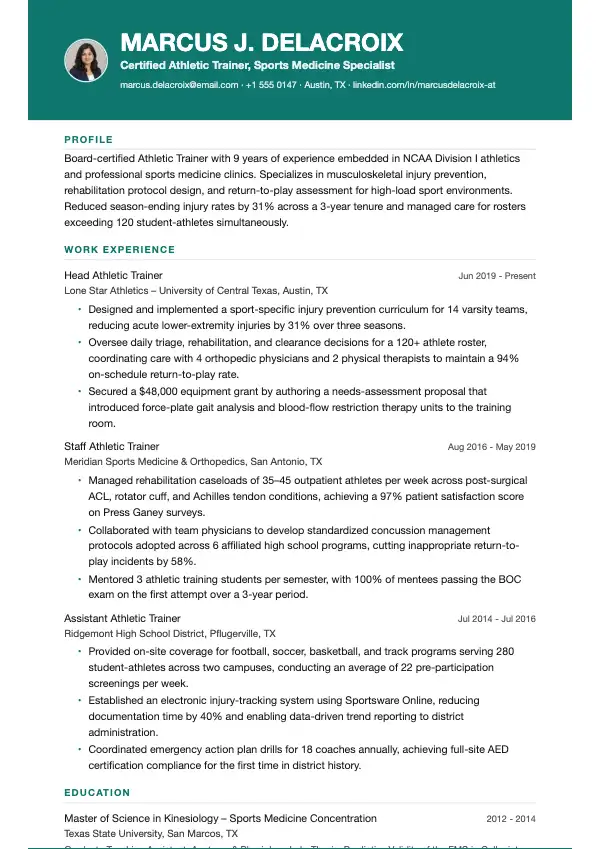
Template: Vermilion
Read this resume as text
Marcus J. Delacroix
Certified Athletic Trainer, Sports Medicine Specialist
marcus.delacroix@email.com · +1 555 0147 · Austin, TX · linkedin.com/in/marcusdelacroix-at
- Profile
- Board-certified Athletic Trainer with 9 years of experience embedded in NCAA Division I athletics and professional sports medicine clinics. Specializes in musculoskeletal injury prevention, rehabilitation protocol design, and return-to-play assessment for high-load sport environments. Reduced season-ending injury rates by 31% across a 3-year tenure and managed care for rosters exceeding 120 student-athletes simultaneously.
- Work Experience
Head Athletic Trainer
Lone Star Athletics – University of Central Texas, Austin, TX · Jun 2019 - Present
- Designed and implemented a sport-specific injury prevention curriculum for 14 varsity teams, reducing acute lower-extremity injuries by 31% over three seasons.
- Oversee daily triage, rehabilitation, and clearance decisions for a 120+ athlete roster, coordinating care with 4 orthopedic physicians and 2 physical therapists to maintain a 94% on-schedule return-to-play rate.
- Secured a $48,000 equipment grant by authoring a needs-assessment proposal that introduced force-plate gait analysis and blood-flow restriction therapy units to the training room.
Staff Athletic Trainer
Meridian Sports Medicine & Orthopedics, San Antonio, TX · Aug 2016 - May 2019
- Managed rehabilitation caseloads of 35–45 outpatient athletes per week across post-surgical ACL, rotator cuff, and Achilles tendon conditions, achieving a 97% patient satisfaction score on Press Ganey surveys.
- Collaborated with team physicians to develop standardized concussion management protocols adopted across 6 affiliated high school programs, cutting inappropriate return-to-play incidents by 58%.
- Mentored 3 athletic training students per semester, with 100% of mentees passing the BOC exam on the first attempt over a 3-year period.
Assistant Athletic Trainer
Ridgemont High School District, Pflugerville, TX · Jul 2014 - Jul 2016
- Provided on-site coverage for football, soccer, basketball, and track programs serving 280 student-athletes across two campuses, conducting an average of 22 pre-participation screenings per week.
- Established an electronic injury-tracking system using Sportsware Online, reducing documentation time by 40% and enabling data-driven trend reporting to district administration.
- Coordinated emergency action plan drills for 18 coaches annually, achieving full-site AED certification compliance for the first time in district history.
- Education
Master of Science in Kinesiology – Sports Medicine Concentration
Texas State University, San Marcos, TX · 2012 - 2014
Graduate Teaching Assistant, Anatomy & Physiology Lab; Thesis: Predictive Validity of the FMS in Collegiate Runners
Bachelor of Science in Athletic Training
University of North Texas, Denton, TX · 2008 - 2012
CAATE-accredited program; Clinical rotations at Texas Health Resources and UNT Athletics
- Skills
- BOC Certification (ATC) · Functional Movement Screen (FMS) · Blood-Flow Restriction (BFR) Therapy · Kinesio Taping & Manual Therapy · Concussion Management (ImPACT) · Sportsware Online & AthleticDirectorU · Force-Plate Gait Analysis · CPR/AED Instructor Certified (ASHI) · Return-to-Play Protocol Design
- Links
- LinkedIn: linkedin.com/in/marcusdelacroix-at · License: Texas Athletic Trainer License #MD-29847 (verifiable via state licensing agency)
What makes this resume work
- The summary leads with board-certification status and years of experience in the first clause, giving ATS parsers and human readers an immediate credential anchor before any soft context appears.
- Every bullet opens with a strong action verb tied to a measurable outcome — percentages, dollar figures, or headcounts — so hiring managers can immediately gauge scope and impact rather than inferring it from vague descriptions.
- Skills are listed as exact credential names and tool titles (e.g., 'ImPACT,' 'Sportsware Online,' 'BFR Therapy') rather than broad categories, matching the precise strings recruiters and ATS systems search when filtering applicants.
- The education section includes thesis topic and clinical rotation sites, signaling research capability and real-world clinical breadth — details that differentiate candidates in competitive university and sports medicine clinic settings.
Keywords that help you pass the ATS
Work the ones that fit your experience into your resume, naturally, not stuffed.
How to write an Athletic Trainer resume
Choose the right format for an Athletic Trainer resume
Most athletic trainers should use a reverse-chronological format. Hiring managers in sports medicine, collegiate athletics, and clinical settings want to see your most recent experience first — they are evaluating clinical progression, patient load, and the level of competition or population you have worked with.
Keep the resume to one page if you have fewer than eight years of experience; two pages are acceptable for those with extensive collegiate, professional sports, or multi-site clinical backgrounds. Use clean section headers, consistent font sizing (10–12 pt), and enough white space so a busy head athletic trainer can scan it quickly.
- Reverse-chronological order for most candidates
- One page for early-career; two pages for senior or multi-setting ATs
- Standard sections: Summary, Experience, Skills, Education, Licenses & Certifications
- Avoid tables or graphics — many applicant tracking systems used by hospital networks and universities parse plain text only
Write a professional summary that earns a second look
Your summary sits at the top and should answer three questions immediately: What setting do you work in? What is your clinical specialty or population? What measurable value do you bring? Skip phrases like 'passionate professional' and focus on specifics — sport coverage, patient volume, or outcomes.
Here is a strong example: "BOC-certified Athletic Trainer with 6 years of experience providing comprehensive sports medicine coverage for NCAA Division I football and track programs. Managed a daily patient load of 30+ student-athletes, reduced average return-to-play time for grade-I ankle sprains by 18% through standardized rehabilitation protocols, and maintained full AED/CPR compliance across a 400-athlete roster."
Write work-experience bullets that show impact, not just duties
Recruiters already know athletic trainers tape ankles and document SOAP notes. Your bullets need to show scope, scale, and outcomes. Lead with a strong action verb, name the specific sport or population, and attach a number wherever possible — athlete count, injury reduction rate, budget managed, or response time.
Avoid listing responsibilities verbatim from a job description. Instead, convert each duty into a result. Two strong examples are below.
- Provided sideline and practice coverage for a 22-sport Division II athletic department serving 550+ student-athletes, averaging 45 patient encounters per week and maintaining a 97% documentation completion rate in Sportsware Online.
- Designed and implemented a pre-participation injury screening program using the Functional Movement Screen (FMS) for 120 high school athletes, identifying 34 at-risk individuals and reducing non-contact lower-extremity injuries by 22% over one academic year.
Skills and certifications recruiters and ATS systems look for
Recruiters at hospital systems, university HR departments, and outpatient providers like ATI Physical Therapy or Athletico search applicants by credential abbreviation and tool name. Place your BOC certification number and state licensure abbreviation in both your summary and a dedicated certifications section.
Hard skills and tools matter as much as credentials. List the EMR or injury-tracking software you actually use, manual therapy techniques you are trained in, and any population-specific competencies such as pediatric sports medicine or concussion management protocols.
- BOC Athletic Trainer certification (ATC) — include credential number
- State licensure — list every state where you hold an active license
- CPR/AED certification (American Red Cross or American Heart Association)
- Software: Sportsware Online, AthleticDirectorU, DragonWave, Meditech, or Epic
- Techniques: Graston, Kinesio taping, dry needling (if certified), FMS, PNF stretching, instrument-assisted soft tissue mobilization (IASTM)
Education, licenses, and extras that complete your resume
List your degree, institution, and graduation year. For athletic trainers, a master's degree is now the entry-level professional degree — CAATE accreditation of your program is worth noting because many employers filter for it. If you graduated from a CAATE-accredited professional master's program after 2022, say so explicitly.
Add a standalone 'Licenses & Certifications' section rather than burying credentials in education. Include continuing education units (CEUs) relevant to your specialty, such as specialty certifications (CSCS from NSCA or PES from NASM). Volunteer coverage for events like marathons, tournaments, or community clinics is worth listing under a brief 'Additional Experience' line if you are early in your career.
- Note CAATE accreditation of your graduate program
- List state license number and expiration year
- Include CSCS, PES, or dry needling certification if held
- Mention any additional specialty certifications or fellowship training
Mistakes to avoid
- Omitting your state license abbreviation and BOC number forces recruiters to follow up before they can verify eligibility, which often means your application gets skipped.
- Writing bullets like 'Responsible for taping and injury prevention' tells hiring managers nothing about your patient volume, sport coverage, or outcomes — always attach a number or result.
- Listing generic software such as 'Microsoft Office' instead of the injury-tracking or EMR platforms you actually used wastes valuable keyword space that ATS systems scan for.
- Failing to tailor your resume to the specific setting — high school, collegiate, clinical outreach, or professional sports — makes it harder for the reader to picture you in the role they are filling.
Frequently asked questions
- Do athletic trainers need a one-page or two-page resume?
- One page is standard if you have fewer than eight years of experience or are applying to a single-setting position such as a high school or small college. Two pages are appropriate for candidates with multi-sport collegiate experience, clinical outreach responsibilities, or leadership roles. Never pad to reach two pages — every line should earn its place.
- Should I include my BOC certification number on my resume?
- Yes. Many employers, particularly hospital-affiliated sports medicine programs and university HR systems, verify BOC status before scheduling interviews. Including your credential number in your certifications section speeds up that check and signals you have nothing to hide. Also list your state license number and expiration date.
- How do I write an athletic trainer resume if I am transitioning from a high school setting to a collegiate or clinical role?
- Emphasize transferable metrics: total athlete count covered, variety of sports, injury documentation volume, and any experience with protocols that mirror the target setting, such as concussion management or pre-participation physicals. Add any continuing education, specialty certifications, or volunteer coverage at higher-level events to bridge the perceived experience gap.
Make it yours in minutes
Open this example in the builder, swap in your details, and export a clean, ATS-ready resume.
Once your resume is ready
More for this application
- Template style
- Teacher resume templates