Resume example
Attorney resume example
By the Resumade team · About our content
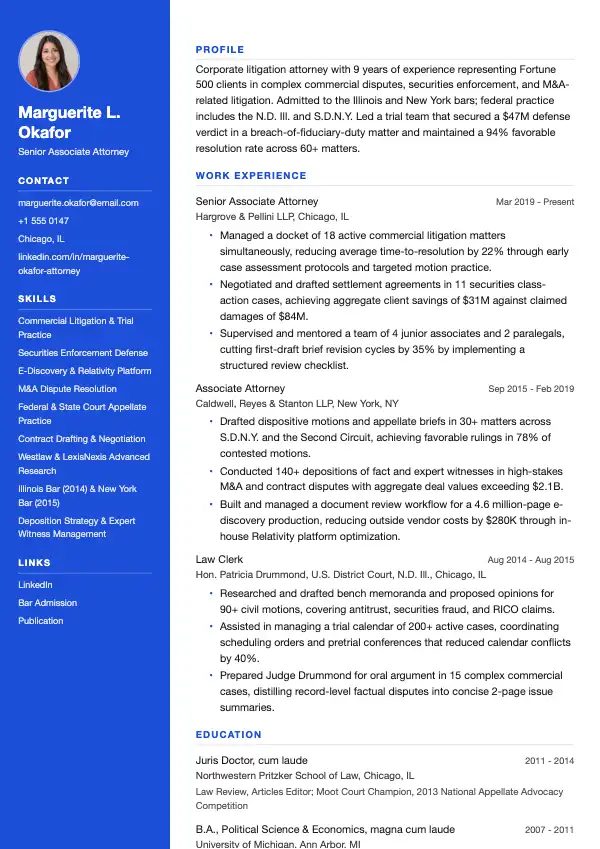
An attorney resume must clear ATS keyword filters for bar admissions, practice areas, and court jurisdictions before a hiring partner reads a single word. This example front-loads credentials, quantifies outcomes, and mirrors the language partners actually search.
Template: Two column
Read this resume as text
Marguerite L. Okafor
Senior Associate Attorney
marguerite.okafor@email.com · +1 555 0147 · Chicago, IL · linkedin.com/in/marguerite-okafor-attorney
- Profile
- Corporate litigation attorney with 9 years of experience representing Fortune 500 clients in complex commercial disputes, securities enforcement, and M&A-related litigation. Admitted to the Illinois and New York bars; federal practice includes the N.D. Ill. and S.D.N.Y. Led a trial team that secured a $47M defense verdict in a breach-of-fiduciary-duty matter and maintained a 94% favorable resolution rate across 60+ matters.
- Work Experience
Senior Associate Attorney
Hargrove & Pellini LLP, Chicago, IL · Mar 2019 - Present
- Managed a docket of 18 active commercial litigation matters simultaneously, reducing average time-to-resolution by 22% through early case assessment protocols and targeted motion practice.
- Negotiated and drafted settlement agreements in 11 securities class-action cases, achieving aggregate client savings of $31M against claimed damages of $84M.
- Supervised and mentored a team of 4 junior associates and 2 paralegals, cutting first-draft brief revision cycles by 35% by implementing a structured review checklist.
Associate Attorney
Caldwell, Reyes & Stanton LLP, New York, NY · Sep 2015 - Feb 2019
- Drafted dispositive motions and appellate briefs in 30+ matters across S.D.N.Y. and the Second Circuit, achieving favorable rulings in 78% of contested motions.
- Conducted 140+ depositions of fact and expert witnesses in high-stakes M&A and contract disputes with aggregate deal values exceeding $2.1B.
- Built and managed a document review workflow for a 4.6 million-page e-discovery production, reducing outside vendor costs by $280K through in-house Relativity platform optimization.
Law Clerk
Hon. Patricia Drummond, U.S. District Court, N.D. Ill., Chicago, IL · Aug 2014 - Aug 2015
- Researched and drafted bench memoranda and proposed opinions for 90+ civil motions, covering antitrust, securities fraud, and RICO claims.
- Assisted in managing a trial calendar of 200+ active cases, coordinating scheduling orders and pretrial conferences that reduced calendar conflicts by 40%.
- Prepared Judge Drummond for oral argument in 15 complex commercial cases, distilling record-level factual disputes into concise 2-page issue summaries.
- Education
Juris Doctor, cum laude
Northwestern Pritzker School of Law, Chicago, IL · 2011 - 2014
Law Review, Articles Editor; Moot Court Champion, 2013 National Appellate Advocacy Competition
B.A., Political Science & Economics, magna cum laude
University of Michigan, Ann Arbor, MI · 2007 - 2011
Phi Beta Kappa; Senior Thesis Prize, Department of Economics
- Skills
- Commercial Litigation & Trial Practice · Securities Enforcement Defense · E-Discovery & Relativity Platform · M&A Dispute Resolution · Federal & State Court Appellate Practice · Contract Drafting & Negotiation · Westlaw & LexisNexis Advanced Research · Illinois Bar (2014) & New York Bar (2015) · Deposition Strategy & Expert Witness Management
- Links
- LinkedIn · Bar Admission · Publication
What makes this resume work
- Bar admissions and federal court jurisdictions appear in both the summary and skills section, ensuring ATS systems scanning for 'Illinois Bar' or 'S.D.N.Y.' match on the first pass.
- Every bullet follows an action-verb-plus-metric structure — specific dollar figures, percentages, and case counts replace vague descriptors and make the candidate's contribution immediately legible to a busy partner.
- The clerkship is treated as a full experience entry rather than a footnote, signaling judicial-process fluency and analytical credibility that lateral partners explicitly value in senior associates.
- Education honors (cum laude, Moot Court Champion, Phi Beta Kappa) are listed concisely but completely, because law firms weight academic pedigree heavily and partners scan for these signals first.
Keywords that help you pass the ATS
Work the ones that fit your experience into your resume, naturally, not stuffed.
How to write an Attorney resume
Choose the right format for an Attorney resume
Most attorneys should use a reverse-chronological format. Hiring partners at law firms and in-house legal departments expect to see your most recent position first and scan for firm prestige, practice area continuity, and progression in responsibility. A functional or hybrid format raises red flags unless you are making a deliberate pivot from, say, litigation to compliance.
Keep the resume to one page if you have fewer than seven years of experience; two pages are standard for senior associates, counsel, and partners. Use clean serif or sans-serif fonts (Georgia, Garamond, Calibri), 10–12 pt body text, and consistent margin widths of 0.75–1 inch. Avoid tables and text boxes — many applicant tracking systems used by large firms and legal staffing agencies parse these incorrectly.
- Reverse-chronological order for all legal experience
- One page for junior associates; two pages for senior attorneys
- Section order: Contact Info → Summary → Experience → Education → Bar Admissions → Skills
- Save and submit as a PDF unless the job posting specifies a Word document
Write a professional summary that earns a second look
Your summary is three to four sentences that answer: what kind of attorney are you, how many years of experience do you have, what is your practice area specialty, and what do you deliver for clients or employers? Skip objective statements — they are outdated. Name the practice area, a signature accomplishment, and the type of employer you target.
Example: "Commercial litigation attorney with nine years of experience at Am Law 100 firms, specializing in securities fraud defense and complex multi-district litigation. Managed a 14-case MDL portfolio valued at over $2.4 billion and achieved favorable settlements in 11 matters without trial. Admitted to the Southern and Eastern Districts of New York and the Second Circuit Court of Appeals. Seeking a senior associate or counsel role in a mid-size litigation boutique."
Write work-experience bullets that show impact, not just duties
Attorneys often write bullets that read like job descriptions — 'drafted motions,' 'conducted depositions,' 'advised clients.' That tells a hiring partner nothing about your caliber. Lead each bullet with a strong action verb and attach a number, outcome, or scale wherever you can. Think about case values, win rates, deal sizes, team size managed, volume of matters handled, or time saved.
If you genuinely cannot share confidential figures, describe scope: 'Fortune 500 clients,' 'cross-border transactions,' 'federal appellate level.' Two strong examples are below.
- Defended a pharmaceutical client in a False Claims Act investigation, coordinating document review across 1.2 million pages and securing a declination from the DOJ after 18 months of negotiation.
- Closed 23 M&A transactions totaling $4.1 billion in aggregate deal value over two years, drafting and negotiating purchase agreements, representations and warranties insurance policies, and HSR filings.
Skills and certifications recruiters and ATS systems look for
Legal ATS platforms — including Greenhouse, Workday, and LawCruit used by large firms — scan for specific practice-area keywords, court admissions, and software proficiency. Build a dedicated Skills section that lists these explicitly rather than burying them in bullet text. Certifications matter more in some specialties than others: a Certified Information Privacy Professional (CIPP/US) credential is highly valued for privacy and data security attorneys; a Certified Compliance and Ethics Professional (CCEP) stands out for in-house compliance roles.
List software tools you actually use. Legal research and practice management tools are concrete signals of day-one productivity.
- Legal research: Westlaw, LexisNexis, Bloomberg Law, Fastcase
- Practice management: Clio, NetDocuments, iManage, Relativity (for e-discovery)
- Certifications: CIPP/US, CCEP, Certified Fraud Examiner (CFE), FINRA Series 7 (only if you still hold it from broker-dealer work)
- Substantive keywords: [your practice area] + jurisdiction-specific terms (e.g., 'UCC Article 9,' 'ERISA,' 'FCPA,' 'Reg D')
- Language skills if relevant to the practice (Spanish, Mandarin, Portuguese)
Education, bar admissions, and extras that matter
List your J.D. first, including law school name, graduation year, and any honors — Law Review, Moot Court, Order of the Coif, class rank if it was top 20%. If you graduated more than ten years ago and your GPA was unremarkable, omit GPA entirely. List your undergraduate degree below the J.D. Bar admissions are not optional and belong in their own clearly labeled section, not buried in education. List every jurisdiction where you are admitted, including federal courts and circuit courts.
Extras worth including: clerkship experience (list it under Experience, not Education), pro bono hours if your firm tracks them publicly, published law review articles, and bar association leadership roles such as section chair positions. Omit hobbies unless they directly signal relevant skills or community standing.
- Bar Admissions section: state bars, federal district courts, circuit courts of appeals
- Clerkship: list under Work Experience with judge's name, court, and year
- Publications: cite in Bluebook format if you list law review articles
- Pro bono: include total hours or notable matters if verifiable
Mistakes to avoid
- Listing bar admissions only in the Education section instead of giving them their own labeled section makes it easy for a hiring partner to miss your jurisdictions during a quick scan.
- Using vague duty-based bullets like 'responsible for managing litigation matters' instead of quantified accomplishments signals junior thinking regardless of your actual seniority.
- Omitting the specific practice area or industry focus from your summary forces the reader to reverse-engineer your specialty from your experience, which costs you the interview.
- Including a photo, personal pronouns in the summary, or references to bar exam scores from decades ago wastes space and can introduce unconscious bias into screening decisions.
Frequently asked questions
- Should an attorney include GPA on a resume?
- Include your GPA if you graduated within the last five years and it was 3.5 or above, or if you are applying to a firm or clerkship that explicitly requests it. After five years, substantive experience outweighs academic performance and GPA can safely be dropped. Never round up or convert to a different scale.
- How do you list a federal clerkship on an attorney resume?
- Place the clerkship under your Work Experience section in reverse-chronological order, not under Education. List the judge's full name and title, the court, and the years served. Firms treat clerkship experience as substantive legal work, and burying it in Education undersells it significantly.
- Is a two-page attorney resume acceptable?
- Yes — two pages are standard and expected for attorneys with more than six or seven years of experience, partners, or those with extensive publication and bar leadership records. Going to three pages is rarely justified unless you are a law professor or have an unusually extensive appellate or publication record. Every line on page two should earn its place.
Make it yours in minutes
Open this example in the builder, swap in your details, and export a clean, ATS-ready resume.
Once your resume is ready
More for this application
- Template style
- Serif resume templates