Resume example
Auditor resume example
By the Resumade team · About our content
A Senior Internal Auditor resume must clear ATS keyword filters for SOX, COSO, and risk assessment while proving to the hiring manager that you find problems others miss — with numbers to back it up. This example does both.
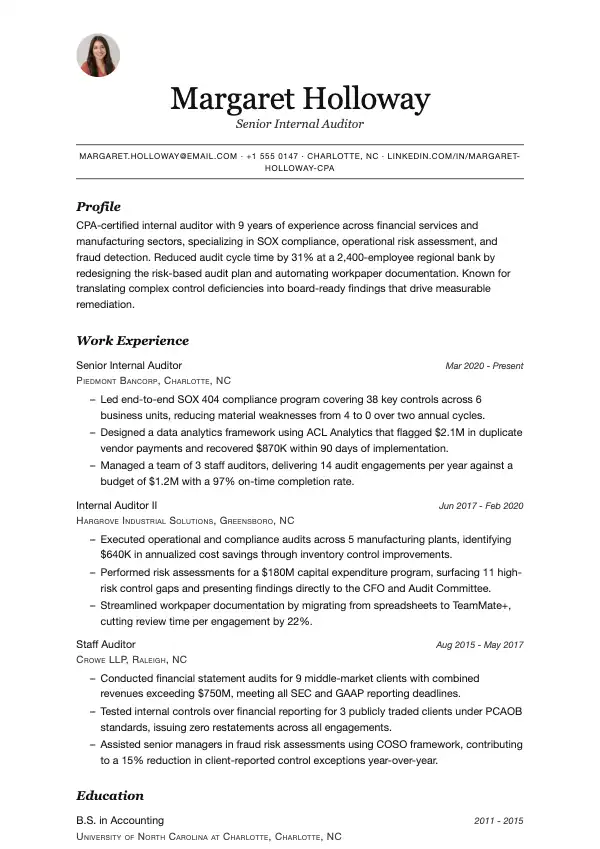
Template: Journal
Read this resume as text
Margaret Holloway
Senior Internal Auditor
margaret.holloway@email.com · +1 555 0147 · Charlotte, NC · linkedin.com/in/margaret-holloway-cpa
- Profile
- CPA-certified internal auditor with 9 years of experience across financial services and manufacturing sectors, specializing in SOX compliance, operational risk assessment, and fraud detection. Reduced audit cycle time by 31% at a 2,400-employee regional bank by redesigning the risk-based audit plan and automating workpaper documentation. Known for translating complex control deficiencies into board-ready findings that drive measurable remediation.
- Work Experience
Senior Internal Auditor
Piedmont Bancorp, Charlotte, NC · Mar 2020 - Present
- Led end-to-end SOX 404 compliance program covering 38 key controls across 6 business units, reducing material weaknesses from 4 to 0 over two annual cycles.
- Designed a data analytics framework using ACL Analytics that flagged $2.1M in duplicate vendor payments and recovered $870K within 90 days of implementation.
- Managed a team of 3 staff auditors, delivering 14 audit engagements per year against a budget of $1.2M with a 97% on-time completion rate.
Internal Auditor II
Hargrove Industrial Solutions, Greensboro, NC · Jun 2017 - Feb 2020
- Executed operational and compliance audits across 5 manufacturing plants, identifying $640K in annualized cost savings through inventory control improvements.
- Performed risk assessments for a $180M capital expenditure program, surfacing 11 high-risk control gaps and presenting findings directly to the CFO and Audit Committee.
- Streamlined workpaper documentation by migrating from spreadsheets to TeamMate+, cutting review time per engagement by 22%.
Staff Auditor
Crowe LLP, Raleigh, NC · Aug 2015 - May 2017
- Conducted financial statement audits for 9 middle-market clients with combined revenues exceeding $750M, meeting all SEC and GAAP reporting deadlines.
- Tested internal controls over financial reporting for 3 publicly traded clients under PCAOB standards, issuing zero restatements across all engagements.
- Assisted senior managers in fraud risk assessments using COSO framework, contributing to a 15% reduction in client-reported control exceptions year-over-year.
- Education
B.S. in Accounting
University of North Carolina at Charlotte, Charlotte, NC · 2011 - 2015
Graduated with Honors; Beta Alpha Psi member
- Skills
- SOX 404 Compliance · Risk-Based Audit Planning · ACL Analytics / IDEA · TeamMate+ Audit Management · COSO & PCAOB Frameworks · Fraud Examination (CFE) · CPA – North Carolina (License #NC-48821) · Financial Statement Analysis · Data Analytics for Audit
- Links
- LinkedIn: linkedin.com/in/margaret-holloway-cpa · License: North Carolina CPA License #NC-48821 (verifiable via state board)
What makes this resume work
- The summary names seniority, years, and two headline achievements in three sentences — giving recruiters an instant ROI case before they read a single bullet.
- Every bullet follows a Verb → Scope → Measurable Result structure: dollar amounts, percentages, and counts replace vague language like 'assisted with' or 'responsible for.'
- Hard skills are listed as exact tool names and framework acronyms (ACL Analytics, TeamMate+, PCAOB, COSO) that ATS systems parse as discrete tokens, not buried inside prose.
- The license entry in both the skills section and the links section ensures the CPA credential surfaces whether a recruiter scans the page or runs a keyword search — doubling its visibility.
Keywords that help you pass the ATS
Work the ones that fit your experience into your resume, naturally, not stuffed.
How to write an Auditor resume
Choose the right format for an Auditor resume
Most auditors should use a reverse-chronological format. Hiring managers at public accounting firms, internal audit departments, and government agencies expect to trace your career progression clearly, and applicant tracking systems parse this layout most reliably. If you have fewer than three years of experience, a hybrid format that leads with a skills section before your work history is acceptable.
Keep the resume to one page if you have under ten years of experience; two pages are appropriate for senior or director-level auditors with extensive engagement histories. Use clean section headers, consistent date formatting (Month YYYY), and margins between 0.5 and 1 inch. Avoid tables and text boxes — many ATS platforms cannot read them.
- Font: Calibri, Garamond, or Arial at 10–12pt for body text
- File format: PDF unless the job posting specifically requests a Word document
- Section order: Contact info → Summary → Experience → Skills → Education → Certifications
- No headshot, no salary history, no references section
Write a professional summary that earns a second look
Your summary sits at the top and functions as a 3–4 line pitch. Name your audit specialty (financial, IT, internal, compliance, operational), your years of experience, the types of entities you've worked with (public companies, nonprofits, government agencies), and one standout credential or achievement. Skip phrases like 'results-driven professional' — they cost you space without adding information.
Example: "CPA with 7 years of external audit experience at a Big Four firm, specializing in financial services and insurance clients under US GAAP and IFRS. Led audit engagements for entities with assets exceeding $4B and managed teams of up to six staff. Proficient in IDEA, TeamMate+, and SAP. Currently pursuing CISA to expand IT audit capabilities."
Write work-experience bullets that show scope and impact
Each bullet should follow an action verb → task → measurable result structure. Auditors often undersell themselves by listing duties instead of outcomes. Quantify wherever possible: dollar values of portfolios reviewed, error rates reduced, findings that led to control improvements, or time saved through process changes. Tailor the language to match the job posting — if the role mentions SOX compliance, that phrase needs to appear in your bullets.
Avoid vague verbs like 'assisted with' or 'helped to.' Use 'executed,' 'identified,' 'remediated,' 'documented,' 'tested,' and 'presented' instead.
- Identified $2.3M in unrecorded liabilities during year-end financial audit of a mid-market manufacturing client, resulting in a restatement and implementation of three new internal controls.
- Reduced audit cycle time by 18% by redesigning the risk assessment workpaper templates in TeamMate+ and training a four-person staff team on the revised workflow.
Skills and certifications recruiters and ATS systems look for
Auditing roles are credential-heavy. Your certifications belong in both a dedicated section and woven into your summary. List software tools explicitly — recruiters search for them by name. Separate hard skills from soft skills; most ATS systems weight technical keywords more heavily.
For IT auditors, add COBIT, NIST, and specific ERP platforms. For government or federal auditors, include GAGAS (Yellow Book) and familiarity with the Uniform Guidance (2 CFR 200, Subpart F), which replaced OMB Circular A-133.
- Certifications: CPA, CIA, CISA, CFE, CRMA, CMA — list only those you hold or are actively pursuing with an expected date
- Audit software: TeamMate+, IDEA, ACL (Galvanize), AuditBoard, Workiva, MindBridge
- ERP and data tools: SAP, Oracle Financials, NetSuite, Power BI, Excel (pivot tables, VLOOKUP, Power Query)
- Standards: US GAAP, IFRS, PCAOB, IIA Standards, SOX Section 302/404, GAGAS
- Soft skills worth naming: stakeholder communication, professional skepticism, project management
Education, licenses, and extras
List your highest degree first — school name, degree, major, and graduation year. If you graduated within the last five years, you can include your GPA if it was 3.5 or above. Accounting, finance, or business administration degrees are standard; if your degree is in another field, emphasize your CPA or CIA credential more prominently in the summary.
Add a separate Certifications section below Education rather than burying credentials inside the education block. Include the issuing body and the year obtained (e.g., 'CPA — Texas State Board of Public Accountancy, 2019'). Professional affiliations such as IIA membership or ISACA chapter involvement are worth a brief line — they signal continued engagement with the profession and can matter in smaller firms or government roles.
- State CPA license: list the state(s) and license number if publicly searchable
- Continuing education: only mention if it's directly relevant (e.g., Yellow Book (GAGAS) CPE requirement met)
- Languages: include if you audit multinational entities or foreign subsidiaries
Mistakes to avoid
- Listing audit duties copied from a job description instead of describing the actual scope, dollar value, and outcome of your specific engagements.
- Omitting the CPA exam status entirely — if you've passed all four sections but haven't yet met the experience requirement, write 'CPA Candidate — all four sections passed' so recruiters don't assume you haven't started.
- Using a single generic resume for every application rather than swapping in the audit standards, software, and industry terminology that match each specific job posting.
- Burying certifications at the bottom of a two-page resume when they are often the first filter a recruiter applies, especially for Big Four or SEC-regulated roles.
Frequently asked questions
- Should an auditor list every client they've worked on?
- No — and many engagements are confidential under NDA or firm policy. Instead, describe clients by industry and size (e.g., 'publicly traded financial services company with $6B in assets'). Focus on the type of work, the standards applied, and the outcomes rather than client names.
- How important is the CPA for getting an auditor job?
- For external audit roles at public accounting firms, the CPA is effectively required at the senior level and strongly preferred even for staff positions. Internal audit roles are more flexible — the CIA is the benchmark credential there — but many corporate employers still list the CPA as preferred. If you're actively pursuing it, say so explicitly on your resume.
- How do I show audit experience if I've only worked in industry internal audit, not public accounting?
- Emphasize the risk frameworks you used (COSO, IIA Standards), the control environments you assessed, and any findings that led to measurable improvements in operations or compliance. Quantify the scope of what you covered — number of business units, annual revenue of the entity, size of your audit plan — and highlight any cross-functional projects where you worked alongside external auditors or regulators.
Make it yours in minutes
Open this example in the builder, swap in your details, and export a clean, ATS-ready resume.
Once your resume is ready
More for this application
- Template style
- Professional resume templates