Resume example
Cloud Engineer resume example
By the Resumade team · About our content
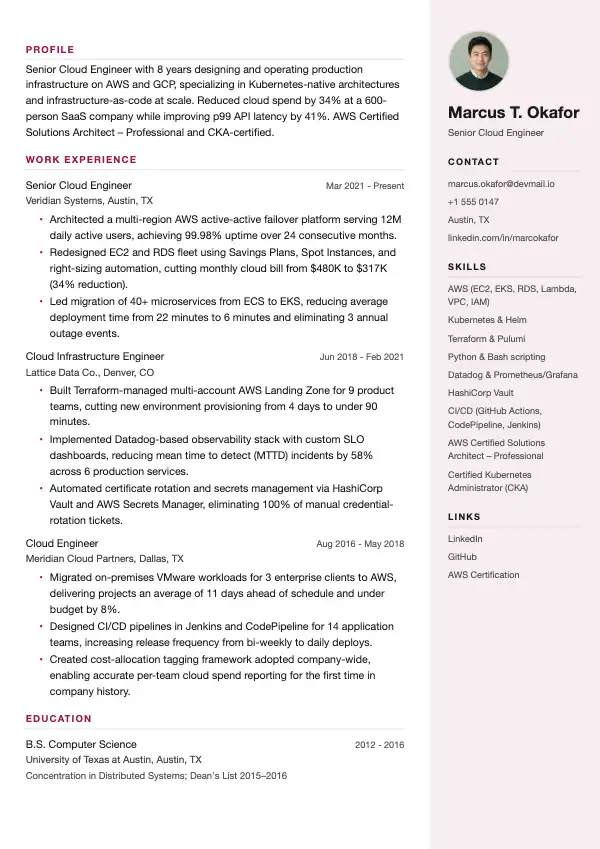
A Cloud Engineer resume must clear automated keyword filters for platform tools and certifications, then immediately prove business impact—cost savings, uptime, and velocity—to a hiring manager on a quick first scan. This example does both by leading every bullet with a verb and a dollar or percentage outcome.
Template: Mist
Read this resume as text
Marcus T. Okafor
Senior Cloud Engineer
marcus.okafor@devmail.io · +1 555 0147 · Austin, TX · linkedin.com/in/marcokafor
- Profile
- Senior Cloud Engineer with 8 years designing and operating production infrastructure on AWS and GCP, specializing in Kubernetes-native architectures and infrastructure-as-code at scale. Reduced cloud spend by 34% at a 600-person SaaS company while improving p99 API latency by 41%. AWS Certified Solutions Architect – Professional and CKA-certified.
- Work Experience
Senior Cloud Engineer
Veridian Systems, Austin, TX · Mar 2021 - Present
- Architected a multi-region AWS active-active failover platform serving 12M daily active users, achieving 99.98% uptime over 24 consecutive months.
- Redesigned EC2 and RDS fleet using Savings Plans, Spot Instances, and right-sizing automation, cutting monthly cloud bill from $480K to $317K (34% reduction).
- Led migration of 40+ microservices from ECS to EKS, reducing average deployment time from 22 minutes to 6 minutes and eliminating 3 annual outage events.
Cloud Infrastructure Engineer
Lattice Data Co., Denver, CO · Jun 2018 - Feb 2021
- Built Terraform-managed multi-account AWS Landing Zone for 9 product teams, cutting new environment provisioning from 4 days to under 90 minutes.
- Implemented Datadog-based observability stack with custom SLO dashboards, reducing mean time to detect (MTTD) incidents by 58% across 6 production services.
- Automated certificate rotation and secrets management via HashiCorp Vault and AWS Secrets Manager, eliminating 100% of manual credential-rotation tickets.
Cloud Engineer
Meridian Cloud Partners, Dallas, TX · Aug 2016 - May 2018
- Migrated on-premises VMware workloads for 3 enterprise clients to AWS, delivering projects an average of 11 days ahead of schedule and under budget by 8%.
- Designed CI/CD pipelines in Jenkins and CodePipeline for 14 application teams, increasing release frequency from bi-weekly to daily deploys.
- Created cost-allocation tagging framework adopted company-wide, enabling accurate per-team cloud spend reporting for the first time in company history.
- Education
B.S. Computer Science
University of Texas at Austin, Austin, TX · 2012 - 2016
Concentration in Distributed Systems; Dean's List 2015–2016
- Skills
- AWS (EC2, EKS, RDS, Lambda, VPC, IAM) · Kubernetes & Helm · Terraform & Pulumi · Python & Bash scripting · Datadog & Prometheus/Grafana · HashiCorp Vault · CI/CD (GitHub Actions, CodePipeline, Jenkins) · AWS Certified Solutions Architect – Professional · Certified Kubernetes Administrator (CKA)
- Links
- LinkedIn · GitHub · AWS Certification
What makes this resume work
- The summary names seniority, years, two cloud platforms, and two certifications in three sentences—giving ATS parsers the exact credential strings recruiters search while telling a human reader the candidate's tier at a glance.
- Every experience bullet follows an action-verb → scope → measurable-result structure (e.g., '$480K to $317K'), so hiring managers can quantify ROI without reading between the lines.
- Hard skills are listed as specific service-level tools (EC2, EKS, RDS) rather than just 'AWS', matching the granular strings that cloud-focused ATS configurations and technical recruiters actually query.
- Certifications appear in both the summary and the skills section, doubling the keyword surface area for ATS systems that index each section independently and weight credentials heavily for cloud roles.
Keywords that help you pass the ATS
Work the ones that fit your experience into your resume, naturally, not stuffed.
How to write a Cloud Engineer resume
Choose the right format for a Cloud Engineer resume
Use a reverse-chronological format. Hiring managers at AWS partners, enterprise IT shops, and cloud-native startups all expect to see your most recent role first, and applicant tracking systems (ATS) parse this layout most reliably. Avoid tables, text boxes, or multi-column layouts — they break ATS parsing and bury your keywords.
Keep the resume to one page if you have under ten years of experience; two pages are acceptable beyond that. Use 0.75-inch margins, a clean sans-serif font like Calibri or Arial at 10–11pt, and clear section headers. Save and submit as a PDF unless the job posting explicitly requests a Word file.
- Sections in order: Contact Info → Summary → Skills → Work Experience → Certifications → Education
- Place a dedicated Skills section near the top so ATS picks up tool names immediately
- Use consistent date formatting (Month YYYY) throughout
- No headshots, no graphics, no icons
Write a professional summary that speaks to cloud hiring managers
Your summary is three to four sentences that answer: what cloud platforms you work on, how many years you have been doing it, and what business value you deliver. Skip phrases like 'results-driven professional' and instead name the stacks and scale you have actually operated.
Example: "Cloud Engineer with 6 years designing and operating production infrastructure on AWS and GCP for SaaS companies serving up to 50 million monthly active users. Deep hands-on experience with Terraform, Kubernetes (EKS and GKE), and CI/CD pipelines using GitHub Actions and ArgoCD. Reduced infrastructure costs by 34% at current employer through reserved instance optimization and right-sizing. AWS Solutions Architect – Professional and CKA certified."
Write work-experience bullets that show impact, not just tasks
Every bullet should follow an action-verb → what you built or changed → measurable result structure. Cloud engineering is highly quantifiable: uptime percentages, cost savings, deployment frequency, provisioning time, team size, and number of services migrated are all fair game. Avoid vague verbs like 'assisted with' or 'worked on.'
If you cannot recall an exact number, use a reasonable range or qualifier ('reduced', 'cut by roughly', 'improved from X to Y'). Recruiters and engineers reviewing resumes know that metrics are estimates; what they are looking for is evidence that you track outcomes.
- Migrated 120 microservices from on-premises VMware to AWS EKS, reducing average deployment time from 45 minutes to 8 minutes and cutting hosting costs by $420K annually.
- Designed and implemented a multi-region active-active architecture on Azure using Traffic Manager and Cosmos DB, achieving 99.97% uptime across a 12-month period for a fintech platform processing $2B in annual transactions.
Skills and certifications recruiters and ATS systems look for
Cloud Engineer job descriptions are keyword-dense. Your Skills section should list tools and platforms verbatim as they appear in postings, because ATS systems match exact strings. Group them into logical clusters — Cloud Platforms, IaC & Automation, Containers & Orchestration, Monitoring, Networking & Security — rather than dumping everything into one undifferentiated list.
Certifications carry real weight in cloud hiring, especially at companies that are AWS, Azure, or GCP partners (partner tiers require certified headcount). List cert name, issuing body, and expiration year. Do not list expired certifications unless you are actively renewing.
- Cloud platforms: AWS, Microsoft Azure, Google Cloud Platform (GCP)
- IaC & automation: Terraform, Pulumi, AWS CloudFormation, Ansible
- Containers & orchestration: Docker, Kubernetes, Helm, EKS, GKE, AKS
- Monitoring & observability: Datadog, Prometheus, Grafana, CloudWatch, Splunk
- High-value certifications: AWS Solutions Architect (Associate or Professional), AWS DevOps Engineer – Professional, Google Professional Cloud Architect, Microsoft Azure Administrator (AZ-104), Certified Kubernetes Administrator (CKA)
Education, licenses, and extras worth including
A bachelor's degree in Computer Science, Information Systems, or a related field is common but not required for most cloud roles — your certifications and experience section will carry more weight. List your degree, institution, and graduation year. Omit GPA unless you graduated within the last two years and it is above 3.5.
Include a Projects section if you are early in your career or making a platform transition (for example, moving from on-prem to cloud-native). Link to a GitHub repo or a personal portfolio page with live infrastructure examples. Open-source contributions to projects like Terraform providers or Kubernetes operators are genuinely noticed by senior engineering reviewers.
- List certifications in their own section, not buried under Education
- Include active GitHub or portfolio URL in your contact header
- Mention security clearances if you have them — they are rare and valuable in government cloud roles
Mistakes to avoid
- Listing cloud platforms without specifying depth — writing 'AWS' when you only used S3 and EC2 will surface immediately in a technical screen, so be specific about which services you have production experience with.
- Omitting cost and performance metrics from infrastructure work, which makes your resume indistinguishable from someone who only touched cloud resources in a lab environment.
- Burying certifications at the bottom of the resume under Education instead of giving them a dedicated section, causing ATS and human reviewers to miss credentials that may be required for a partner-tier role.
- Using a heavily designed template with columns or icons that causes ATS systems to misread or skip entire sections, so your resume scores poorly and sits low in the recruiter's list.
Frequently asked questions
- How long should a Cloud Engineer resume be?
- One page is the target if you have fewer than ten years of experience. Two pages are acceptable for senior or staff-level engineers with extensive multi-platform or architecture experience. Never pad to fill space — every line should justify its presence with a specific tool, metric, or responsibility.
- Do cloud certifications really matter on a resume?
- Yes, especially at companies that hold AWS, Azure, or GCP partner status, because those partnerships require a minimum number of certified employees on staff. Even outside partner organizations, certifications signal that your knowledge has been validated against a current exam, which matters when cloud services change rapidly. List them prominently in their own section with the expiration year.
- Should I tailor my Cloud Engineer resume for each job application?
- Yes, at minimum update your summary and skills section to mirror the exact platform names and tools listed in the job description. If a posting emphasizes Azure and your resume leads with AWS, a recruiter may move on before reading far enough to see you have Azure experience too. Spend ten minutes per application adjusting terminology to match the posting.
Make it yours in minutes
Open this example in the builder, swap in your details, and export a clean, ATS-ready resume.
Once your resume is ready
More for this application
- Template style
- Software Engineer resume templates