Resume example
Site Reliability Engineer resume example
By the Resumade team · About our content
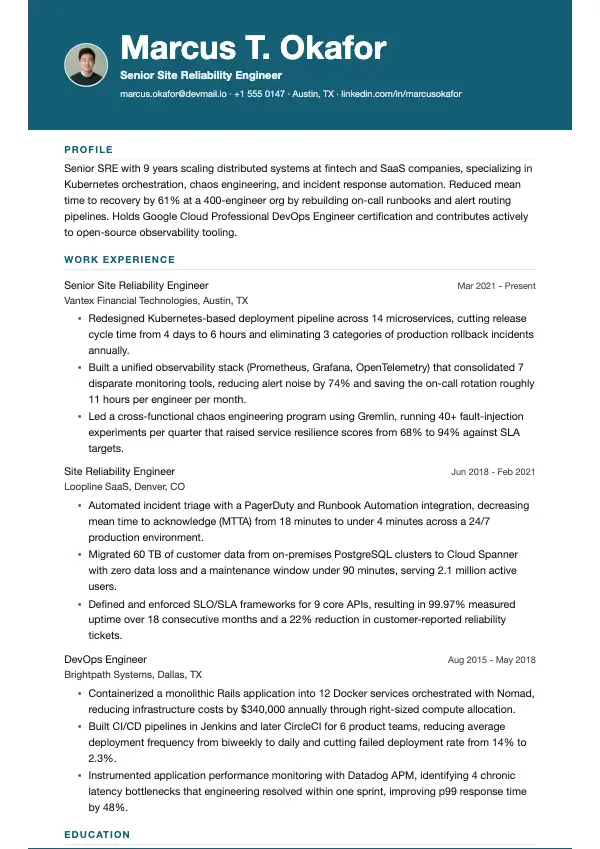
An SRE resume must prove reliability ownership with hard numbers, surface the right infrastructure keywords for automated screening, and show progression from firefighting to proactive system design — this example does all three.
Template: Aurora
Read this resume as text
Marcus T. Okafor
Senior Site Reliability Engineer
marcus.okafor@devmail.io · +1 555 0147 · Austin, TX · linkedin.com/in/marcusokafor
- Profile
- Senior SRE with 9 years scaling distributed systems at fintech and SaaS companies, specializing in Kubernetes orchestration, chaos engineering, and incident response automation. Reduced mean time to recovery by 61% at a 400-engineer org by rebuilding on-call runbooks and alert routing pipelines. Holds Google Cloud Professional DevOps Engineer certification and contributes actively to open-source observability tooling.
- Work Experience
Senior Site Reliability Engineer
Vantex Financial Technologies, Austin, TX · Mar 2021 - Present
- Redesigned Kubernetes-based deployment pipeline across 14 microservices, cutting release cycle time from 4 days to 6 hours and eliminating 3 categories of production rollback incidents annually.
- Built a unified observability stack (Prometheus, Grafana, OpenTelemetry) that consolidated 7 disparate monitoring tools, reducing alert noise by 74% and saving the on-call rotation roughly 11 hours per engineer per month.
- Led a cross-functional chaos engineering program using Gremlin, running 40+ fault-injection experiments per quarter that raised service resilience scores from 68% to 94% against SLA targets.
Site Reliability Engineer
Loopline SaaS, Denver, CO · Jun 2018 - Feb 2021
- Automated incident triage with a PagerDuty and Runbook Automation integration, decreasing mean time to acknowledge (MTTA) from 18 minutes to under 4 minutes across a 24/7 production environment.
- Migrated 60 TB of customer data from on-premises PostgreSQL clusters to Cloud Spanner with zero data loss and a maintenance window under 90 minutes, serving 2.1 million active users.
- Defined and enforced SLO/SLA frameworks for 9 core APIs, resulting in 99.97% measured uptime over 18 consecutive months and a 22% reduction in customer-reported reliability tickets.
DevOps Engineer
Brightpath Systems, Dallas, TX · Aug 2015 - May 2018
- Containerized a monolithic Rails application into 12 Docker services orchestrated with Nomad, reducing infrastructure costs by $340,000 annually through right-sized compute allocation.
- Built CI/CD pipelines in Jenkins and later CircleCI for 6 product teams, reducing average deployment frequency from biweekly to daily and cutting failed deployment rate from 14% to 2.3%.
- Instrumented application performance monitoring with Datadog APM, identifying 4 chronic latency bottlenecks that engineering resolved within one sprint, improving p99 response time by 48%.
- Education
B.S. Computer Science
University of Texas at Arlington, Arlington, TX · 2011 - 2015
Concentration in Distributed Systems; Dean's List 3 semesters
- Skills
- Kubernetes & Helm · Terraform (IaC) · Prometheus / Grafana / OpenTelemetry · Google Cloud Platform (GCP) · Python & Bash scripting · Chaos Engineering (Gremlin, LitmusChaos) · SLO/SLI/Error Budget design · PostgreSQL & Cloud Spanner · Google Cloud Professional DevOps Engineer (certified 2022)
- Links
- LinkedIn: linkedin.com/in/marcusokafor · GitHub: github.com/mtokafor-sre · Portfolio: marcusokafor.dev
What makes this resume work
- Every bullet opens with a strong action verb and closes with a specific metric — percentages, dollar figures, or time savings — so hiring managers can immediately gauge business impact rather than inferring it.
- Skills are listed as discrete, searchable tool names (e.g., 'Prometheus / Grafana / OpenTelemetry' rather than 'monitoring') so ATS parsers match recruiter queries without ambiguity.
- The career arc is deliberate: DevOps Engineer → SRE → Senior SRE signals intentional specialization, which resonates with engineering hiring managers who distrust résumés that jump laterally without growth.
- The summary leads with seniority and years, names two high-value specialisms (chaos engineering, incident automation), and anchors credibility with a certification — giving a recruiter everything they need at a glance.
Keywords that help you pass the ATS
Work the ones that fit your experience into your resume, naturally, not stuffed.
How to write a Site Reliability Engineer resume
Choose the right format for a Site Reliability Engineer resume
Use a reverse-chronological format. SRE hiring managers want to see your most recent production environment experience first, because tooling and scale evolve fast and a role from 2018 carries less weight than what you shipped last quarter.
Keep it to one page if you have under ten years of experience, two pages maximum if you have more. Use clean section headers, consistent font sizing, and no tables or text boxes — applicant tracking systems used by Amazon, Google, and mid-size SaaS companies regularly misparse those layouts and drop your keywords.
- Set margins between 0.5 and 1 inch; anything tighter looks desperate, anything wider wastes space
- Use a single-column layout or a simple two-column with a narrow sidebar for skills only
- Save as PDF unless the job posting explicitly requests a .docx file
- Name your file: LastName_FirstName_SRE_Resume.pdf
Write a professional summary that frames your SRE specialty
Your summary sits directly under your name and contact info. It should name your years of experience, the scale you've operated at (number of services, requests per second, uptime targets), and one or two technical differentiators. Recruiters spend about seven seconds on an initial scan (Ladders eye-tracking study, 2018) — give them a reason to keep reading.
Example: "Site Reliability Engineer with 7 years of experience maintaining 99.99% availability across distributed microservices handling 500K+ RPS on AWS. Deep expertise in Kubernetes, Terraform, and observability pipelines using Prometheus and Grafana. Led incident response programs that reduced MTTR by 42% and eliminated two Sev-1 outages per quarter on average."
Write work-experience bullets that prove impact with numbers
Each bullet should follow an action-verb → technical context → measurable outcome structure. Avoid vague statements like 'improved system reliability' — every SRE candidate writes that. Quantify error budgets, on-call load, deployment frequency, cost savings, or latency improvements. If your company treated SLO data as confidential, use percentages or relative comparisons instead of absolutes.
Two example bullets you can adapt:
- Redesigned CI/CD pipelines in Jenkins and ArgoCD, cutting average deployment time from 47 minutes to 11 minutes and increasing release frequency from bi-weekly to daily across 14 microservices.
- Built a centralized alerting framework using PagerDuty and Prometheus alertmanager that reduced false-positive pages by 63%, dropping weekly on-call interruptions from 28 to 10 per engineer.
List the skills and certifications recruiters and ATS systems look for
SRE job descriptions are dense with tool names, and ATS systems keyword-match aggressively. Create a dedicated Skills section and mirror the exact terminology in the posting — 'GKE' and 'Google Kubernetes Engine' are not always treated as equivalent. Group skills by category: cloud platforms, container orchestration, observability, IaC, scripting, and incident management.
Certifications carry real weight in SRE hiring, especially at companies that list them as requirements or search applicants by them. List the full certification name, issuing body, and year obtained.
- Cloud: AWS (CCP, SAA, DevOps Professional), GCP (Associate Cloud Engineer, Professional DevOps Engineer), Azure (AZ-104, AZ-400)
- Container/orchestration: Kubernetes (CKA, CKAD, CKS), Docker, Helm, Istio
- Observability: Prometheus, Grafana, Datadog, New Relic, OpenTelemetry, ELK Stack
- IaC & config management: Terraform, Pulumi, Ansible, Chef
- Languages: Python, Go, Bash — list only what you can be interviewed on immediately
Education, licenses, and extras that round out the picture
A bachelor's degree in Computer Science, Computer Engineering, or a related field is the baseline expectation at most companies, but it is rarely a hard filter if your experience section is strong. List your degree, institution, and graduation year — no GPA unless you graduated within the last two years and it is above 3.5.
Add an 'Additional' or 'Projects' section only if the content is genuinely relevant: an open-source project with GitHub stars, a conference talk at SREcon or KubeCon, or a published postmortem that demonstrates your incident analysis thinking. These signal community engagement and depth that a job history alone cannot convey.
- Include Google's SRE certification or LinkedIn Learning SRE paths only if you lack cloud-provider credentials
- List publications, postmortems, or internal runbooks you authored if they are publicly accessible
- Omit hobbies unless they directly demonstrate a relevant technical skill
Mistakes to avoid
- Listing every tool you have ever touched instead of the subset you can defend under interview pressure makes your skills section look padded and undermines trust.
- Writing SLO and SLA targets without context — '99.9% uptime' means nothing without stating the traffic volume, system complexity, or how you achieved it.
- Using infrastructure team or DevOps job titles without clarifying SRE-specific responsibilities like error budget management, toil reduction, or capacity planning, which leaves recruiters guessing about your actual scope.
- Omitting on-call metrics such as alert volume, MTTR, or incident frequency, which are the clearest signals of real SRE experience and are almost always missing from weak resumes.
Frequently asked questions
- Should a Site Reliability Engineer resume look different from a DevOps engineer resume?
- Yes, even though the tools overlap heavily. An SRE resume should emphasize SLOs, error budgets, toil reduction, and blameless postmortem culture — concepts rooted in Google's SRE model. If your resume reads identically to a DevOps resume, you are not differentiating yourself for roles at companies that treat SRE as a distinct discipline with a specific operational philosophy.
- How many certifications should I list on an SRE resume?
- List every current, relevant certification, but prioritize cloud-provider and Kubernetes credentials because those appear most frequently in SRE job requirements. Do not list expired certifications or entry-level credentials like AWS Cloud Practitioner if you also hold the Solutions Architect Associate or higher — it dilutes the signal.
- Is it worth including a GitHub profile link on an SRE resume?
- Yes, if your repositories demonstrate relevant work — Terraform modules, Kubernetes operators, custom exporters, or chaos engineering scripts with meaningful commit history. A sparse or inactive GitHub profile adds nothing and can actually raise questions, so only link it if the content supports your resume claims.
Make it yours in minutes
Open this example in the builder, swap in your details, and export a clean, ATS-ready resume.
Once your resume is ready
More for this application
- Template style
- Software Engineer resume templates