Resume example
Security Engineer resume example
By the Resumade team · About our content
A Security Engineer resume must satisfy both automated keyword filters and a hiring manager who reads for evidence of real threat impact. This example leads with quantified results, surfaces certifications early, and maps every bullet to a business outcome.
Template: Journal
Read this resume as text
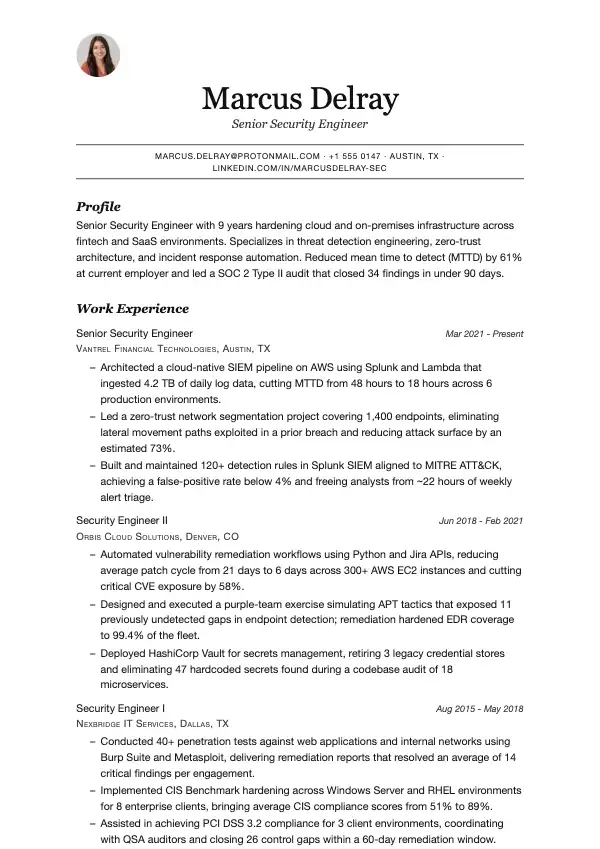
Marcus Delray
Senior Security Engineer
marcus.delray@protonmail.com · +1 555 0147 · Austin, TX · linkedin.com/in/marcusdelray-sec
- Profile
- Senior Security Engineer with 9 years hardening cloud and on-premises infrastructure across fintech and SaaS environments. Specializes in threat detection engineering, zero-trust architecture, and incident response automation. Reduced mean time to detect (MTTD) by 61% at current employer and led a SOC 2 Type II audit that closed 34 findings in under 90 days.
- Work Experience
Senior Security Engineer
Vantrel Financial Technologies, Austin, TX · Mar 2021 - Present
- Architected a cloud-native SIEM pipeline on AWS using Splunk and Lambda that ingested 4.2 TB of daily log data, cutting MTTD from 48 hours to 18 hours across 6 production environments.
- Led a zero-trust network segmentation project covering 1,400 endpoints, eliminating lateral movement paths exploited in a prior breach and reducing attack surface by an estimated 73%.
- Built and maintained 120+ detection rules in Splunk SIEM aligned to MITRE ATT&CK, achieving a false-positive rate below 4% and freeing analysts from ~22 hours of weekly alert triage.
Security Engineer II
Orbis Cloud Solutions, Denver, CO · Jun 2018 - Feb 2021
- Automated vulnerability remediation workflows using Python and Jira APIs, reducing average patch cycle from 21 days to 6 days across 300+ AWS EC2 instances and cutting critical CVE exposure by 58%.
- Designed and executed a purple-team exercise simulating APT tactics that exposed 11 previously undetected gaps in endpoint detection; remediation hardened EDR coverage to 99.4% of the fleet.
- Deployed HashiCorp Vault for secrets management, retiring 3 legacy credential stores and eliminating 47 hardcoded secrets found during a codebase audit of 18 microservices.
Security Engineer I
Nexbridge IT Services, Dallas, TX · Aug 2015 - May 2018
- Conducted 40+ penetration tests against web applications and internal networks using Burp Suite and Metasploit, delivering remediation reports that resolved an average of 14 critical findings per engagement.
- Implemented CIS Benchmark hardening across Windows Server and RHEL environments for 8 enterprise clients, bringing average CIS compliance scores from 51% to 89%.
- Assisted in achieving PCI DSS 3.2 compliance for 3 client environments, coordinating with QSA auditors and closing 26 control gaps within a 60-day remediation window.
- Education
B.S. Computer Science, Cybersecurity Concentration
University of Texas at Dallas, Richardson, TX · 2011 - 2015
Dean's List 2013–2015; Senior capstone: network intrusion detection using ML classifiers
- Skills
- CISSP (Certified, 2020) · Splunk SIEM & SPL · AWS Security (GuardDuty, Security Hub, IAM) · MITRE ATT&CK Framework · Penetration Testing (Burp Suite, Metasploit) · Python scripting for security automation · Zero-Trust Architecture · Vulnerability Management (Tenable Nessus, Qualys) · Incident Response & Digital Forensics
- Links
- LinkedIn: linkedin.com/in/marcusdelray-sec · GitHub: github.com/mdelray-sec · Certification: CISSP, 2020 (verifiable via ISC2)
What makes this resume work
- The summary names seniority, years, two domain specialisms, and two concrete results in three sentences — giving a recruiter everything they need to shortlist at a glance.
- Each bullet opens with a strong action verb and closes with a specific metric (%, days, count), so hiring managers can immediately gauge scope and impact rather than inferring it from vague task descriptions.
- The skills section front-loads the CISSP certification and names actual tools (Splunk, Nessus, Burp Suite) rather than broad categories, matching the exact strings security recruiters enter into ATS keyword searches.
- The progression from Engineer I through Senior Engineer II tells a coherent growth story — expanding from execution (pen tests, hardening) to architecture (zero-trust design, SIEM pipeline) — which validates the senior title without requiring a cover letter to explain it.
Keywords that help you pass the ATS
Work the ones that fit your experience into your resume, naturally, not stuffed.
How to write a Security Engineer resume
Choose the right format for a Security Engineer resume
Use a reverse-chronological format. Security hiring managers and recruiters at companies like Palo Alto Networks, CrowdStrike, or in-house enterprise teams want to see your most recent hands-on experience first — they are not interested in functional formats that bury your timeline. Keep the resume to one page if you have under ten years of experience; two pages is acceptable beyond that.
Stick to clean, single-column layouts with clear section headers. ATS platforms used heavily in security hiring — Workday, Greenhouse, Lever — parse poorly formatted tables and text boxes, so avoid them. Use 10–12pt font, consistent date formatting (Month YYYY), and at least half-inch margins.
- Sections in order: Contact Info → Summary → Work Experience → Skills & Certifications → Education
- Save and submit as a PDF unless the job posting explicitly requests a .docx
- Use standard section labels — 'Work Experience' not 'Where I've Been' — for ATS compatibility
- No photos, no headshots, no QR codes
Write a professional summary that passes the first scan
Your summary should be three to four sentences that tell a hiring manager your specialty, your tool depth, and a concrete outcome — in that order. Generic phrases like 'results-driven professional' waste the only lines a recruiter reads before deciding whether to continue. Name the domain you operate in: cloud security, AppSec, network security, detection engineering, or GRC.
Example: "Security Engineer with 7 years securing cloud-native environments on AWS and GCP, specializing in SIEM tuning, threat detection, and vulnerability management. Built and maintained Splunk-based detection pipelines that reduced mean time to detect (MTTD) from 48 hours to under 4 hours at a 2,000-seat SaaS company. CISSP and AWS Security Specialty certified. Comfortable leading tabletop exercises and translating technical risk for non-technical stakeholders."
Write work-experience bullets that show impact, not just duties
Every bullet should follow an action verb → tool or method → measurable result structure. Security engineers often undersell themselves by listing responsibilities instead of outcomes. Quantify wherever possible: reduction in alert fatigue, vulnerabilities remediated, coverage percentage, time saved, incidents contained. If exact numbers are confidential, use ranges or percentages.
Avoid bullets like 'Responsible for monitoring SIEM.' That tells a recruiter nothing about your skill level or your impact. The two examples below show the difference.
- Engineered 140+ custom Splunk detection rules mapped to MITRE ATT&CK, increasing true-positive alert rate by 38% and cutting analyst triage time by 6 hours per week.
- Led remediation of 1,200+ critical and high CVEs across a hybrid AWS/on-prem environment using Tenable.io, reducing the organization's critical vulnerability backlog by 74% in one quarter.
List the skills and certifications recruiters and ATS actually search for
Security job descriptions are keyword-dense. Your skills section needs to reflect the actual tools and frameworks you use, not a wishlist. Group them logically: SIEM & Detection, Cloud Security, Vulnerability Management, Endpoint, Frameworks, and Scripting. Certifications deserve their own subsection — spell them out fully and include the issuing body so ATS can match both the abbreviation and the full name.
Prioritize certifications that appear repeatedly in job postings for your target roles. For cloud-focused roles, AWS Security Specialty and Google Professional Cloud Security Engineer matter. For broader enterprise roles, CISSP and CISM carry weight. CompTIA Security+ is a baseline many federal contractors require.
- SIEM & Detection: Splunk (SPL), Microsoft Sentinel, Elastic SIEM, IBM QRadar
- Cloud Security: AWS Security Hub, GuardDuty, GCP Security Command Center, Azure Defender
- Vulnerability Management: Tenable.io, Qualys, Rapid7 InsightVM
- Endpoint & Network: CrowdStrike Falcon, SentinelOne, Palo Alto Cortex XDR, Wireshark, Zeek
- Frameworks & Standards: MITRE ATT&CK, NIST CSF, CIS Controls, SOC 2, ISO 27001
- Scripting: Python, Bash, PowerShell
Education, licenses, and extras that strengthen your candidacy
List your highest degree, the institution, and graduation year. A bachelor's in Computer Science, Information Systems, or Cybersecurity is the most common baseline, but many working security engineers hold degrees in unrelated fields — that is fine as long as your certifications and experience compensate. Do not list your GPA unless you graduated within the last two years and it is above 3.5.
Add a separate line for active certifications with their expiration or renewal dates where relevant. Include any clearances — Secret, Top Secret, TS/SCI — prominently, since cleared candidates are actively recruited. Bug bounty participation (HackerOne, Bugcrowd), CTF placements, published CVEs, or open-source security tooling contributions belong in a brief 'Additional' section at the bottom and can differentiate you from candidates with identical credentials.
- List clearance level and status (Active, Inactive, Eligible) near the top of the resume if the role requires it
- Include certification full names: 'Certified Information Systems Security Professional (CISSP) — ISC2'
- Link to a GitHub profile only if it contains public, relevant security projects
Mistakes to avoid
- Listing every tool you have ever touched instead of emphasizing the five to eight you use at a professional level makes your skills section look inflated and unconvincing to technical reviewers.
- Writing bullets that describe job duties — 'monitored firewall logs,' 'assisted with incident response' — rather than outcomes gives hiring managers no way to gauge your seniority or impact.
- Omitting your active security clearance or letting it appear only in a cover letter costs you interviews, since many defense and federal applications ask about clearance status up front, and recruiters screen on it first.
- Using a functional or skills-first resume format to hide employment gaps raises immediate red flags in security hiring, where verifiable work history and background checks are standard.
Frequently asked questions
- Should a Security Engineer resume include a GitHub or portfolio link?
- Yes, but only if the repository contains substantive, public-facing security work — custom detection rules, scripts, CTF write-ups, or tool contributions. A sparse or unrelated GitHub does more harm than good. Place the link in your contact header and make sure every pinned project has a clear README.
- How do I write a Security Engineer resume if I am transitioning from IT or a help desk role?
- Lead with a summary that names your target specialization and highlights transferable skills like network troubleshooting, patch management, or incident triage. Stack certifications — Security+, CEH, or AWS Security Specialty — to compensate for the lack of a dedicated security title. Include any security-adjacent tasks from your current role, even if they were informal, and quantify them.
- How long should a Security Engineer resume be?
- One page for fewer than ten years of experience; two pages for senior or principal-level engineers with extensive project histories. Never go to three pages — cut older or less relevant roles to a single line or remove them entirely. Recruiters spend about seven seconds on an initial screen (Ladders eye-tracking study, 2018), so density and relevance matter more than comprehensiveness.
Make it yours in minutes
Open this example in the builder, swap in your details, and export a clean, ATS-ready resume.
Once your resume is ready
More for this application
- Template style
- Software Engineer resume templates