Resume example
Editor resume example
By the Resumade team · About our content
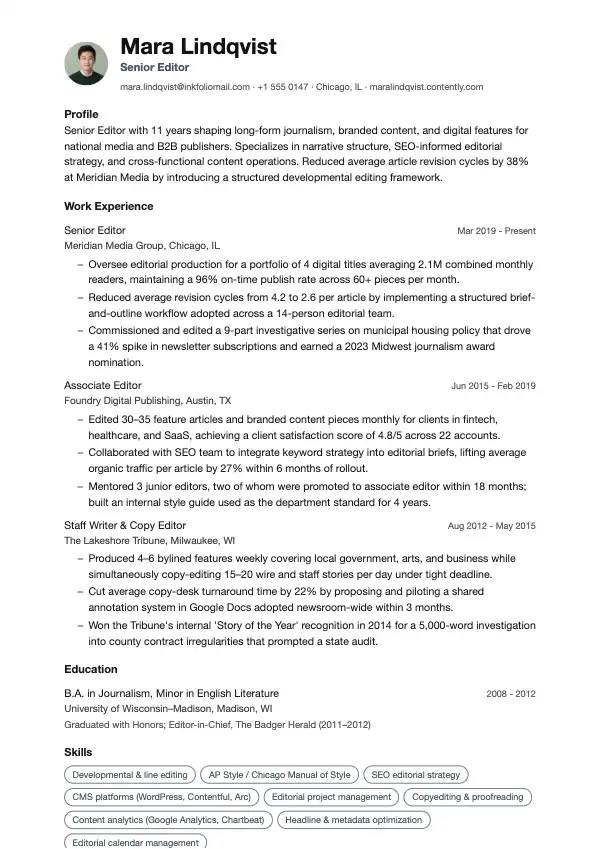
Editors are hired on taste, throughput, and measurable impact rather than a list of publications, so this example opens with a quantified summary. Action-verb bullets tie each role to real outcomes, and terms like 'editorial strategy' and 'SEO' appear without keyword stuffing.
Template: Minimal
Read this resume as text
Mara Lindqvist
Senior Editor
mara.lindqvist@inkfoliomail.com · +1 555 0147 · Chicago, IL · maralindqvist.contently.com
- Profile
- Senior Editor with 11 years shaping long-form journalism, branded content, and digital features for national media and B2B publishers. Specializes in narrative structure, SEO-informed editorial strategy, and cross-functional content operations. Reduced average article revision cycles by 38% at Meridian Media by introducing a structured developmental editing framework.
- Work Experience
Senior Editor
Meridian Media Group, Chicago, IL · Mar 2019 - Present
- Oversee editorial production for a portfolio of 4 digital titles averaging 2.1M combined monthly readers, maintaining a 96% on-time publish rate across 60+ pieces per month.
- Reduced average revision cycles from 4.2 to 2.6 per article by implementing a structured brief-and-outline workflow adopted across a 14-person editorial team.
- Commissioned and edited a 9-part investigative series on municipal housing policy that drove a 41% spike in newsletter subscriptions and earned a 2023 Midwest journalism award nomination.
Associate Editor
Foundry Digital Publishing, Austin, TX · Jun 2015 - Feb 2019
- Edited 30–35 feature articles and branded content pieces monthly for clients in fintech, healthcare, and SaaS, achieving a client satisfaction score of 4.8/5 across 22 accounts.
- Collaborated with SEO team to integrate keyword strategy into editorial briefs, lifting average organic traffic per article by 27% within 6 months of rollout.
- Mentored 3 junior editors, two of whom were promoted to associate editor within 18 months; built an internal style guide used as the department standard for 4 years.
Staff Writer & Copy Editor
The Lakeshore Tribune, Milwaukee, WI · Aug 2012 - May 2015
- Produced 4–6 bylined features weekly covering local government, arts, and business while simultaneously copy-editing 15–20 wire and staff stories per day under tight deadline.
- Cut average copy-desk turnaround time by 22% by proposing and piloting a shared annotation system in Google Docs adopted newsroom-wide within 3 months.
- Won the Tribune's internal 'Story of the Year' recognition in 2014 for a 5,000-word investigation into county contract irregularities that prompted a state audit.
- Education
B.A. in Journalism, Minor in English Literature
University of Wisconsin–Madison, Madison, WI · 2008 - 2012
Graduated with Honors; Editor-in-Chief, The Badger Herald (2011–2012)
- Skills
- Developmental & line editing · AP Style / Chicago Manual of Style · SEO editorial strategy · CMS platforms (WordPress, Contentful, Arc) · Editorial project management · Copyediting & proofreading · Content analytics (Google Analytics, Chartbeat) · Headline & metadata optimization · Editorial calendar management
- Links
- Portfolio: maralindqvist.contently.com · LinkedIn: linkedin.com/in/maralindqvist
What makes this resume work
- The summary names seniority, years of experience, and a specific headline result (38% fewer revision cycles) in three tight sentences — giving a hiring manager a reason to keep reading before reaching the first job entry.
- Every bullet opens with a strong action verb (Oversee, Commissioned, Edited) and closes with a number — reader counts, client scores, traffic lifts — making impact concrete and comparable across candidates.
- Skills are listed as discrete, searchable phrases (e.g., 'CMS platforms (WordPress, Contentful, Arc)') rather than vague categories, which satisfies both ATS keyword matching and a human reviewer's need for tool-level specificity.
- The education note about serving as Editor-in-Chief of a college paper is a single line that signals leadership and editorial credibility without padding a section that should stay brief for a mid-to-senior candidate.
Keywords that help you pass the ATS
Work the ones that fit your experience into your resume, naturally, not stuffed.
How to write an Editor resume
Choose the right format for an Editor resume
Most editors do best with a reverse-chronological format. Hiring managers at publishers, media companies, and content agencies want to see your most recent work first, because editorial standards and tools change fast — a five-year-old role at a print magazine tells them less than your last six months managing a CMS-driven digital publication.
Keep the document to one page if you have fewer than ten years of experience; two pages are acceptable for senior or managing editors with a deep portfolio. Use clean, readable typography — Georgia or Calibri at 10–12pt — and leave enough white space that a busy editor-in-chief can skim it quickly. Avoid tables and text boxes; many applicant tracking systems (ATS) used by Condé Nast, Hearst, and large content agencies still misread them.
- Reverse-chronological order for most candidates
- One page under ten years; two pages for senior roles
- Standard fonts only — no decorative headers
- No tables or text boxes that break ATS parsing
Write a professional summary that sells your editorial voice
Your summary sits at the top and does one job: tell the hiring manager what kind of editor you are and what you deliver. Skip objectives and generic phrases like 'detail-oriented professional.' Name the content type you specialize in, your years of experience, and one concrete result.
Here is a strong example for a digital editor applying to a mid-size media brand: "Digital editor with eight years of experience shaping long-form features, news briefs, and SEO-driven content for B2C audiences. Managed a team of twelve freelancers at a health and wellness publication, cutting average time-to-publish by 22% while maintaining a sub-1% error rate across 400+ articles per quarter. Proficient in WordPress, Asana, and AP Style."
Write work-experience bullets that show impact, not just duties
Every bullet should answer the question: so what? Editors often undersell themselves by listing responsibilities instead of outcomes. Quantify wherever possible — volume of content, team size, traffic lift, error reduction, turnaround time. Use strong action verbs: edited, commissioned, restructured, streamlined, mentored, negotiated.
Tie your bullets to the publication's goals — page views, subscriber growth, brand consistency, or production efficiency — because those are the metrics your future employer cares about.
- Edited and published 25–30 articles per week across three verticals, increasing organic search traffic by 34% year-over-year through consistent SEO best practices and strategic keyword integration.
- Restructured the copy-editing workflow for a 10-person team by implementing a shared style guide in Notion, reducing revision cycles from an average of 3.2 rounds to 1.7 and saving roughly 15 hours of editorial labor per week.
Skills and certifications recruiters and ATS look for
Build a dedicated skills section and mirror the exact language from the job posting wherever it's accurate. ATS at large media companies filter on specific tool names and style guides. Include both hard skills and the editorial specializations that set you apart.
Certifications matter less in editorial than in some fields, but a few carry real weight: ACES (American Copy Editors Society) certification signals professional-grade copy-editing knowledge, and Google Analytics Individual Qualification (GAIQ) shows you can tie content decisions to data. HubSpot Content Marketing Certification is useful for roles at content agencies or in-house brand teams.
- Style guides: AP Style, Chicago Manual of Style, APA, house style development
- CMS platforms: WordPress, Drupal, Contentful, HubSpot CMS
- Project management: Asana, Trello, Notion, Airtable
- SEO tools: SEMrush, Ahrefs, Google Search Console, Clearscope
- Certifications: ACES Copy Editing Certification, GAIQ, HubSpot Content Marketing
Education, licenses, and extras
A bachelor's degree in English, journalism, communications, or a related field is the standard baseline, though many working editors hold degrees in the subject area they cover — science editors often have STEM backgrounds, legal editors may have paralegal training. List your degree, institution, and graduation year. Omit GPA unless you graduated in the last three years and it is above 3.5.
Add a portfolio link directly in your contact header — this is non-negotiable for editorial roles. Hiring managers will check it before they call you. If you have relevant extras like a journalism fellowship, membership in ACES or EFA (Editorial Freelancers Association), or language fluency, list them at the bottom. Published clips or a Muck Rack profile URL are also worth including.
- Link your portfolio or Muck Rack profile in the header
- Note ACES or EFA membership if applicable
- Include language fluency for roles at international or multilingual outlets
Mistakes to avoid
- Listing style guides you know passively rather than the ones you actively enforce — recruiters will test you on AP or Chicago in interviews, so only claim what you can defend.
- Omitting content volume and output metrics, which leaves hiring managers with no way to gauge whether you can handle the pace of their publication.
- Using a creative or heavily designed resume template that breaks ATS parsing at larger media companies and content agencies.
- Forgetting to include a portfolio link or listing one that leads to an outdated or password-protected page, which is the fastest way to get passed over.
Frequently asked questions
- Do editors need a portfolio separate from their resume?
- Yes — almost every editorial job posting expects one. Include a direct URL to a personal site, Contently profile, or Muck Rack page in your resume header. A resume without clips is a significant disadvantage because editors are evaluated on the quality of published work, not just credentials.
- How do I show editing experience if most of my work is uncredited?
- Focus on outcomes you can verify — traffic growth, publication volume, error-rate reduction, team size managed — rather than bylines. You can also note the publication name and your role without claiming authorship. If you have permission from a former employer, include before-and-after editing samples in your portfolio.
- Is it worth getting ACES certification as an editor?
- It depends on the role. For copy-editing positions at newspapers, academic publishers, or legal content firms, ACES certification is a genuine differentiator and signals rigorous standards. For digital content or managing-editor roles focused on strategy and SEO, it carries less weight than demonstrated traffic results and CMS proficiency.
Make it yours in minutes
Open this example in the builder, swap in your details, and export a clean, ATS-ready resume.
Once your resume is ready
More for this application
- Template style
- Serif resume templates