Resume example
Elementary Teacher resume example
By the Resumade team · About our content
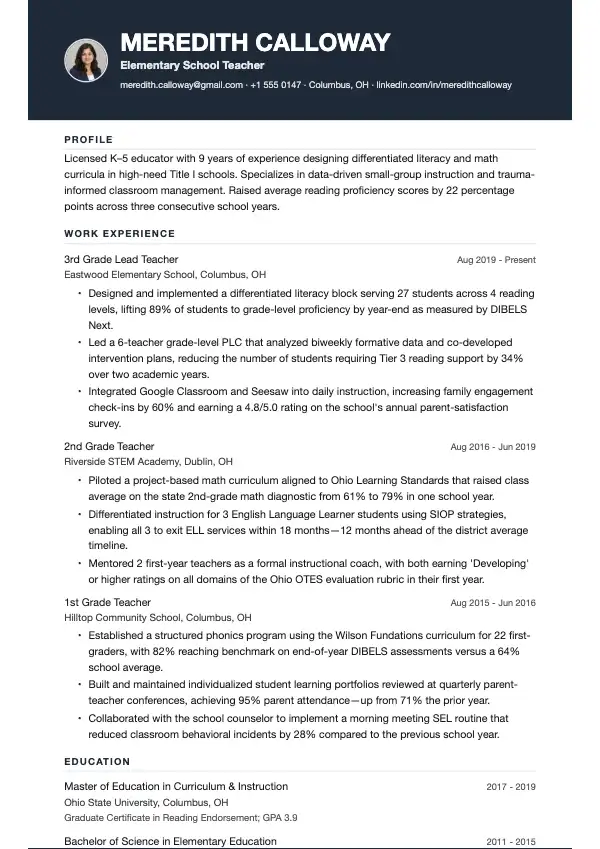
An elementary teacher resume must clear district ATS filters loaded with standards and certification terms while showing a hiring principal exactly how you move student achievement data. This example does both through license-forward skills and bullet-level proof points.
Template: Vermilion
Read this resume as text
Meredith Calloway
Elementary School Teacher
meredith.calloway@gmail.com · +1 555 0147 · Columbus, OH · linkedin.com/in/meredithcalloway
- Profile
- Licensed K–5 educator with 9 years of experience designing differentiated literacy and math curricula in high-need Title I schools. Specializes in data-driven small-group instruction and trauma-informed classroom management. Raised average reading proficiency scores by 22 percentage points across three consecutive school years.
- Work Experience
3rd Grade Lead Teacher
Eastwood Elementary School, Columbus, OH · Aug 2019 - Present
- Designed and implemented a differentiated literacy block serving 27 students across 4 reading levels, lifting 89% of students to grade-level proficiency by year-end as measured by DIBELS Next.
- Led a 6-teacher grade-level PLC that analyzed biweekly formative data and co-developed intervention plans, reducing the number of students requiring Tier 3 reading support by 34% over two academic years.
- Integrated Google Classroom and Seesaw into daily instruction, increasing family engagement check-ins by 60% and earning a 4.8/5.0 rating on the school's annual parent-satisfaction survey.
2nd Grade Teacher
Riverside STEM Academy, Dublin, OH · Aug 2016 - Jun 2019
- Piloted a project-based math curriculum aligned to Ohio Learning Standards that raised class average on the state 2nd-grade math diagnostic from 61% to 79% in one school year.
- Differentiated instruction for 3 English Language Learner students using SIOP strategies, enabling all 3 to exit ELL services within 18 months—12 months ahead of the district average timeline.
- Mentored 2 first-year teachers as a formal instructional coach, with both earning 'Developing' or higher ratings on all domains of the Ohio OTES evaluation rubric in their first year.
1st Grade Teacher
Hilltop Community School, Columbus, OH · Aug 2015 - Jun 2016
- Established a structured phonics program using the Wilson Fundations curriculum for 22 first-graders, with 82% reaching benchmark on end-of-year DIBELS assessments versus a 64% school average.
- Built and maintained individualized student learning portfolios reviewed at quarterly parent-teacher conferences, achieving 95% parent attendance—up from 71% the prior year.
- Collaborated with the school counselor to implement a morning meeting SEL routine that reduced classroom behavioral incidents by 28% compared to the previous school year.
- Education
Master of Education in Curriculum & Instruction
Ohio State University, Columbus, OH · 2017 - 2019
Graduate Certificate in Reading Endorsement; GPA 3.9
Bachelor of Science in Elementary Education
Ohio University, Athens, OH · 2011 - 2015
Dean's List 6 semesters; Student Teaching Placement at Title I school
- Skills
- Ohio Teaching License (K–5, Reading Endorsement) · Differentiated Instruction · DIBELS Next & Progress Monitoring · Google Classroom & Seesaw · Wilson Fundations Phonics · SIOP Framework for ELL Instruction · Trauma-Informed Teaching Practices · IEP Collaboration & Accommodations · Data-Driven Small-Group Instruction
- Links
- LinkedIn: linkedin.com/in/meredithcalloway · Portfolio: meredithcalloway.weebly.com
What makes this resume work
- Every experience bullet closes with a specific number—percentages, student counts, or survey scores—so hiring managers can immediately gauge classroom impact rather than infer it from vague descriptors.
- The skills section leads with the Ohio Teaching License and Reading Endorsement, terms district HR staff commonly search for in their applicant-tracking systems, so the resume matches those searches word for word.
- The summary names the school context (Title I, high-need) up front, signaling cultural fit and realistic experience to principals who need teachers prepared for challenging environments—not just idealized classrooms.
- Mentorship and PLC leadership woven into mid-career bullets demonstrate readiness for a lead-teacher or instructional-coach trajectory without requiring a separate leadership section that could bloat the one-page format.
Keywords that help you pass the ATS
Work the ones that fit your experience into your resume, naturally, not stuffed.
How to write an Elementary Teacher resume
Choose the right format for an Elementary Teacher resume
Use a reverse-chronological format. School districts and HR departments are traditional hiring environments — they expect to see your most recent classroom experience at the top, not a functional or hybrid layout that buries your teaching history. Keep your resume to one page if you have fewer than eight years of experience; two pages are acceptable for veteran teachers with extensive professional development or committee work.
Set margins to 0.75–1 inch, use a clean font like Calibri or Georgia at 10.5–12pt, and organize content into clear sections. Applicant tracking systems used by large districts — including Frontline Education (formerly AppliTrack), which many US districts rely on — parse plain text more reliably than tables or text boxes, so avoid those entirely.
- Stick to reverse-chronological order for all experience sections
- Use Frontline Education-compatible formatting: no tables, no headers/footers with key info
- One page for early-career teachers; two pages maximum for veterans
- Save and submit as a PDF unless the district portal specifies .docx
Write a professional summary that gets you past the first cut
Your summary sits at the top and gives a hiring principal three to four sentences on who you are, what grade band and subject areas you cover, and what makes you effective. Skip the generic 'passionate educator' opener — lead with your certification, grade level, and a concrete result instead.
Here is an example that works: "Ohio-licensed Elementary Teacher with seven years of experience in Title I schools serving diverse learners in grades 2–4. Consistently moved 80% or more of struggling readers to grade-level proficiency within one academic year using structured literacy and Fountas & Pinnell benchmark assessments. Skilled in differentiated instruction, IEP collaboration, and Google Classroom. Seeking a third-grade position where data-driven instruction and strong family communication are priorities."
Write work-experience bullets that show measurable impact
Every bullet should answer 'so what?' Lead with an action verb, name the tool or strategy you used, and attach a number wherever you can — class size, assessment scores, attendance rates, or the number of students served. Principals review dozens of applications; vague bullets like 'taught reading' get skipped.
Quantify behavior management wins, parent communication volume, and co-teaching outcomes just as readily as test score gains. If your school used PBIS, mention your tier and the outcome. If you ran a small-group intervention using iReady or Lexia Core5, say how many students and what the growth data showed.
- Delivered Tier 2 reading intervention to 12 second-graders using Lexia Core5; 9 of 12 students met or exceeded grade-level benchmarks on the spring iReady diagnostic, a 25-point average growth gain.
- Managed a 28-student inclusive classroom alongside a special education co-teacher, maintaining a 94% on-task rate during instruction as measured by weekly PBIS fidelity checks and reducing office referrals by 40% year over year.
Skills and certifications recruiters and ATS systems look for
Districts sort applicants by license type and endorsements, often using questions on the application itself. List your state teaching license with its exact endorsement wording (e.g., 'Texas EC–6 Generalist'), any ESL or Bilingual endorsement, and your ESOL or SPED certifications if applicable. Include CPR/First Aid certification if you hold it — some districts ask for it.
In your skills section, name specific platforms and curricula rather than broad categories. 'Technology' means nothing; 'Google Workspace for Education, Seesaw, ClassDojo, and Smartboard' is scannable and searchable.
- State elementary teaching license with exact grade-band endorsement
- Reading training: Orton-Gillingham, Wilson Reading, or structured literacy training
- Assessment platforms: iReady, Fountas & Pinnell Benchmark Assessment System, DIBELS Next
- Curriculum knowledge: Eureka Math, Wonders ELA, STEMscopes
- ESL, Bilingual, or SPED endorsements; CPR/First Aid certification
Education, licenses, and extras that round out your resume
List your degree, major, university, and graduation year. If you completed a student teaching placement in a specific grade or setting — urban, rural, inclusion classroom — note that in a brief parenthetical. Do not omit your GPA if it was 3.5 or above and you graduated within the last five years.
Below education, add a short section for professional development and affiliations. Completing a Science of Reading training cohort, a Responsive Classroom course, or serving as a grade-level team lead signals initiative. Membership in ILA (International Literacy Association) or NAESP is worth one line. If you speak a second language at a conversational or fluent level, include it — bilingual teachers are in high demand in most US metro districts.
Mistakes to avoid
- Listing your teaching certificate number or full license details without stating the endorsement level and grade band, which can cause district ATS filters to miss your application.
- Using duty-focused bullets like 'responsible for lesson planning' instead of outcome-focused bullets that name the curriculum framework and show student growth data.
- Omitting the specific grade levels you have taught — writing 'elementary teacher' without specifying K–2 or 3–5 forces principals to guess whether you fit the open position.
- Including a headshot or references on the resume itself, which is unnecessary in US hiring and can introduce unconscious bias that works against you.
Frequently asked questions
- Should an elementary teacher include a cover letter with every application?
- Yes, in almost every case. Many principals read the cover letter before the resume to gauge your communication skills and your specific interest in their school. Tailor the first paragraph to the school's mission or a known initiative — such as a STEM focus or a literacy grant — to stand out from generic applicants.
- How do I write an elementary teacher resume with no classroom experience?
- Lead with your student teaching placement, naming the grade, school type, and any measurable outcomes you observed or contributed to. Add relevant paraprofessional, tutoring, camp counselor, or after-school program experience and frame every bullet around instructional or behavioral support skills. Certifications like a substitute license or a completed Orton-Gillingham training can compensate for limited full-time experience.
- What is the best length for an elementary teacher resume?
- One page is standard for teachers with fewer than eight years in the classroom. Two pages are appropriate once you have significant professional development history, leadership roles such as curriculum committee chair or instructional coach duties, or a long list of relevant certifications. Never pad to fill a second page — a tight one-pager is always stronger than a thin two-pager.
Make it yours in minutes
Open this example in the builder, swap in your details, and export a clean, ATS-ready resume.
Once your resume is ready
More for this application
- Cover letter example
- Teacher Cover Letter Example
- Template style
- Teacher resume templates