Resume example
Environmental Scientist resume example
By the Resumade team · About our content
An environmental scientist resume must clear ATS keyword filters built around regulatory frameworks and sampling methods, then prove field competence and project outcomes to a technical hiring manager. This example does both by leading every bullet with a specific action and closing with a measurable result.
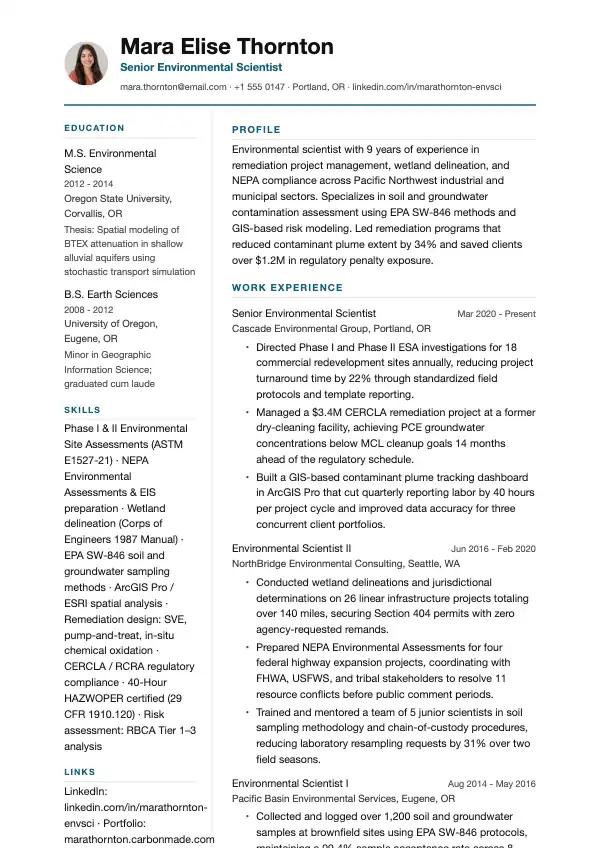
Template: Quadrant
Read this resume as text
Mara Elise Thornton
Senior Environmental Scientist
mara.thornton@email.com · +1 555 0147 · Portland, OR · linkedin.com/in/marathornton-envsci
- Profile
- Environmental scientist with 9 years of experience in remediation project management, wetland delineation, and NEPA compliance across Pacific Northwest industrial and municipal sectors. Specializes in soil and groundwater contamination assessment using EPA SW-846 methods and GIS-based risk modeling. Led remediation programs that reduced contaminant plume extent by 34% and saved clients over $1.2M in regulatory penalty exposure.
- Work Experience
Senior Environmental Scientist
Cascade Environmental Group, Portland, OR · Mar 2020 - Present
- Directed Phase I and Phase II ESA investigations for 18 commercial redevelopment sites annually, reducing project turnaround time by 22% through standardized field protocols and template reporting.
- Managed a $3.4M CERCLA remediation project at a former dry-cleaning facility, achieving PCE groundwater concentrations below MCL cleanup goals 14 months ahead of the regulatory schedule.
- Built a GIS-based contaminant plume tracking dashboard in ArcGIS Pro that cut quarterly reporting labor by 40 hours per project cycle and improved data accuracy for three concurrent client portfolios.
Environmental Scientist II
NorthBridge Environmental Consulting, Seattle, WA · Jun 2016 - Feb 2020
- Conducted wetland delineations and jurisdictional determinations on 26 linear infrastructure projects totaling over 140 miles, securing Section 404 permits with zero agency-requested remands.
- Prepared NEPA Environmental Assessments for four federal highway expansion projects, coordinating with FHWA, USFWS, and tribal stakeholders to resolve 11 resource conflicts before public comment periods.
- Trained and mentored a team of 5 junior scientists in soil sampling methodology and chain-of-custody procedures, reducing laboratory resampling requests by 31% over two field seasons.
Environmental Scientist I
Pacific Basin Environmental Services, Eugene, OR · Aug 2014 - May 2016
- Collected and logged over 1,200 soil and groundwater samples at brownfield sites using EPA SW-846 protocols, maintaining a 99.4% sample acceptance rate across 8 laboratory partners.
- Assisted in preparation of Remedial Investigation reports for 6 state-listed Superfund sites, contributing technical sections that received no deficiency comments from ODEQ reviewers.
- Operated direct-push drilling rigs and monitored well installations at 14 sites, reducing mobilization costs by $18,000 annually through optimized equipment scheduling.
- Education
M.S. Environmental Science
Oregon State University, Corvallis, OR · 2012 - 2014
Thesis: Spatial modeling of BTEX attenuation in shallow alluvial aquifers using stochastic transport simulation
B.S. Earth Sciences
University of Oregon, Eugene, OR · 2008 - 2012
Minor in Geographic Information Science; graduated cum laude
- Skills
- Phase I & II Environmental Site Assessments (ASTM E1527-21) · NEPA Environmental Assessments & EIS preparation · Wetland delineation (Corps of Engineers 1987 Manual) · EPA SW-846 soil and groundwater sampling methods · ArcGIS Pro / ESRI spatial analysis · Remediation design: SVE, pump-and-treat, in-situ chemical oxidation · CERCLA / RCRA regulatory compliance · 40-Hour HAZWOPER certified (29 CFR 1910.120) · Risk assessment: RBCA Tier 1–3 analysis
- Links
- LinkedIn: linkedin.com/in/marathornton-envsci · Portfolio: marathornton.carbonmade.com
What makes this resume work
- Each bullet closes with a concrete number — percentages, dollar figures, or time savings — so hiring managers can immediately gauge the candidate's scale of impact without reading between the lines.
- Hard skills are written in recruiter-searchable language (e.g., 'ASTM E1527-21,' 'EPA SW-846,' 'CERCLA') rather than vague descriptors, which ensures the resume surfaces in ATS keyword searches used by environmental consulting firms and federal agencies.
- The thesis note in the education section signals a specialized technical depth in groundwater modeling that differentiates Mara from generalist candidates without requiring a separate publications section.
- The three roles show a clear progression from field technician tasks to project management and client-facing deliverables, giving reviewers a narrative arc that supports the 'Senior' title without the candidate having to state it explicitly.
Keywords that help you pass the ATS
Work the ones that fit your experience into your resume, naturally, not stuffed.
How to write an Environmental Scientist resume
Choose the right format for an Environmental Scientist resume
Use a reverse-chronological format unless you are switching from a related field like geology or civil engineering, in which case a hybrid format works better. Recruiters at environmental consulting firms, state agencies, and federal contractors expect to scan your most recent field and lab experience first, so keep that front and center.
Stick to one page if you have fewer than eight years of experience; two pages are acceptable for senior scientists with extensive project portfolios, regulatory work, or publications. Use clear section headers, 10–12 pt font, and generous white space. Submit as a PDF unless the job posting specifies otherwise, since ATS platforms used by firms like AECOM, Tetra Tech, and state EPAs generally parse PDFs without issue.
- Reverse-chronological for most candidates; hybrid if pivoting from adjacent science fields
- One page under eight years of experience, two pages maximum for senior roles
- PDF format unless the posting explicitly requests .docx
- Margins between 0.5 and 1 inch; no tables or text boxes that break ATS parsing
Write a professional summary that passes the first scan
Your summary should be three to four sentences that name your specialty, years of experience, and one or two concrete outcomes. Generic phrases like 'results-driven professional' waste space. Tie your summary directly to the job posting's language — if the role mentions CERCLA site assessment or stormwater compliance, those words belong in your summary.
Example: "Environmental Scientist with 7 years of experience conducting Phase I and Phase II ESAs, soil and groundwater sampling, and RCRA compliance audits across industrial and brownfield sites in the Mid-Atlantic region. Managed a portfolio of 30+ active projects simultaneously while maintaining a 98% on-time report delivery rate. Proficient in ArcGIS, EQuIS, and EPA SW-846 sampling methods. Holds a CHMM certification and 40-hour HAZWOPER training."
Write work-experience bullets that show impact with numbers
Each bullet should follow an action-verb + task + quantified result structure. Avoid describing job duties in generic terms; instead, show scope, scale, and outcome. Hiring managers at consulting firms want to know how many sites you managed, what regulations you worked under, and what your work actually changed or prevented.
Focus on regulatory compliance outcomes, cost savings, remediation milestones, and project turnaround times. If you wrote reports, say how many and for which regulatory frameworks. If you collected samples, state the number of samples and the analytical methods used.
- Directed soil and groundwater remediation at a 12-acre former dry-cleaning site under NJDEP oversight, reducing total petroleum hydrocarbon concentrations by 74% over 18 months and achieving site closure six weeks ahead of schedule.
- Collected and logged 400+ soil and water samples annually using EPA SW-846 methods, maintaining a 99.6% chain-of-custody accuracy rate and zero regulatory deficiencies across three consecutive state audits.
Include the skills and certifications recruiters and ATS systems look for
Environmental science job postings are highly technical, and ATS filters screen heavily for specific regulatory frameworks, software, and credentials. Build a dedicated skills section that mirrors the language in the posting. Group skills by category — field methods, software, regulations, and certifications — so both humans and automated systems can read them quickly.
Prioritize certifications that signal regulatory credibility and site safety competence. Many federal and state agency contracts require HAZWOPER as a baseline. CHMM and PE licensure open doors to senior and project manager roles. GIS proficiency is increasingly non-negotiable for spatial data analysis and site mapping.
- Certifications: 40-Hour HAZWOPER, CHMM (Certified Hazardous Materials Manager), LSRP (NJ), LSP (MA), PG (Professional Geologist), PE (Professional Engineer)
- Regulations: CERCLA, RCRA, Clean Water Act, NPDES, TSCA, state-specific cleanup programs
- Software: ArcGIS, EQuIS, Groundwater Vistas, AutoCAD, EPA SWMM, Microsoft Project
- Field methods: EPA SW-846, ASTM Phase I/II standards, soil gas surveying, groundwater monitoring well installation
- Lab skills: VOC/SVOC analysis interpretation, chain-of-custody documentation, QA/QC review
Education, licenses, and extras that strengthen your candidacy
List your highest degree first with institution, graduation year, and relevant thesis or concentration if applicable. A B.S. or M.S. in Environmental Science, Environmental Engineering, Geology, or Chemistry is standard. For federal roles or senior consulting positions, an M.S. often differentiates candidates. Do not list your GPA unless it is above 3.5 and you graduated within the last three years.
Add a separate 'Licenses & Certifications' section below education so these credentials are easy to find. Include the issuing body and expiration or renewal year where relevant. If you have published peer-reviewed work, presented at conferences like SETAC or AEHS, or hold professional memberships in NAEP or A&WMA, list those in a brief 'Professional Affiliations & Publications' section at the bottom.
- List state-specific professional licenses (PG, LSP, LSRP) with license number and state
- Include OSHA training dates — HAZWOPER refresher currency matters to site safety officers
- Note relevant fieldwork, internships, or thesis research if you have fewer than three years of experience
Mistakes to avoid
- Listing HAZWOPER or other safety certifications without specifying whether they are 8-hour refresher or 40-hour initial, since hiring managers and site safety officers treat these as meaningfully different credentials.
- Using vague verbs like 'assisted with' or 'helped conduct' instead of owning your contributions — if you collected the samples or wrote the report, say so directly.
- Omitting the specific regulatory frameworks you have worked under, such as CERCLA, RCRA, or state-specific programs, which are primary ATS filter terms for environmental science roles.
- Failing to quantify site or project scope, such as acreage, number of monitoring wells, sample counts, or remediation timelines, which makes it impossible for reviewers to gauge the scale of your experience.
Frequently asked questions
- Do I need a Professional Geologist or Professional Engineer license to get hired as an Environmental Scientist?
- For entry- and mid-level roles at consulting firms, a PG or PE is not always required, but it significantly expands your eligibility for project manager positions and state agency contracts that mandate licensed professional sign-off on reports. Many firms will hire you without one and support your licensure application once you meet the experience threshold. List any pending applications or exam completions on your resume.
- How should I handle a resume for both field and office-based environmental science roles?
- Tailor your skills section to emphasize field methods and safety certifications when applying to site assessment or remediation roles, and shift emphasis to data analysis tools, report writing, and regulatory knowledge for compliance or policy positions. Keep a master resume with all experience and create targeted versions rather than sending one generic document. The summary section is the fastest place to signal which type of role you are pursuing.
- Is a one-page resume realistic for an Environmental Scientist with five years of experience?
- Yes, one page is achievable and preferred at the five-year mark if you are concise with bullets and cut older or irrelevant internship detail. Focus each bullet on outcomes rather than task lists, and consolidate similar responsibilities across projects into a single high-impact statement. Two pages become appropriate when you have a substantial regulatory history, multiple site closures, or publications that genuinely add value.
Make it yours in minutes
Open this example in the builder, swap in your details, and export a clean, ATS-ready resume.
Once your resume is ready
More for this application
- Template style
- ATS-Friendly resume templates