Resume example
Fashion Designer resume example
By the Resumade team · About our content
A Fashion Designer resume must clear ATS keyword filters for tools like CLO 3D and PLM while showing hiring managers commercial instinct through measurable results. This example does both by pairing domain-specific hard skills with revenue and efficiency metrics in every role.
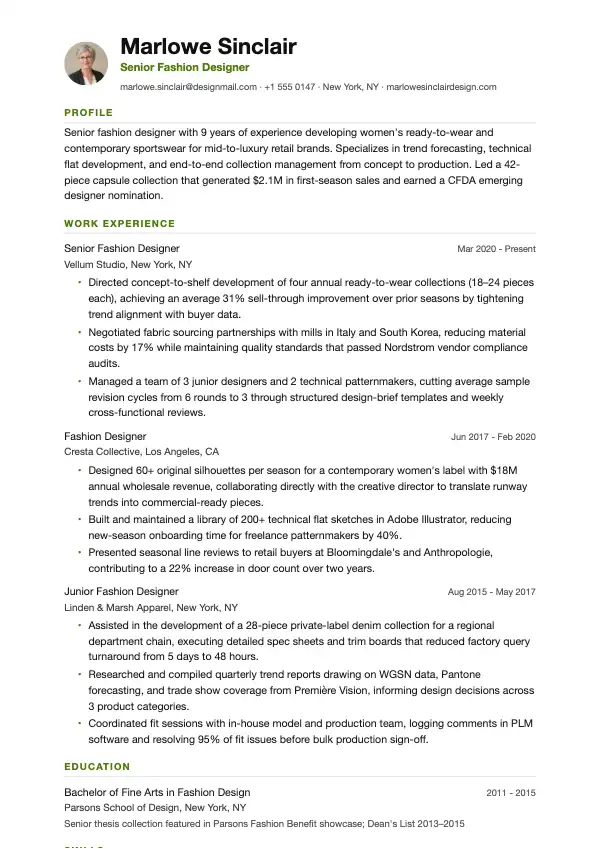
Template: Onyx
Read this resume as text
Marlowe Sinclair
Senior Fashion Designer
marlowe.sinclair@designmail.com · +1 555 0147 · New York, NY · marlowesinclairdesign.com
- Profile
- Senior fashion designer with 9 years of experience developing women's ready-to-wear and contemporary sportswear for mid-to-luxury retail brands. Specializes in trend forecasting, technical flat development, and end-to-end collection management from concept to production. Led a 42-piece capsule collection that generated $2.1M in first-season sales and earned a CFDA emerging designer nomination.
- Work Experience
Senior Fashion Designer
Vellum Studio, New York, NY · Mar 2020 - Present
- Directed concept-to-shelf development of four annual ready-to-wear collections (18–24 pieces each), achieving an average 31% sell-through improvement over prior seasons by tightening trend alignment with buyer data.
- Negotiated fabric sourcing partnerships with mills in Italy and South Korea, reducing material costs by 17% while maintaining quality standards that passed Nordstrom vendor compliance audits.
- Managed a team of 3 junior designers and 2 technical patternmakers, cutting average sample revision cycles from 6 rounds to 3 through structured design-brief templates and weekly cross-functional reviews.
Fashion Designer
Cresta Collective, Los Angeles, CA · Jun 2017 - Feb 2020
- Designed 60+ original silhouettes per season for a contemporary women's label with $18M annual wholesale revenue, collaborating directly with the creative director to translate runway trends into commercial-ready pieces.
- Built and maintained a library of 200+ technical flat sketches in Adobe Illustrator, reducing new-season onboarding time for freelance patternmakers by 40%.
- Presented seasonal line reviews to retail buyers at Bloomingdale's and Anthropologie, contributing to a 22% increase in door count over two years.
Junior Fashion Designer
Linden & Marsh Apparel, New York, NY · Aug 2015 - May 2017
- Assisted in the development of a 28-piece private-label denim collection for a regional department chain, executing detailed spec sheets and trim boards that reduced factory query turnaround from 5 days to 48 hours.
- Researched and compiled quarterly trend reports drawing on WGSN data, Pantone forecasting, and trade show coverage from Première Vision, informing design decisions across 3 product categories.
- Coordinated fit sessions with in-house model and production team, logging comments in PLM software and resolving 95% of fit issues before bulk production sign-off.
- Education
Bachelor of Fine Arts in Fashion Design
Parsons School of Design, New York, NY · 2011 - 2015
Senior thesis collection featured in Parsons Fashion Benefit showcase; Dean's List 2013–2015
- Skills
- Adobe Illustrator & Photoshop (technical flats, mood boards) · CLO 3D virtual sampling · Product Lifecycle Management (PLM) — Centric Software · WGSN trend forecasting platform · Garment construction & pattern grading · Fabric sourcing & textile knowledge (wovens, knits, performance fabrics) · Technical spec sheet & BOM development · Color story development & Pantone matching · Sustainable material sourcing & supply chain compliance
- Links
- Portfolio: marlowesinclairdesign.com · LinkedIn: linkedin.com/in/marlowesinclairdesign
What makes this resume work
- Every bullet opens with a strong action verb and closes with a specific number — sell-through percentages, dollar figures, or time savings — so hiring managers immediately see business impact rather than vague responsibilities.
- Skills are listed as concrete tools and competencies (CLO 3D, Centric PLM, WGSN) rather than adjectives, which mirrors the exact terminology recruiters and ATS systems search for in fashion industry applicants.
- The summary front-loads seniority, years of experience, and a headline result (the $2.1M capsule collection) in the first sentence, giving a skimming recruiter an instant reason to keep reading.
- The education note calls out the Parsons Fashion Benefit showcase and Dean's List standing, adding prestige signals that matter in a design-credential-conscious industry without padding the section with irrelevant coursework.
Keywords that help you pass the ATS
Work the ones that fit your experience into your resume, naturally, not stuffed.
How to write a Fashion Designer resume
Choose the right format for a Fashion Designer resume
Use a reverse-chronological format unless you are switching from an unrelated field or have fewer than two years of experience, in which case a hybrid format works better. Fashion is a visual industry, but your resume itself should be clean and ATS-readable — single-column or a restrained two-column layout with standard section headers, not a heavily designed PDF that parsing software will scramble.
Keep it to one page if you have under ten years of experience; two pages are acceptable for senior designers or creative directors with extensive collection credits. Use a legible serif or sans-serif font (Garamond, Helvetica, or similar) at 10–12 pt, and save the portfolio link for the header rather than embedding images in the document.
- Place your portfolio URL directly in the header next to your contact information
- Use section headers ATS systems recognize: Summary, Experience, Skills, Education
- Avoid tables, text boxes, and graphics that corrupt on upload
- Export as PDF unless the job posting explicitly requests a .docx file
Write a professional summary that positions your design specialty
Your summary should name your specialty (womenswear, activewear, accessories, etc.), your career level, and one or two concrete achievements. Recruiters spend about seven seconds on an initial scan (Ladders eye-tracking study, 2018) — your summary has to anchor your niche immediately.
Here is a strong example: "Womenswear designer with 8 years of experience developing contemporary RTW collections for mid-market and contemporary price points. Led end-to-end design for a 120-piece private-label line that drove a 22% increase in category sell-through at Target. Proficient in CLO 3D, Adobe Illustrator, and Gerber AccuMark; experienced working directly with overseas mills in China and Bangladesh."
Write work-experience bullets that show output, not just duties
Each bullet should follow an action-verb + task + measurable result structure. Avoid phrases like 'responsible for' or 'assisted with.' Quantify wherever possible: number of SKUs, sell-through percentages, lead-time reductions, wholesale volume, or headcount managed. If you cannot recall exact figures, use conservative estimates and be prepared to discuss them.
Hiring managers want to see that you understand the business side of design — costing, vendor negotiation, calendar management — not only the creative side.
- Designed and tech-packed a 90-SKU activewear collection from concept through production, reducing average sample revision rounds from 4 to 2 and cutting time-to-market by 3 weeks
- Sourced performance knit fabrics from 6 Taiwanese mills, negotiating a 12% cost reduction on base fabric while maintaining OEKO-TEX Standard 100 compliance across the line
Skills and certifications recruiters and ATS systems look for
List hard skills explicitly because ATS filters on exact keyword matches. Separate software proficiencies from technical design skills and soft competencies. Certifications are not universally required in fashion, but specific credentials do add weight at larger corporate employers and in sustainable-focused brands.
Include the software versions you actually use where relevant (e.g., Illustrator CC, CLO 3D 7.x), because some job postings filter on specific tools.
- Software: Adobe Illustrator, Photoshop, CLO 3D, Browzwear, Gerber AccuMark, Lectra Modaris, Microsoft PLM (Centric, NGC)
- Technical skills: flat sketching, tech pack creation, pattern grading, garment construction, colorway development, fabric and trim sourcing
- Certifications worth listing: CFDA membership, FIT Professional Development certificates, AATCC textile testing knowledge, GOTS or OEKO-TEX familiarity for sustainable roles
- Business skills: line planning, cost engineering, vendor communication, trend forecasting (WGSN, Trendalytics)
Education, licenses, and extras that strengthen a Fashion Designer resume
List your degree, school, and graduation year. Top programs (Parsons, FIT, RISD, Pratt, Savannah College of Art and Design, Academy of Art University) carry name recognition and are worth spelling out fully rather than abbreviating. If you studied abroad or completed a notable atelier apprenticeship, include it.
Add a separate 'Notable Collections / Press' line if your work has been featured in trade publications (WWD, Business of Fashion) or worn by recognizable clients — this is standard in fashion resumes and expected at senior levels. Include language skills if you work with overseas factories, since Mandarin, Cantonese, or Portuguese fluency is a genuine differentiator for production-heavy roles.
- List study-abroad semesters at recognized international fashion schools (Istituto Marangoni, Central Saint Martins)
- Include internships at recognizable brands even if they were unpaid — they signal industry access
- Add a portfolio line: 'Portfolio: yourname.com' — never embed images in the resume file itself
Mistakes to avoid
- Submitting a heavily designed resume as a graphic file (JPEG or heavily formatted PDF) that ATS software cannot parse, so the text a recruiter sees in the system is incomplete or missing.
- Listing only creative tasks — sketching, mood boards, color stories — without showing any business impact like sell-through rates, SKU counts, cost targets met, or calendar adherence.
- Using vague category labels like 'women's fashion' instead of specific price-point and category language (contemporary RTW, mass-market activewear, luxury accessories) that matches how recruiters search candidate databases.
- Omitting the technical production skills — tech pack creation, grading rules, garment spec writing — that corporate and mass-market employers weight equally or more heavily than aesthetic design ability.
Frequently asked questions
- Should a fashion designer resume include a photo?
- No. US hiring norms and anti-discrimination best practices mean you should not include a headshot on your resume. Your portfolio site can include a professional photo if you choose, but keep the resume document itself photo-free.
- How important is a portfolio link on a fashion designer resume?
- It is essential — treat it as a required field, not optional. Place the URL in the header next to your email address and make sure the link resolves to a live, password-free portfolio before you apply. Many hiring managers will click the link before reading the resume in detail.
- Do fashion designers need to list software skills if they are senior level?
- Yes, even at director level. ATS systems at large retailers and brands filter on specific tool names like CLO 3D, Centric PLM, or Gerber AccuMark, and omitting them can cause your resume to rank below less experienced candidates who listed the keywords. Keep the skills section concise but complete.
Make it yours in minutes
Open this example in the builder, swap in your details, and export a clean, ATS-ready resume.
Once your resume is ready
More for this application
- Template style
- Designer resume templates