Resume example
Full-Stack Developer resume example
By the Resumade team · About our content
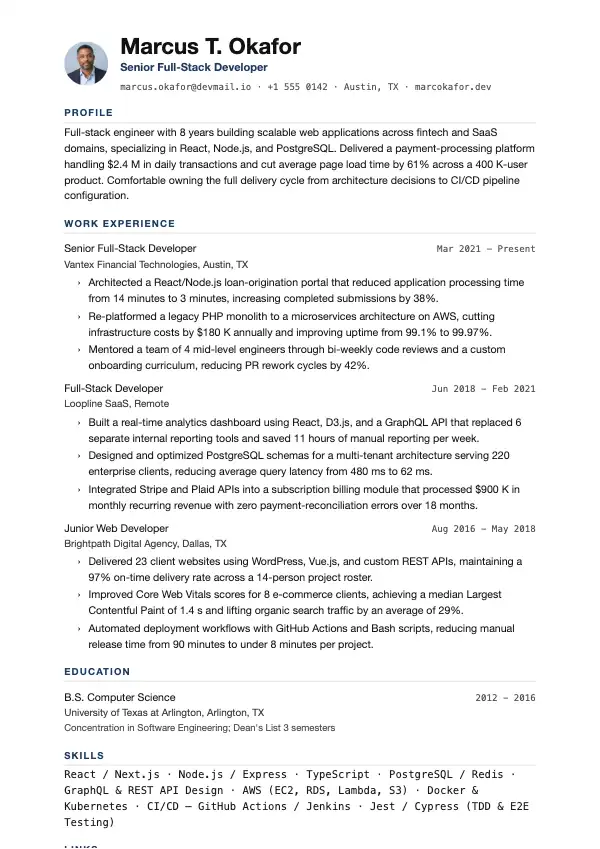
A Full-Stack Developer resume must clear automated keyword filters and then immediately show a hiring manager that you ship real features with measurable impact. This example does both: it names the core stack in the summary, clusters tools for ATS scanning, and leads every bullet with an action verb tied to a business or performance result.
Template: Circuit
Read this resume as text
Marcus T. Okafor
Senior Full-Stack Developer
marcus.okafor@devmail.io · +1 555 0142 · Austin, TX · marcokafor.dev
- Profile
- Full-stack engineer with 8 years building scalable web applications across fintech and SaaS domains, specializing in React, Node.js, and PostgreSQL. Delivered a payment-processing platform handling $2.4 M in daily transactions and cut average page load time by 61% across a 400 K-user product. Comfortable owning the full delivery cycle from architecture decisions to CI/CD pipeline configuration.
- Work Experience
Senior Full-Stack Developer
Vantex Financial Technologies, Austin, TX · Mar 2021 - Present
- Architected a React/Node.js loan-origination portal that reduced application processing time from 14 minutes to 3 minutes, increasing completed submissions by 38%.
- Re-platformed a legacy PHP monolith to a microservices architecture on AWS, cutting infrastructure costs by $180 K annually and improving uptime from 99.1% to 99.97%.
- Mentored a team of 4 mid-level engineers through bi-weekly code reviews and a custom onboarding curriculum, reducing PR rework cycles by 42%.
Full-Stack Developer
Loopline SaaS, Remote · Jun 2018 - Feb 2021
- Built a real-time analytics dashboard using React, D3.js, and a GraphQL API that replaced 6 separate internal reporting tools and saved 11 hours of manual reporting per week.
- Designed and optimized PostgreSQL schemas for a multi-tenant architecture serving 220 enterprise clients, reducing average query latency from 480 ms to 62 ms.
- Integrated Stripe and Plaid APIs into a subscription billing module that processed $900 K in monthly recurring revenue with zero payment-reconciliation errors over 18 months.
Junior Web Developer
Brightpath Digital Agency, Dallas, TX · Aug 2016 - May 2018
- Delivered 23 client websites using WordPress, Vue.js, and custom REST APIs, maintaining a 97% on-time delivery rate across a 14-person project roster.
- Improved Core Web Vitals scores for 8 e-commerce clients, achieving a median Largest Contentful Paint of 1.4 s and lifting organic search traffic by an average of 29%.
- Automated deployment workflows with GitHub Actions and Bash scripts, reducing manual release time from 90 minutes to under 8 minutes per project.
- Education
B.S. Computer Science
University of Texas at Arlington, Arlington, TX · 2012 - 2016
Concentration in Software Engineering; Dean's List 3 semesters
- Skills
- React / Next.js · Node.js / Express · TypeScript · PostgreSQL / Redis · GraphQL & REST API Design · AWS (EC2, RDS, Lambda, S3) · Docker & Kubernetes · CI/CD — GitHub Actions / Jenkins · Jest / Cypress (TDD & E2E Testing)
- Links
- Portfolio: marcokafor.dev · GitHub: github.com/marcokafor · LinkedIn: linkedin.com/in/marcus-okafor
What makes this resume work
- The summary opens with seniority level, years of experience, and two specific domains (fintech and SaaS) before naming the primary stack, giving recruiters and ATS systems the context they need in under 60 words.
- Every experience bullet follows the formula Action Verb + Feature or Task + Quantified Outcome, so hiring managers can immediately assess scope — no vague phrases like 'worked on' or 'helped with' appear anywhere.
- Skills are listed as discrete, searchable tool names rather than broad categories, which mirrors the exact terms recruiters enter into applicant-tracking systems like Greenhouse, Lever, and Workday.
- The progression from Junior Developer at an agency to a Senior role at a fintech company tells a coherent career story, making it easy for a hiring manager to trace growing ownership and technical depth without reading between the lines.
Keywords that help you pass the ATS
Work the ones that fit your experience into your resume, naturally, not stuffed.
How to write a Full-Stack Developer resume
Choose the right format for a Full-Stack Developer resume
Use a reverse-chronological format unless you are making a significant career pivot. Hiring managers and applicant tracking systems both expect to see your most recent role first, and most full-stack positions attract dozens of applicants, so anything unconventional risks being misparsed or skimmed past.
Keep the resume to one page if you have fewer than ten years of experience; two pages are acceptable beyond that. Use clean section headers, consistent font sizing (10–12 pt body, 14–16 pt name), and enough white space so a recruiter can scan your stack at a glance. Avoid tables and multi-column layouts — many ATS parsers scramble them.
- Standard sections: Contact, Summary, Skills, Experience, Projects, Education
- Save as a PDF unless the job posting explicitly requests a .docx
- File name format: FirstName-LastName-Resume.pdf
- Margins between 0.5 in and 1 in; no headers/footers containing critical info
Write a professional summary that earns a closer read
Your summary sits directly below your name and contact info. It should be three to four sentences that name your specialty, years of experience, the layers of the stack you own, and one concrete outcome. Skip phrases like 'passionate developer' or 'team player' — they add no signal.
Example: "Full-stack developer with 6 years building production web applications using React, Node.js, and PostgreSQL. Reduced API response times by 38% at a Series B fintech by migrating a monolith to a microservices architecture on AWS. Comfortable owning features from database schema to CI/CD pipeline. Currently holding AWS Certified Developer – Associate and actively contributing to two open-source projects on GitHub."
Write work-experience bullets that show scope and impact
Each bullet should follow an action-verb → task → measurable result structure. Quantify with real numbers: load times, error rates, deployment frequency, team size, revenue affected, or user counts. If you led a project, say how many engineers were involved. Recruiters at product companies want to see that you shipped things, not just that you wrote code.
Avoid vague verbs like 'worked on' or 'helped with.' Own your contributions explicitly. If you built an internal tool that saved engineering hours, calculate and state those hours. Two to five bullets per role is the right range — more than five dilutes impact.
- Rebuilt the customer-facing checkout flow in Next.js and Stripe, cutting cart abandonment by 22% and reducing page load time from 4.1 s to 1.3 s across 1.2 million monthly users.
- Designed and deployed a RESTful microservices API on AWS Lambda and API Gateway, reducing infrastructure costs by $14,000/month while handling a 3× spike in traffic during a product launch.
List the skills and certifications recruiters and ATS systems look for
Create a dedicated Skills section that mirrors the language in job postings. Group technologies logically: Frontend, Backend, Databases, DevOps/Cloud, Testing. Do not list soft skills here — save those for your summary or bullets. ATS systems keyword-match against the job description, so if a posting says 'TypeScript' and you only wrote 'JavaScript,' you may not surface.
Certifications carry real weight for cloud and DevOps-adjacent roles. List the full official name, issuing body, and year. Do not list expired certifications unless you are actively renewing them.
- Frontend: React, Next.js, Vue.js, TypeScript, Tailwind CSS, Webpack
- Backend: Node.js, Express, Python (Django/FastAPI), GraphQL, REST
- Databases: PostgreSQL, MySQL, MongoDB, Redis
- DevOps/Cloud: AWS (EC2, Lambda, RDS, S3), Docker, Kubernetes, GitHub Actions, Terraform
- Certifications that stand out: AWS Certified Developer – Associate, Google Professional Cloud Developer, MongoDB Associate Developer, HashiCorp Terraform Associate
Education, licenses, and extras that close the deal
List your highest degree, institution, and graduation year. GPA is optional and only worth including if it is 3.5 or above and you graduated within the last three years. A CS, software engineering, or related degree is standard, but a coding bootcamp (General Assembly, Flatiron, App Academy) is widely accepted at startups and mid-size companies when paired with a strong project section.
Add a Projects section if your work history is short or if you have built something notable outside of employment — include the live URL or GitHub link, the stack used, and one metric. An active GitHub profile with green contribution squares and well-documented repos is a genuine differentiator that recruiters at technical companies check before the phone screen.
- Link your GitHub profile and any live project URLs directly in the resume header
- Include a personal portfolio site if it shows deployed, functional work
- List relevant coursework only if you are a recent graduate with limited experience
Mistakes to avoid
- Listing every technology you have ever touched instead of the ones you can defend in a technical interview creates red flags when interviewers probe depth.
- Using a two-column or table-based layout that causes ATS parsers to scramble your experience dates and job titles, making your resume unreadable to the system.
- Writing bullets that describe responsibilities rather than outcomes — 'maintained the backend API' tells a hiring manager nothing about the scale, quality, or impact of your work.
- Omitting version control, testing frameworks, and CI/CD tools from your skills section, which signals to senior engineers that you may not work well in a collaborative production environment.
Frequently asked questions
- Should a full-stack developer include both frontend and backend projects on their resume?
- Yes, and you should make the split visible. Showing projects or roles where you owned the entire feature — from React component to database query — is exactly what 'full-stack' means to a hiring manager. If all your listed work is frontend-only or backend-only, you will likely be screened for a specialist role instead.
- How important is a GitHub profile link on a full-stack developer resume?
- It is effectively expected at most product and engineering-led companies. Recruiters and engineering managers use it to verify that your listed skills are real and to gauge how you write and document code. Make sure your pinned repositories are current, have README files, and reflect the stack you claim on your resume.
- Do full-stack developer resumes need a separate projects section?
- If you have five or more years of relevant employment, your experience section can carry the resume and a projects section is optional. If you have fewer than three years of experience or are transitioning from another field, a projects section is essential — it is your primary evidence of technical ability and should include the live URL, tech stack, and at least one measurable outcome per project.
Make it yours in minutes
Open this example in the builder, swap in your details, and export a clean, ATS-ready resume.
Once your resume is ready
More for this application
- Cover letter example
- Software Engineer Cover Letter Example
- Template style
- Software Engineer resume templates