Resume example
HVAC Technician resume example
By the Resumade team · About our content
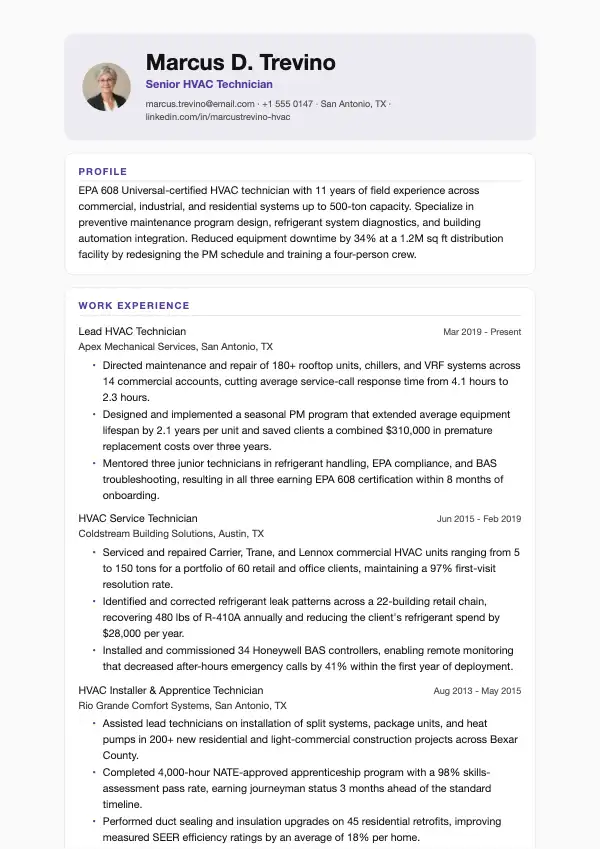
An HVAC technician resume must prove EPA certification and field scope in the first glance, then back it up with quantified results that show reliability and cost impact. This example does both — certs are visible above the fold and every bullet closes with a number.
Template: Portrait
Read this resume as text
Marcus D. Trevino
Senior HVAC Technician
marcus.trevino@email.com · +1 555 0147 · San Antonio, TX · linkedin.com/in/marcustrevino-hvac
- Profile
- EPA 608 Universal-certified HVAC technician with 11 years of field experience across commercial, industrial, and residential systems up to 500-ton capacity. Specialize in preventive maintenance program design, refrigerant system diagnostics, and building automation integration. Reduced equipment downtime by 34% at a 1.2M sq ft distribution facility by redesigning the PM schedule and training a four-person crew.
- Work Experience
Lead HVAC Technician
Apex Mechanical Services, San Antonio, TX · Mar 2019 - Present
- Directed maintenance and repair of 180+ rooftop units, chillers, and VRF systems across 14 commercial accounts, cutting average service-call response time from 4.1 hours to 2.3 hours.
- Designed and implemented a seasonal PM program that extended average equipment lifespan by 2.1 years per unit and saved clients a combined $310,000 in premature replacement costs over three years.
- Mentored three junior technicians in refrigerant handling, EPA compliance, and BAS troubleshooting, resulting in all three earning EPA 608 certification within 8 months of onboarding.
HVAC Service Technician
Coldstream Building Solutions, Austin, TX · Jun 2015 - Feb 2019
- Serviced and repaired Carrier, Trane, and Lennox commercial HVAC units ranging from 5 to 150 tons for a portfolio of 60 retail and office clients, maintaining a 97% first-visit resolution rate.
- Identified and corrected refrigerant leak patterns across a 22-building retail chain, recovering 480 lbs of R-410A annually and reducing the client's refrigerant spend by $28,000 per year.
- Installed and commissioned 34 Honeywell BAS controllers, enabling remote monitoring that decreased after-hours emergency calls by 41% within the first year of deployment.
HVAC Installer & Apprentice Technician
Rio Grande Comfort Systems, San Antonio, TX · Aug 2013 - May 2015
- Assisted lead technicians on installation of split systems, package units, and heat pumps in 200+ new residential and light-commercial construction projects across Bexar County.
- Completed 4,000-hour NATE-approved apprenticeship program with a 98% skills-assessment pass rate, earning journeyman status 3 months ahead of the standard timeline.
- Performed duct sealing and insulation upgrades on 45 residential retrofits, improving measured SEER efficiency ratings by an average of 18% per home.
- Education
Associate of Applied Science, HVAC/R Technology
San Antonio College, San Antonio, TX · 2011 - 2013
Graduated with honors; coursework included refrigeration systems, electrical controls, and building automation fundamentals.
- Skills
- EPA 608 Universal Certification · NATE Certification (Air Conditioning & Heat Pump) · Refrigerant Recovery & Handling (R-410A, R-22, R-32) · Building Automation Systems (Honeywell, Johnson Controls) · Chiller & VRF System Diagnostics · Preventive Maintenance Program Design · Commercial Rooftop Unit Servicing (Carrier, Trane, Lennox) · HVAC Load Calculations & Energy Auditing · OSHA 10 Certified
- Links
- LinkedIn: linkedin.com/in/marcustrevino-hvac
What makes this resume work
- The summary leads with EPA 608 Universal certification and a specific tonnage range, signaling immediately to recruiters that Marcus can handle large commercial systems without further clarification.
- Each bullet follows a strict action-verb + outcome structure with dollar amounts, percentages, or unit counts, making it easy for hiring managers to calculate ROI before the interview.
- Skill entries mirror exact terms used in HVAC job postings — 'R-410A,' 'VRF system diagnostics,' 'Honeywell BAS' — so ATS parsers surface this resume for the searches that matter most.
- The career arc from apprentice to lead technician is told in three roles that show increasing scope (residential → commercial → multi-site portfolio management), demonstrating a clear growth trajectory rather than lateral movement.
Keywords that help you pass the ATS
Work the ones that fit your experience into your resume, naturally, not stuffed.
How to write an HVAC Technician resume
Choose the right format for an HVAC Technician resume
Use a reverse-chronological format. Employers and service managers want to see your most recent employer first — they're checking whether you've been in the trade consistently and what systems you've worked on lately. A functional or hybrid format raises red flags in this field because it obscures gaps or limited hands-on time.
Keep the resume to one page if you have fewer than ten years of experience, two pages if you're a senior tech or lead with a long project history. Use clean sections with clear headers — Summary, Work Experience, Skills, Certifications, Education. Avoid tables and text boxes; many applicant tracking systems used by HVAC contractors and facilities management companies strip that formatting and scramble your content.
- Margins: 0.75–1 inch; font: Arial or Calibri, 10–12pt
- File format: PDF unless the job posting specifically requests a Word doc
- Section order: Summary → Experience → Skills → Certifications → Education
Write a professional summary that gets you past the first scan
Your summary sits at the top and does one job: convince a dispatcher, service manager, or HR coordinator to keep reading. Name your years of experience, the systems you know best, and one concrete result or credential. Skip phrases like 'hardworking team player' — every resume says that.
"EPA 608-certified HVAC Technician with 7 years of residential and light-commercial experience installing and servicing split systems, heat pumps, and gas furnaces up to 5 tons. Reduced average call-back rate by 18% at previous employer through systematic refrigerant leak detection and coil cleaning protocols. NATE-certified in Air Conditioning and Heat Pumps."
Write work-experience bullets that show scope and results
Each bullet should follow an action-verb → task/system → result or scale structure. Hiring managers in HVAC want to know what equipment you touched, how complex the job was, and whether you left the customer better off. Vague bullets like 'performed maintenance on HVAC units' waste space.
Pull numbers from dispatch logs, performance reviews, or your own memory — callbacks, units serviced per day, tonnage, energy savings, or customer satisfaction scores all work.
- Diagnosed and repaired refrigerant leaks on 3–25 ton commercial rooftop units (Carrier, Trane, Lennox), cutting repeat service calls by 22% over 12 months.
- Installed and commissioned 140+ residential mini-split systems annually, maintaining a 4.9-star customer satisfaction rating across 200+ verified reviews.
Skills and certifications recruiters and ATS systems look for
HVAC job postings are scanned by ATS before a human sees them. Mirror the exact language from the posting in your skills section. Certifications carry significant weight — EPA 608 is non-negotiable for any refrigerant work, and NATE credentials signal competency to commercial clients and larger contractors. List tools and systems by name rather than generic categories.
Soft skills like 'communication' belong in your summary or bullets, not a standalone list. Use the skills section for hard, verifiable items.
- Certifications: EPA 608 (Universal), NATE (specify specialty: AC, Heat Pumps, Gas Furnaces, etc.), OSHA 10 or 30, R-410A/R-32 handling
- Systems: Carrier, Trane, Lennox, Daikin, Mitsubishi Electric, Rheem, York
- Tools: manifold gauge sets, digital multimeters (Fluke), micron gauges, combustion analyzers, nitrogen leak detectors, vacuum pumps
- Software: ServiceTitan, FieldEdge, Housecall Pro, building automation system (BAS) interfaces
- Skills: load calculations (Manual J), ductwork design, preventive maintenance contracts, refrigerant recovery and reclaim
Education, licenses, and extras that round out your resume
List your highest level of education, but in HVAC, a two-year associate degree or vocational certificate from a trade school often carries more weight than a four-year degree with no hands-on training. Name the program specifically — 'HVAC/R Technology, AOS, Lincoln Tech, 2018' tells a hiring manager more than just 'Associate Degree.'
State contractor licenses and journeyman cards belong in a dedicated Licenses section directly below Education. If you hold an electrical or plumbing cross-trade certification, list it — it makes you more valuable for tenant improvement and new-construction work. Include any manufacturer training completions (Carrier University, Daikin Learning, Trane TechneTraining) because commercial accounts often require factory-certified technicians on warranty work.
- State HVAC contractor or journeyman license (list state and license number)
- Manufacturer certifications: Carrier University, Trane TechneTraining, Mitsubishi Diamond Contractor
- Driver's license class (CDL if required for large equipment transport)
Mistakes to avoid
- Listing 'EPA certified' without specifying the type (Type I, II, III, or Universal) — recruiters and ATS systems search for the specific designation.
- Omitting the tonnage, system type, or brand from experience bullets, which makes it impossible for a hiring manager to judge whether your background matches their service calls.
- Using a functional resume format to hide an employment gap, which immediately signals inexperience or instability to service managers who read dozens of HVAC resumes a month.
- Leaving out your state contractor or journeyman license number, which is a disqualifying omission for any job requiring licensed work on permitted projects.
Frequently asked questions
- Do I need EPA 608 certification listed on my HVAC resume?
- Yes, and it should appear in both your certifications section and your summary. Servicing refrigerant-containing equipment without the EPA 608 certification type that covers it (Type I, II, III, or Universal) violates Section 608 of the Clean Air Act, so most employers won't consider candidates who don't list it. If you hold Universal, say so rather than listing just Type I or II, since it covers all equipment categories.
- How do I write an HVAC resume with no experience?
- Lead with your trade school program, any apprenticeship hours logged, and hands-on coursework — list the specific equipment you trained on by brand and system type. Include any EPA 608 certification you've already earned, helper or apprentice roles, and relevant skills like electrical troubleshooting or ductwork fabrication. A short internship or even a documented home project with quantified scope (square footage, system size) is better than leaving the experience section blank.
- Should I list every brand of equipment I've worked on?
- Yes, because ATS systems and hiring managers search for specific brand names when they have service agreements with those manufacturers or stock those parts. Prioritize brands you have deep experience with rather than listing every unit you've touched once. If you have factory training or a manufacturer certification for a brand, note that alongside the brand name.
Make it yours in minutes
Open this example in the builder, swap in your details, and export a clean, ATS-ready resume.
Once your resume is ready
More for this application
- Template style
- Simple resume templates