Resume example
Insurance Agent resume example
By the Resumade team · About our content
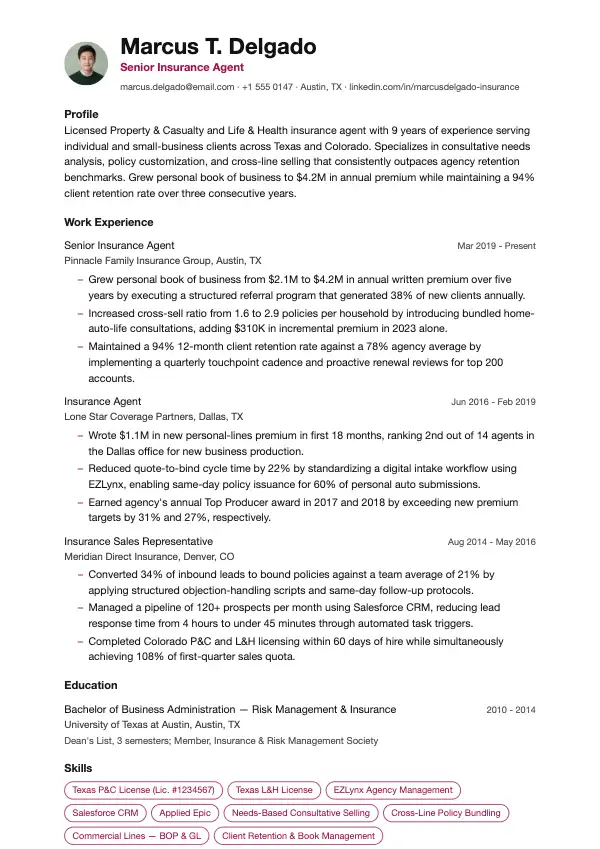
Carriers and agencies look first for license types and premium volume on an insurance agent resume, in their ATS searches and on the first read. This example surfaces both immediately, then backs every claim with dollar figures and percentages.
Template: Minimal
Read this resume as text
Marcus T. Delgado
Senior Insurance Agent
marcus.delgado@email.com · +1 555 0147 · Austin, TX · linkedin.com/in/marcusdelgado-insurance
- Profile
- Licensed Property & Casualty and Life & Health insurance agent with 9 years of experience serving individual and small-business clients across Texas and Colorado. Specializes in consultative needs analysis, policy customization, and cross-line selling that consistently outpaces agency retention benchmarks. Grew personal book of business to $4.2M in annual premium while maintaining a 94% client retention rate over three consecutive years.
- Work Experience
Senior Insurance Agent
Pinnacle Family Insurance Group, Austin, TX · Mar 2019 - Present
- Grew personal book of business from $2.1M to $4.2M in annual written premium over five years by executing a structured referral program that generated 38% of new clients annually.
- Increased cross-sell ratio from 1.6 to 2.9 policies per household by introducing bundled home-auto-life consultations, adding $310K in incremental premium in 2023 alone.
- Maintained a 94% 12-month client retention rate against a 78% agency average by implementing a quarterly touchpoint cadence and proactive renewal reviews for top 200 accounts.
Insurance Agent
Lone Star Coverage Partners, Dallas, TX · Jun 2016 - Feb 2019
- Wrote $1.1M in new personal-lines premium in first 18 months, ranking 2nd out of 14 agents in the Dallas office for new business production.
- Reduced quote-to-bind cycle time by 22% by standardizing a digital intake workflow using EZLynx, enabling same-day policy issuance for 60% of personal auto submissions.
- Earned agency's annual Top Producer award in 2017 and 2018 by exceeding new premium targets by 31% and 27%, respectively.
Insurance Sales Representative
Meridian Direct Insurance, Denver, CO · Aug 2014 - May 2016
- Converted 34% of inbound leads to bound policies against a team average of 21% by applying structured objection-handling scripts and same-day follow-up protocols.
- Managed a pipeline of 120+ prospects per month using Salesforce CRM, reducing lead response time from 4 hours to under 45 minutes through automated task triggers.
- Completed Colorado P&C and L&H licensing within 60 days of hire while simultaneously achieving 108% of first-quarter sales quota.
- Education
Bachelor of Business Administration — Risk Management & Insurance
University of Texas at Austin, Austin, TX · 2010 - 2014
Dean's List, 3 semesters; Member, Insurance & Risk Management Society
- Skills
- Texas P&C License (Lic. #1234567) · Texas L&H License · EZLynx Agency Management · Salesforce CRM · Applied Epic · Needs-Based Consultative Selling · Cross-Line Policy Bundling · Commercial Lines — BOP & GL · Client Retention & Book Management
- Links
- LinkedIn: linkedin.com/in/marcusdelgado-insurance · License: Texas P&C License #1234567 (verifiable via state insurance department)
What makes this resume work
- The summary opens with license types spelled out verbatim — 'Property & Casualty' and 'Life & Health' — matching the exact strings recruiters and ATS systems search for, then anchors credibility with a $4.2M premium figure in the third sentence.
- Every bullet follows an action-verb → activity → measurable result structure, using concrete numbers ($310K, 94%, 22%) rather than vague descriptors, so hiring managers can benchmark Marcus against their own production targets instantly.
- The skills section lists actual platform names (EZLynx, Applied Epic, Salesforce CRM) alongside license credentials with a state prefix, which satisfies both technical keyword filters and the first question every agency owner asks: 'Is this person already licensed here?'
- The career arc is deliberately progressive — representative to agent to senior agent — with premium volume nearly doubling across each role, telling a growth story that justifies the senior title without a single word of self-promotion.
Keywords that help you pass the ATS
Work the ones that fit your experience into your resume, naturally, not stuffed.
How to write an Insurance Agent resume
Choose the right format for an Insurance Agent resume
Most insurance agents do best with a reverse-chronological format. Recruiters at carriers and independent agencies want to see your most recent book of business and production history up front — not buried. If you are switching from a captive to an independent model, or entering insurance from financial services, a hybrid format that leads with a skills summary before your timeline can help bridge the gap.
Keep the resume to one page if you have fewer than ten years of experience; two pages are acceptable for senior agents or those with multiple lines of authority. Use clean section headers, consistent font sizing (10–12 pt body, 14–16 pt name), and enough white space that a hiring manager can scan your production numbers at a glance.
- Reverse-chronological: best for agents with steady carrier or agency history
- Hybrid: useful when pivoting from banking, financial planning, or real estate
- Avoid functional-only formats — they hide tenure and raise red flags with agency owners
- File format: PDF unless the job posting specifically requests a Word document
Write a professional summary that leads with production
Your summary is three to four sentences that tell a hiring manager exactly what you sell, how well you sell it, and what kind of agency or carrier you fit. Skip objectives like 'seeking a challenging role.' Instead, name your lines of authority, your average annual premium volume, and your retention rate if it is above 85 percent.
Example: "Licensed Property & Casualty and Life & Health agent with 7 years of experience in personal and commercial lines across Texas and Oklahoma. Consistently ranked in the top 15% of a 120-agent region for new business premium, writing an average of $1.2M in annual premium. Maintain a 91% client retention rate through proactive policy reviews and cross-selling umbrella and life products. Seeking a commercial lines growth role with an independent agency."
Write work-experience bullets that show production numbers
Every bullet under your past roles should answer 'so what?' with a number. Vague bullets like 'responsible for selling insurance policies' tell recruiters nothing. Use dollar amounts, percentages, policy counts, retention figures, and rankings whenever possible. If you managed a book of business, state its size. If you cross-sold, show the attach rate.
Quantify new business, renewals, and any awards separately — they measure different skills. Mention the agency management systems you used (Applied Epic, EZLynx, Hawksoft, AgencyZoom) and any carrier portals you worked in regularly.
- Grew personal lines book from $800K to $1.4M in annual premium over three years by targeting referral partnerships with two local mortgage brokers and a real estate team.
- Reduced policy lapse rate from 14% to 7% in 18 months by implementing a 60-day pre-renewal outreach workflow inside AgencyZoom, recovering an estimated $62K in at-risk premium.
Skills and certifications recruiters and ATS systems look for
Most agency management systems parse resumes for license types and designations before a human ever reads them. List your active state licenses explicitly — 'Texas P&C License,' 'Florida 2-20 General Lines License' — rather than just writing 'licensed agent.' Include the line of authority: Property & Casualty, Life & Health, Surplus Lines, or Variable Products.
Professional designations carry real weight in commercial and benefits roles. The CPCU, CIC, CISR, CLU, and ChFC are recognized across the industry. If you are early-career, the CISR is achievable and signals commitment. Also list software and carrier-specific tools, since agencies often screen for familiarity with their exact stack.
- Designations: CPCU, CIC, CISR, CLU, ChFC, LUTCF
- Software: Applied Epic, EZLynx, Hawksoft, AgencyZoom, Vertafore AMS360, Salesforce
- Hard skills: policy rating, loss ratio analysis, commercial lines underwriting guidelines, benefits enrollment platforms (Employee Navigator, bswift)
- Soft skills worth naming: needs-based selling, objection handling, pipeline management, account rounding
Education, licenses, and extras that close the deal
A four-year degree is preferred at larger carriers and benefits brokerages but is rarely a hard requirement at independent agencies. If your degree is unrelated to business or finance, let your licenses and production numbers do the heavy lifting. List your highest degree, institution, and graduation year — nothing more unless you graduated with honors or held a relevant leadership role.
Always include a dedicated Licenses section separate from Education. State the license type, issuing state, and expiration year. If you hold non-resident licenses, list them — they are a tangible asset for agencies writing business across state lines. Add any continuing education hours or carrier-specific training programs that show ongoing professional development.
- List every active state license with line of authority and expiration date
- Non-resident licenses are worth including — they expand your geographic value
- Carrier training programs and CE hours belong in a separate 'Professional Development' subsection
- Volunteer work with financial literacy nonprofits or chamber of commerce roles reinforces community-focused selling skills
Mistakes to avoid
- Listing 'licensed insurance agent' without specifying the line of authority or the issuing state makes it impossible for ATS systems and recruiters to verify your qualifications quickly.
- Omitting book-of-business size and retention rates leaves hiring managers guessing about your actual production level, which is the single most important metric agency owners evaluate.
- Using the same generic resume for captive carrier roles and independent agency roles ignores the fact that each environment values different skills — captive roles emphasize brand compliance and referral programs, while independent roles reward market access and quoting efficiency.
- Burying expired or lapsed licenses in the resume without noting their status can create compliance concerns and erode trust before the first interview.
Frequently asked questions
- Do I need to list my insurance license number on my resume?
- You do not need to include the license number on the resume itself — that level of detail belongs on a formal application or background check form. Do list the license type, issuing state, and expiration year so recruiters can quickly confirm you are currently active. Agencies will verify the number through their state's department of insurance database before making an offer.
- How should I write an insurance agent resume if I am switching from a captive carrier to an independent agency?
- Lead your summary with transferable metrics: premium volume, retention rate, and lines of authority. Then add a skills section that highlights your familiarity with comparative rating tools like EZLynx or TurboRater, even if you only used them for personal practice, since independent agencies rely on them daily. Frame your captive experience as deep product knowledge and underwriting familiarity rather than brand loyalty.
- What is the right resume length for an insurance agent with 15 years of experience?
- Two pages is appropriate at that experience level, especially if you hold multiple designations, manage a large commercial book, or have held leadership roles like agency principal or sales manager. Prioritize the last ten years in detail and compress earlier roles to a single line each. Do not pad the resume to fill two pages — every line should either show production or prove a qualification.
Make it yours in minutes
Open this example in the builder, swap in your details, and export a clean, ATS-ready resume.
Once your resume is ready
More for this application
- Template style
- Professional resume templates