Resume example
Interior Designer resume example
By the Resumade team · About our content
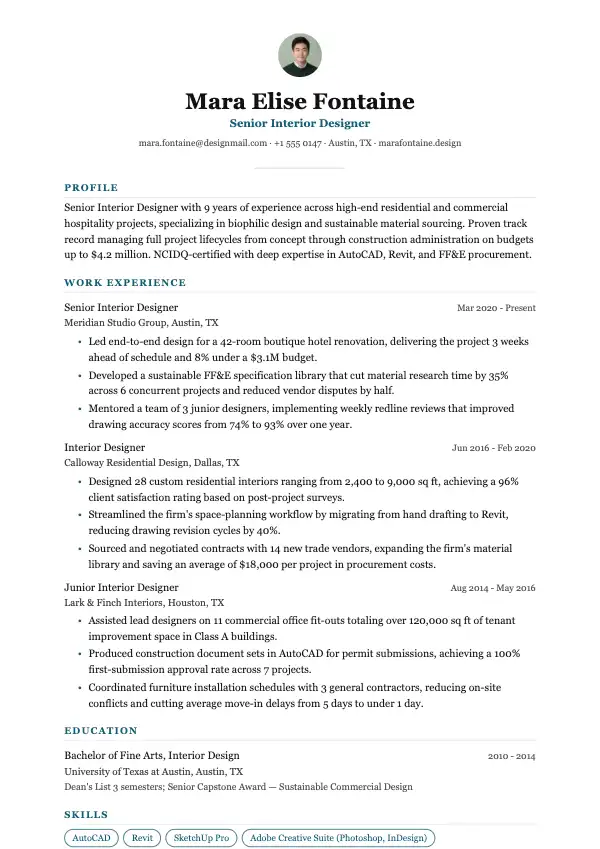
An Interior Designer resume must clear ATS keyword filters for software and certifications while showing hiring managers real project outcomes. This example does both: it leads with credentials and quantified results from the first line.
Template: Classic
Read this resume as text
Mara Elise Fontaine
Senior Interior Designer
mara.fontaine@designmail.com · +1 555 0147 · Austin, TX · marafontaine.design
- Profile
- Senior Interior Designer with 9 years of experience across high-end residential and commercial hospitality projects, specializing in biophilic design and sustainable material sourcing. Proven track record managing full project lifecycles from concept through construction administration on budgets up to $4.2 million. NCIDQ-certified with deep expertise in AutoCAD, Revit, and FF&E procurement.
- Work Experience
Senior Interior Designer
Meridian Studio Group, Austin, TX · Mar 2020 - Present
- Led end-to-end design for a 42-room boutique hotel renovation, delivering the project 3 weeks ahead of schedule and 8% under a $3.1M budget.
- Developed a sustainable FF&E specification library that cut material research time by 35% across 6 concurrent projects and reduced vendor disputes by half.
- Mentored a team of 3 junior designers, implementing weekly redline reviews that improved drawing accuracy scores from 74% to 93% over one year.
Interior Designer
Calloway Residential Design, Dallas, TX · Jun 2016 - Feb 2020
- Designed 28 custom residential interiors ranging from 2,400 to 9,000 sq ft, achieving a 96% client satisfaction rating based on post-project surveys.
- Streamlined the firm's space-planning workflow by migrating from hand drafting to Revit, reducing drawing revision cycles by 40%.
- Sourced and negotiated contracts with 14 new trade vendors, expanding the firm's material library and saving an average of $18,000 per project in procurement costs.
Junior Interior Designer
Lark & Finch Interiors, Houston, TX · Aug 2014 - May 2016
- Assisted lead designers on 11 commercial office fit-outs totaling over 120,000 sq ft of tenant improvement space in Class A buildings.
- Produced construction document sets in AutoCAD for permit submissions, achieving a 100% first-submission approval rate across 7 projects.
- Coordinated furniture installation schedules with 3 general contractors, reducing on-site conflicts and cutting average move-in delays from 5 days to under 1 day.
- Education
Bachelor of Fine Arts, Interior Design
University of Texas at Austin, Austin, TX · 2010 - 2014
Dean's List 3 semesters; Senior Capstone Award — Sustainable Commercial Design
- Skills
- AutoCAD · Revit · SketchUp Pro · Adobe Creative Suite (Photoshop, InDesign) · FF&E Specification & Procurement · NCIDQ Certification · LEED Green Associate · Space Planning & Programming · Construction Documents & Administration
- Links
- Portfolio: marafontaine.design · LinkedIn: linkedin.com/in/marafontaine
What makes this resume work
- The summary names the NCIDQ certification and two flagship tools (AutoCAD, Revit) in the opening paragraph, satisfying the first pass of any ATS scan before a recruiter reads a single bullet.
- Every experience bullet anchors impact in a hard number — square footage, percentage savings, budget figures, or client scores — making it impossible to dismiss the candidate as vague or junior.
- The skills section separates software tools from professional credentials and soft competencies, grouping them in the order most interior design job postings prioritize them.
- The education note calls out a sustainability-focused capstone award, reinforcing the biophilic and LEED specialization mentioned in the summary without adding a separate section that bloats the page.
Keywords that help you pass the ATS
Work the ones that fit your experience into your resume, naturally, not stuffed.
How to write an Interior Designer resume
Choose the right format for an Interior Designer resume
Most interior designers do best with a reverse-chronological format. It shows career progression clearly and satisfies applicant tracking systems (ATS) that scan for work history first. If you are pivoting from architecture, staging, or retail visual merchandising, a hybrid format lets you front-load a skills section before the experience timeline.
Keep the document to one page if you have fewer than eight years of experience; two pages are acceptable for senior designers or principals who need to list multiple project types, client sectors, and software competencies. Use clean typography — a single sans-serif font such as Calibri or Helvetica at 10–11 pt body size — and resist the urge to turn your resume into a portfolio piece with heavy graphics, which ATS software cannot parse.
- Use clearly labeled sections: Summary, Experience, Skills, Education, Certifications
- Save and submit as a PDF unless the job posting specifically requests a Word file
- Margins between 0.5" and 1" keep the layout readable without wasting space
- List your portfolio URL or Houzz profile in the header next to your contact info
Write a professional summary that positions your design specialty
Your summary is three to four sentences that tell a hiring manager your specialty, years of experience, and the value you deliver — before they read a single bullet. Tailor it to the job posting: a firm focused on high-end residential expects different language than a commercial contract studio working on healthcare or hospitality projects.
Here is a strong example: "NCIDQ-certified interior designer with nine years of experience delivering high-end residential and boutique hospitality projects from concept through construction administration. Proficient in AutoCAD, Revit, and SketchUp, with a track record of completing projects an average of 6% under budget while maintaining client satisfaction scores above 4.8 out of 5. Skilled in FF&E specification, vendor negotiation, and leading cross-functional teams of architects, contractors, and procurement coordinators."
Write work-experience bullets that show measurable impact
Every bullet should follow an action verb + task + result structure. Interior design is highly project-driven, so quantify scope: square footage, project budget, number of units, timeline, or client satisfaction data. Avoid vague phrases like 'assisted with design' or 'worked on various projects.' Specify what you designed, what software you used, and what the outcome was.
Pull metrics from project budgets, client reviews, repeat business rates, or timeline adherence. If your firm tracked these numbers formally, use them. If not, reasonable estimates based on invoices or project records are acceptable as long as they are accurate.
- Designed and managed FF&E procurement for a 42-unit luxury apartment complex with a $1.8M budget, delivering final installation two weeks ahead of schedule and 4% under budget
- Produced full construction document sets in Revit for a 12,000 sq ft boutique hotel lobby renovation, reducing RFI volume by 30% compared to the firm's previous comparable project
Skills and certifications recruiters and ATS look for
Interior design job postings consistently filter for specific software, certifications, and project-type experience. Your skills section should mirror the language in the postings you are targeting. Place hard skills — software, codes, specification platforms — above soft skills, and list certifications separately so they stand out.
NCIDQ certification is the single most recognized credential in the US and should appear prominently. LEED AP is valuable for commercial and sustainable design roles. WELL AP is increasingly requested for healthcare and corporate wellness projects.
- Software: AutoCAD, Revit, SketchUp Pro, Rhino, Adobe Creative Suite, 3ds Max, Chief Architect
- Specification platforms: Design Manager, Studio Designer, Mydoma Studio, SpecLink
- Certifications: NCIDQ, LEED AP ID+C, WELL AP, CIDA-accredited program graduate
- Code knowledge: ADA compliance, IBC, NFPA 101 Life Safety Code
- Project types: high-end residential, hospitality, healthcare, corporate workplace, retail
Education, licenses, and extras that close the deal
List your degree, institution, and graduation year. A Bachelor of Fine Arts or Bachelor of Science in Interior Design from a CIDA-accredited program carries weight with larger firms and institutional clients. If you hold a degree in architecture or a related field, note it — it signals fluency in construction documents and building systems.
Below education, add a separate Certifications section rather than burying credentials in the education block. Include any state-specific licensure (required in 27 states for the title 'Interior Designer'), continuing education units (CEUs) relevant to a specialty, and professional memberships such as ASID, IIDA, or AIA Allied. A brief line pointing to your online portfolio, Houzz profile, or published project features in trade press rounds out the picture without replacing the portfolio itself.
- Note state licensure status if you are in a title-act or practice-act state (e.g., 'Licensed Interior Designer — Florida')
- List ASID or IIDA membership tier (Allied, Associate, Professional) — it signals community standing
- Include any published features: Architectural Digest, Luxe Interiors, local shelter magazines
Mistakes to avoid
- Submitting a visually heavy, graphic-laden resume that looks like a mood board — ATS systems cannot read text embedded in images or elaborate design templates, so your keywords never get parsed.
- Omitting project scale and budget from experience bullets, which leaves hiring managers unable to judge whether your experience matches their project tier.
- Listing NCIDQ as 'in progress' without specifying which sections you have passed or your expected completion date, which reads as vague rather than transparent.
- Using a single generic resume for every application instead of swapping in the project type — residential, hospitality, healthcare — that matches each firm's specialty.
Frequently asked questions
- Do interior designers need a portfolio or a resume when applying for jobs?
- You need both. The resume gets you past ATS filters and gives the hiring manager a structured overview of your experience, software skills, and credentials. The portfolio proves your aesthetic range and technical ability. Include your portfolio URL in your resume header so recruiters can access it immediately.
- Is NCIDQ certification required to get hired as an interior designer in the US?
- It depends on the state and the employer. Twenty-seven states regulate the title or practice of interior design and may require NCIDQ passage for licensure. Even in unregulated states, mid-size and large firms — especially those doing commercial, healthcare, or government work — treat NCIDQ as a baseline credential for designers beyond the entry level.
- How should I handle a resume gap if I freelanced or ran my own design studio?
- List freelance or independent work as a formal position: 'Independent Interior Design Consultant, 2021–2023' with client types, project scope, and measurable outcomes in the bullets. Gaps that are framed as intentional self-employment are rarely questioned when backed by real project details and a strong portfolio.
Make it yours in minutes
Open this example in the builder, swap in your details, and export a clean, ATS-ready resume.
Once your resume is ready
More for this application
- Template style
- Designer resume templates