Resume example
Medical Coder resume example
By the Resumade team · About our content
A Medical Coder resume must clear ATS filters loaded with coding systems and compliance terms, then prove accuracy and revenue impact to a hiring manager at first glance. This example does both.
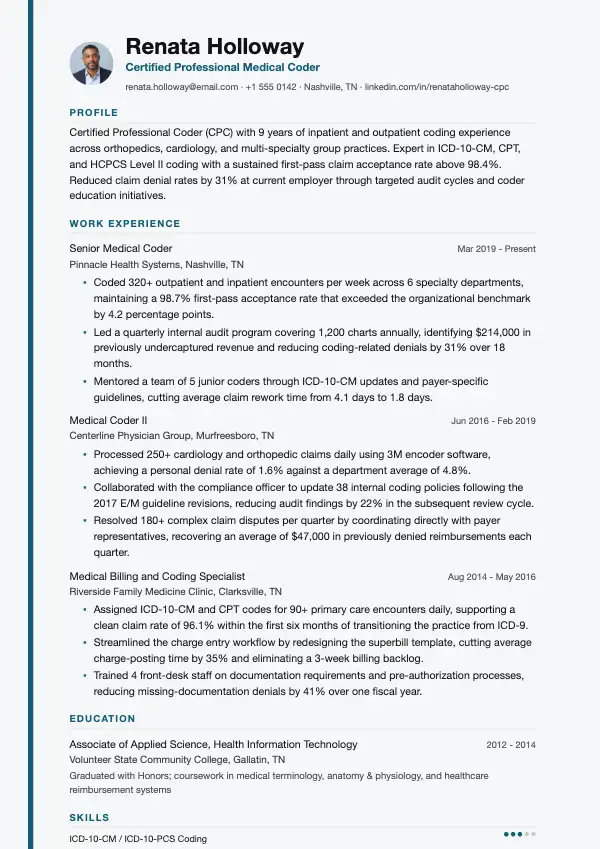
Template: Cadence
Read this resume as text
Renata Holloway
Certified Professional Medical Coder
renata.holloway@email.com · +1 555 0142 · Nashville, TN · linkedin.com/in/renataholloway-cpc
- Profile
- Certified Professional Coder (CPC) with 9 years of inpatient and outpatient coding experience across orthopedics, cardiology, and multi-specialty group practices. Expert in ICD-10-CM, CPT, and HCPCS Level II coding with a sustained first-pass claim acceptance rate above 98.4%. Reduced claim denial rates by 31% at current employer through targeted audit cycles and coder education initiatives.
- Work Experience
Senior Medical Coder
Pinnacle Health Systems, Nashville, TN · Mar 2019 - Present
- Coded 320+ outpatient and inpatient encounters per week across 6 specialty departments, maintaining a 98.7% first-pass acceptance rate that exceeded the organizational benchmark by 4.2 percentage points.
- Led a quarterly internal audit program covering 1,200 charts annually, identifying $214,000 in previously undercaptured revenue and reducing coding-related denials by 31% over 18 months.
- Mentored a team of 5 junior coders through ICD-10-CM updates and payer-specific guidelines, cutting average claim rework time from 4.1 days to 1.8 days.
Medical Coder II
Centerline Physician Group, Murfreesboro, TN · Jun 2016 - Feb 2019
- Processed 250+ cardiology and orthopedic claims daily using 3M encoder software, achieving a personal denial rate of 1.6% against a department average of 4.8%.
- Collaborated with the compliance officer to update 38 internal coding policies following the 2017 E/M guideline revisions, reducing audit findings by 22% in the subsequent review cycle.
- Resolved 180+ complex claim disputes per quarter by coordinating directly with payer representatives, recovering an average of $47,000 in previously denied reimbursements each quarter.
Medical Billing and Coding Specialist
Riverside Family Medicine Clinic, Clarksville, TN · Aug 2014 - May 2016
- Assigned ICD-10-CM and CPT codes for 90+ primary care encounters daily, supporting a clean claim rate of 96.1% within the first six months of transitioning the practice from ICD-9.
- Streamlined the charge entry workflow by redesigning the superbill template, cutting average charge-posting time by 35% and eliminating a 3-week billing backlog.
- Trained 4 front-desk staff on documentation requirements and pre-authorization processes, reducing missing-documentation denials by 41% over one fiscal year.
- Education
Associate of Applied Science, Health Information Technology
Volunteer State Community College, Gallatin, TN · 2012 - 2014
Graduated with Honors; coursework in medical terminology, anatomy & physiology, and healthcare reimbursement systems
- Skills
- ICD-10-CM / ICD-10-PCS Coding · CPT & HCPCS Level II Coding · CPC Certification (AAPC #20148837) · 3M Encoder & TruCode · Epic EHR & Meditech · E/M Leveling & Documentation Auditing · Denial Management & Appeals · Medicare/Medicaid Compliance · HIPAA Privacy & Security Standards
- Links
- LinkedIn: linkedin.com/in/renataholloway-cpc · Certification: CPC, AAPC #20148837 (verifiable via AAPC)
What makes this resume work
- Every bullet opens with a strong action verb and closes with a specific number — claim volumes, dollar amounts, or percentage improvements — so hiring managers can immediately gauge the candidate's scale and accuracy.
- The skills section front-loads the two certifications (CPC with AAPC member number) and the two dominant encoder platforms recruiters search for, so the resume turns up in the searches medical-coding recruiters actually run.
- The summary is written in three deliberate sentences: seniority plus years, specialty domains, and a headline metric — giving a recruiter the full picture in one skimming pass without redundant adjectives.
- Job titles escalate visibly from Specialist to Coder II to Senior Coder, telling a clear career-progression story that signals reliability and growth to compliance-focused healthcare organizations.
Keywords that help you pass the ATS
Work the ones that fit your experience into your resume, naturally, not stuffed.
How to write a Medical Coder resume
Choose the right format for a Medical Coder resume
Use a reverse-chronological format unless you are making a lateral move into coding from a clinical role, in which case a combination format lets you lead with a skills section before listing experience. Keep the resume to one page if you have fewer than eight years of experience; two pages are acceptable for senior coders or those with multiple specialty credentials.
Use clean section headers, consistent date formatting (MM/YYYY), and standard fonts like Calibri or Georgia at 10–12 pt. Avoid tables and text boxes — most hospital and staffing-agency applicant tracking systems (ATS), including Workday and iCIMS, parse plain text more reliably than formatted layouts.
- Margins: 0.75–1 inch on all sides
- File format: PDF unless the job posting explicitly requests a Word document
- Section order: Contact info → Summary → Skills → Experience → Education & Certifications
- Include your CPC, CCS, or other credential abbreviation directly after your name in the header
Write a professional summary that passes the first scan
Your summary should tell a hiring manager your credential, your specialty or setting, your years of experience, and one concrete result — all in three to four sentences. Skip objectives and generic phrases like 'detail-oriented professional.'
Example: "CPC-certified outpatient coder with seven years of experience in multi-specialty physician group settings, including cardiology and orthopedics. Proficient in ICD-10-CM, CPT, and HCPCS Level II coding using 3M encoder and Epic EHR. Maintained a personal coding accuracy rate of 98.4% across quarterly audits and reduced claim denial rates by 11% through root-cause analysis and coder education. Seeking a remote senior coding role in a high-volume facility."
Write work-experience bullets that show measurable impact
Each bullet should follow the action → method → result pattern. Quantify wherever possible: accuracy rates, volume of charts coded per day, denial reduction percentages, audit scores, and turnaround times are all standard metrics in this field. Avoid vague verbs like 'assisted with' or 'responsible for.'
Focus on the coding systems, encoders, and EHRs you used — recruiters and ATS filter on these terms. Mention specific specialties (E&M, surgical, HCC risk adjustment, DRG validation) rather than just 'medical coding.'
- Coded an average of 85 outpatient charts per day in cardiology and vascular surgery using 3M CodeFinder and Epic, sustaining a 98.1% accuracy rate across six consecutive quarterly internal audits.
- Identified documentation gaps in HCC risk-adjustment coding that, after provider education, increased RAF score capture by 14% and recovered an estimated $320,000 in annual revenue for a 12-provider primary care group.
Skills and certifications recruiters and ATS look for
List credentials by their official AAPC or AHIMA abbreviation. Spell out the full name once if space allows, then use the abbreviation consistently. Beyond credentials, include the specific encoders, EHR platforms, and coding systems you have hands-on experience with — these are the terms recruiters search.
Group skills into two or three categories (Coding Systems, Software & Tools, Compliance) rather than dumping everything into one undifferentiated list.
- Credentials: CPC, CCS, COC, CRC, RHIT, RHIA — list only what you hold
- Code sets: ICD-10-CM, ICD-10-PCS, CPT, HCPCS Level II, DRG, APC, HCC
- Encoders & software: 3M CodeFinder, Optum EncoderPro, TruCode, Nuance CAC
- EHR platforms: Epic, Cerner, Meditech, Athenahealth, eClinicalWorks
- Compliance knowledge: HIPAA, OIG guidelines, LCD/NCD coverage policies, RAC audit processes
Education, licenses, and extras that strengthen your application
List your highest degree first with institution name, degree, and graduation year. If you completed a CAHIIM-accredited HIM program or an AAPC-approved coding program, name it explicitly — these carry weight with compliance-focused employers. If you did not finish a degree, list completed coursework or your diploma alongside your credential.
Add a brief Continuing Education or Professional Development section if you have completed specialty workshops, AAPC chapter officer roles, or vendor-specific training such as 3M or Optum certification courses. Remote coders should note any home-office compliance setup or HIPAA-compliant remote work experience, since this is a real hiring filter for virtual positions.
- List CEU completion if you are within a credential renewal cycle — it signals active engagement
- Note any specialty coding experience (trauma, oncology, behavioral health) as a separate line if it is not obvious from your job titles
- Include LinkedIn URL only if your profile is complete and current
Mistakes to avoid
- Listing 'CPC' when you actually hold the apprentice CPC-A designation — employers will discover it during credentialing and consider it a misrepresentation.
- Using generic EHR language like 'familiar with electronic health records' instead of naming the specific platforms you have used, which causes ATS keyword misses.
- Omitting coding volume and accuracy metrics entirely, which are the primary benchmarks hiring managers use to compare candidates at the same credential level.
- Including outdated ICD-9 experience as a headline skill rather than a historical footnote — it signals to recruiters that your training may not be current.
Frequently asked questions
- Do I need a degree to get a medical coding job, and should I list one on my resume?
- Most entry-level coding positions require only a recognized credential such as the CPC or CCS, not a four-year degree. If you have a degree, list it — it can help with compliance or management tracks. If you do not, lead with your credential and any formal coding program coursework instead.
- How do I write a medical coding resume with no experience beyond practicum?
- Lead with your credential and your practicum or externship details, including the setting, specialty, volume of charts coded, and your accuracy rate if audited. Add any volunteer or part-time clinical administrative work, and include a skills section that lists every encoder and EHR you touched during training — these are searchable keywords that matter more than job titles at the entry level.
- Should I tailor my resume differently for remote medical coding jobs?
- Yes — remote coding postings screen heavily for self-sufficiency and compliance readiness. Explicitly state that you have worked remotely before, name the secure connectivity tools you have used (VPN, Citrix, Imprivata), and note any HIPAA-compliant home-office setup. Coding production metrics become even more important because remote managers rely on output data rather than direct observation.
Make it yours in minutes
Open this example in the builder, swap in your details, and export a clean, ATS-ready resume.
Once your resume is ready
More for this application
- Template style
- Two-Page resume templates