Resume example
Medical Billing Specialist resume example
By the Resumade team · About our content
A Medical Billing Specialist resume must clear ATS filters loaded with coding and payer terminology, then convince a revenue cycle manager that you protect the practice's cash flow. This example does both by leading every bullet with a quantified outcome and grouping skills exactly as recruiters search them.
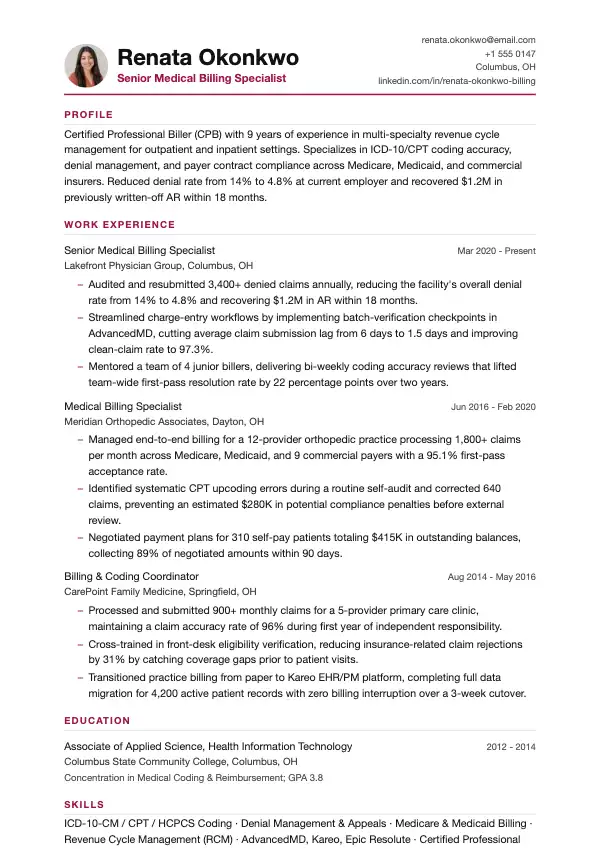
Template: Meridian
Read this resume as text
Renata Okonkwo
Senior Medical Billing Specialist
renata.okonkwo@email.com · +1 555 0147 · Columbus, OH · linkedin.com/in/renata-okonkwo-billing
- Profile
- Certified Professional Biller (CPB) with 9 years of experience in multi-specialty revenue cycle management for outpatient and inpatient settings. Specializes in ICD-10/CPT coding accuracy, denial management, and payer contract compliance across Medicare, Medicaid, and commercial insurers. Reduced denial rate from 14% to 4.8% at current employer and recovered $1.2M in previously written-off AR within 18 months.
- Work Experience
Senior Medical Billing Specialist
Lakefront Physician Group, Columbus, OH · Mar 2020 - Present
- Audited and resubmitted 3,400+ denied claims annually, reducing the facility's overall denial rate from 14% to 4.8% and recovering $1.2M in AR within 18 months.
- Streamlined charge-entry workflows by implementing batch-verification checkpoints in AdvancedMD, cutting average claim submission lag from 6 days to 1.5 days and improving clean-claim rate to 97.3%.
- Mentored a team of 4 junior billers, delivering bi-weekly coding accuracy reviews that lifted team-wide first-pass resolution rate by 22 percentage points over two years.
Medical Billing Specialist
Meridian Orthopedic Associates, Dayton, OH · Jun 2016 - Feb 2020
- Managed end-to-end billing for a 12-provider orthopedic practice processing 1,800+ claims per month across Medicare, Medicaid, and 9 commercial payers with a 95.1% first-pass acceptance rate.
- Identified systematic CPT upcoding errors during a routine self-audit and corrected 640 claims, preventing an estimated $280K in potential compliance penalties before external review.
- Negotiated payment plans for 310 self-pay patients totaling $415K in outstanding balances, collecting 89% of negotiated amounts within 90 days.
Billing & Coding Coordinator
CarePoint Family Medicine, Springfield, OH · Aug 2014 - May 2016
- Processed and submitted 900+ monthly claims for a 5-provider primary care clinic, maintaining a claim accuracy rate of 96% during first year of independent responsibility.
- Cross-trained in front-desk eligibility verification, reducing insurance-related claim rejections by 31% by catching coverage gaps prior to patient visits.
- Transitioned practice billing from paper to Kareo EHR/PM platform, completing full data migration for 4,200 active patient records with zero billing interruption over a 3-week cutover.
- Education
Associate of Applied Science, Health Information Technology
Columbus State Community College, Columbus, OH · 2012 - 2014
Concentration in Medical Coding & Reimbursement; GPA 3.8
- Skills
- ICD-10-CM / CPT / HCPCS Coding · Denial Management & Appeals · Medicare & Medicaid Billing · Revenue Cycle Management (RCM) · AdvancedMD, Kareo, Epic Resolute · Certified Professional Biller (CPB) — AAPC · HIPAA Compliance & Audit Readiness · Accounts Receivable (AR) Follow-Up · EOB / ERA Reconciliation
- Links
- LinkedIn: linkedin.com/in/renata-okonkwo-billing · Certification: Certified Professional Biller (CPB), AAPC (verifiable via AAPC)
What makes this resume work
- Every bullet opens with a strong action verb and closes with a specific number — denial rate percentages, dollar amounts recovered, and timeframes — so hiring managers can immediately size up the candidate's impact without reading between the lines.
- The skills section mirrors the exact terminology found in job postings and ATS databases (e.g., 'Denial Management & Appeals,' 'EOB / ERA Reconciliation') rather than vague phrases like 'billing software' that most parsers would miss.
- The summary front-loads the CPB certification and years of experience, then delivers two headline results in the third sentence, giving a recruiter on a quick first scan a complete picture before they reach the job history.
- The career progression — Coordinator to Specialist to Senior Specialist — is made explicit through title changes across three employers, demonstrating growth without requiring a separate 'career objective' section that would waste prime resume real estate.
Keywords that help you pass the ATS
Work the ones that fit your experience into your resume, naturally, not stuffed.
How to write a Medical Billing Specialist resume
Choose the right format for a Medical Billing Specialist resume
Use a reverse-chronological format. Hiring managers in healthcare revenue cycle want to see your most recent employer first because billing regulations, payer contracts, and software platforms change constantly — a gap or outdated experience buried at the bottom raises flags.
Keep the resume to one page if you have fewer than eight years of experience; two pages are acceptable for senior billers who handle multiple specialties or manage a team. Use clean section headers, consistent font sizing (10–12 pt), and enough white space so ATS software can parse the document without errors. Save and submit as a PDF unless the job posting specifies otherwise.
- Sections in order: Contact Info → Summary → Work Experience → Skills → Certifications → Education
- Avoid tables and text boxes — many ATS platforms misread them
- List each employer with: job title, practice or company name, city/state, and month/year dates
Write a professional summary that targets the role
Your summary sits directly below your contact information and should be three to four sentences. Name your specialty (e.g., outpatient, hospital, DME, mental health), years of experience, and one or two measurable results. Skip phrases like 'hard-working team player.'
Example: "Certified Professional Biller (CPB) with seven years of experience in multi-specialty outpatient billing across commercial, Medicare, and Medicaid payers. Reduced claim denial rate from 14% to 6% at a 12-provider internal medicine group by implementing a front-end eligibility verification workflow in Kareo. Proficient in ICD-10-CM, CPT, and HCPCS Level II coding with a clean-claim rate consistently above 97%."
Write work-experience bullets that prove your impact
Each bullet should follow an action verb → task → result structure. Quantify wherever possible: denial rates, collection rates, days in A/R, dollar volume managed, number of claims processed per day, or team size supervised. Generic duties like 'responsible for billing' tell a recruiter nothing.
Focus on the full revenue cycle: charge entry, claim submission, payment posting, denial management, appeals, and patient balance follow-up. If you worked with a specific clearinghouse or practice management system, name it.
- Resolved 320+ denied claims per month in AdvancedMD, recovering an average of $48,000 in previously written-off revenue per quarter by identifying systematic modifier errors on E/M codes.
- Reduced days in accounts receivable from 52 to 34 over six months by restructuring the payer follow-up schedule and training two junior billing staff on UnitedHealthcare and Aetna portal workflows.
Skills and certifications recruiters and ATS systems look for
Medical billing job postings are heavily keyword-driven. Include a dedicated Skills section that lists software platforms, coding systems, and payer knowledge explicitly. Certifications carry significant weight — many employers ask about them on the application or search for them by name.
Soft skills like 'attention to detail' belong in your bullets as demonstrated behavior, not in a list. Use the skills section for hard, searchable terms only.
- Certifications: CPB (AAPC Certified Professional Biller), CPC (Certified Professional Coder), CBCS (NHA), RHIT (AHIMA) — list acronym and full name
- Software: Epic, Athenahealth, Kareo, AdvancedMD, Medisoft, Greenway Health, Waystar, Availity, Change Healthcare
- Coding systems: ICD-10-CM, CPT, HCPCS Level II, DRG, modifiers
- Payer knowledge: Medicare, Medicaid, Tricare, commercial managed care, workers' compensation
- Processes: EOB/ERA reconciliation, prior authorization, coordination of benefits, HIPAA compliance, NCCI edits
Education, licenses, and extras that strengthen your candidacy
List your highest degree first: degree type, major, school name, and graduation year. An associate's or bachelor's in health information management, medical billing and coding, or healthcare administration is standard. If you completed a billing-specific certificate program through AAPC, AHIMA, or a community college, list it here rather than in the certifications section.
Add a brief 'Additional' or 'Professional Development' line if you have completed continuing education units (CEUs) required for credential maintenance, attended AAPC chapter meetings, or hold specialty credentials such as the CPMA (auditing) or CPCO (compliance). Bilingual ability in Spanish is a genuine asset in many markets and worth noting.
Mistakes to avoid
- Listing only the software name without showing how you used it — recruiters cannot tell whether you entered charges in Epic or built the billing configuration.
- Omitting denial rate, clean-claim rate, or days-in-A/R figures when you have them, which forces the resume to read like a generic job description instead of a performance record.
- Using outdated coding references such as ICD-9 without also demonstrating ICD-10-CM proficiency, which signals to hiring managers that your skills may not be current.
- Failing to tailor payer experience to the job posting — a hospital billing role and a small-practice outpatient role require different payer mixes, and a one-size-fits-all resume misses that distinction.
Frequently asked questions
- Do I need a certification to get hired as a Medical Billing Specialist?
- Certification is not legally required, but the CPB from AAPC or the CBCS from NHA meaningfully improves your chances, especially for remote roles where employers cannot verify competency through in-person observation. Many job postings list a credential as 'preferred' but will pass over uncertified candidates when the applicant pool is competitive. If you are entry-level, obtaining the CPB or CBCS before applying is worth the investment.
- How do I write a Medical Billing Specialist resume with no experience?
- Lead with your certification, any externship or practicum completed during your training program, and coursework that covered specific payer types or software platforms. If you interned at a clinic or physician's office, treat it like a job entry with bullets describing the volume of claims you touched and the systems you used. Volunteer work doing billing for a nonprofit healthcare organization also counts and should be included.
- What metrics should I include on a Medical Billing Specialist resume?
- The most credible numbers are denial rate (percentage of claims denied on first submission), clean-claim rate, days in accounts receivable, monthly or annual dollar volume billed, and collection rate as a percentage of net collectible charges. If you managed a team, include headcount and any productivity or accuracy improvements you drove. Even approximate figures — 'processed approximately 150 claims daily' — are more useful to a hiring manager than no numbers at all.
Make it yours in minutes
Open this example in the builder, swap in your details, and export a clean, ATS-ready resume.
Once your resume is ready
More for this application
- Template style
- Professional resume templates