Resume example
Physician Assistant resume example
By the Resumade team · About our content
A Physician Assistant resume must clear ATS keyword filters for specialty and certification terms, then immediately show hiring managers that you can handle patient volume and complexity independently. This example does both with a metrics-anchored summary and role-specific bullets.
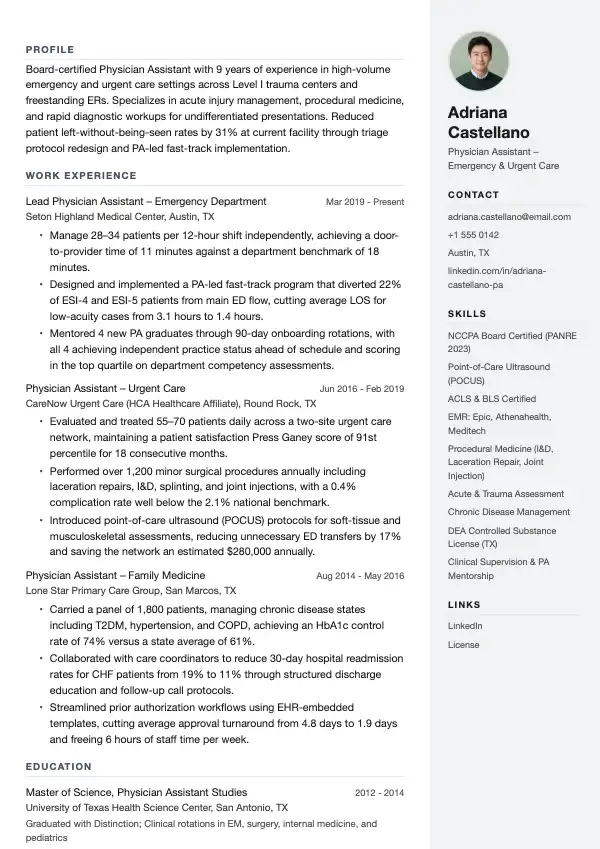
Template: Mist
Read this resume as text
Adriana Castellano
Physician Assistant – Emergency & Urgent Care
adriana.castellano@email.com · +1 555 0142 · Austin, TX · linkedin.com/in/adriana-castellano-pa
- Profile
- Board-certified Physician Assistant with 9 years of experience in high-volume emergency and urgent care settings across Level I trauma centers and freestanding ERs. Specializes in acute injury management, procedural medicine, and rapid diagnostic workups for undifferentiated presentations. Reduced patient left-without-being-seen rates by 31% at current facility through triage protocol redesign and PA-led fast-track implementation.
- Work Experience
Lead Physician Assistant – Emergency Department
Seton Highland Medical Center, Austin, TX · Mar 2019 - Present
- Manage 28–34 patients per 12-hour shift independently, achieving a door-to-provider time of 11 minutes against a department benchmark of 18 minutes.
- Designed and implemented a PA-led fast-track program that diverted 22% of ESI-4 and ESI-5 patients from main ED flow, cutting average LOS for low-acuity cases from 3.1 hours to 1.4 hours.
- Mentored 4 new PA graduates through 90-day onboarding rotations, with all 4 achieving independent practice status ahead of schedule and scoring in the top quartile on department competency assessments.
Physician Assistant – Urgent Care
CareNow Urgent Care (HCA Healthcare Affiliate), Round Rock, TX · Jun 2016 - Feb 2019
- Evaluated and treated 55–70 patients daily across a two-site urgent care network, maintaining a patient satisfaction Press Ganey score of 91st percentile for 18 consecutive months.
- Performed over 1,200 minor surgical procedures annually including laceration repairs, I&D, splinting, and joint injections, with a 0.4% complication rate well below the 2.1% national benchmark.
- Introduced point-of-care ultrasound (POCUS) protocols for soft-tissue and musculoskeletal assessments, reducing unnecessary ED transfers by 17% and saving the network an estimated $280,000 annually.
Physician Assistant – Family Medicine
Lone Star Primary Care Group, San Marcos, TX · Aug 2014 - May 2016
- Carried a panel of 1,800 patients, managing chronic disease states including T2DM, hypertension, and COPD, achieving an HbA1c control rate of 74% versus a state average of 61%.
- Collaborated with care coordinators to reduce 30-day hospital readmission rates for CHF patients from 19% to 11% through structured discharge education and follow-up call protocols.
- Streamlined prior authorization workflows using EHR-embedded templates, cutting average approval turnaround from 4.8 days to 1.9 days and freeing 6 hours of staff time per week.
- Education
Master of Science, Physician Assistant Studies
University of Texas Health Science Center, San Antonio, TX · 2012 - 2014
Graduated with Distinction; Clinical rotations in EM, surgery, internal medicine, and pediatrics
Bachelor of Science, Biology
Texas State University, San Marcos, TX · 2008 - 2012
Cum Laude; Pre-Health Honors Program
- Skills
- NCCPA Board Certified (PANRE 2023) · Point-of-Care Ultrasound (POCUS) · ACLS & BLS Certified · EMR: Epic, Athenahealth, Meditech · Procedural Medicine (I&D, Laceration Repair, Joint Injection) · Acute & Trauma Assessment · Chronic Disease Management · DEA Controlled Substance License (TX) · Clinical Supervision & PA Mentorship
- Links
- LinkedIn · License
What makes this resume work
- The summary names seniority, specialty, and one headline result in three sentences — giving screeners an instant reason to keep reading before they reach the experience section.
- Every bullet opens with a strong action verb and closes with a hard number (time saved, percentage improved, dollars recovered), making impact scannable at a glance for each role.
- Hard skills are listed as specific certifications and tools (POCUS, Epic, PANRE, DEA license) rather than vague categories, which matches the exact terms recruiters and ATS engines search for in PA candidates.
- Progression from family medicine to urgent care to ED lead is made explicit through title changes and scope escalation in the bullets, demonstrating deliberate career growth rather than lateral movement.
Keywords that help you pass the ATS
Work the ones that fit your experience into your resume, naturally, not stuffed.
How to write a Physician Assistant resume
Choose the right format for a Physician Assistant resume
Use a reverse-chronological format. Hiring managers at hospitals, urgent care centers, and specialty practices scan dozens of applications quickly, and they expect to see your most recent clinical role first. A functional or hybrid format raises red flags unless you are a new graduate with limited rotations.
Keep your resume to one page if you have fewer than ten years of experience; two pages are acceptable for PAs with extensive subspecialty or leadership history. Use clean section headers, consistent font sizing (10–12 pt body, 14–16 pt name), and half-inch margins. Avoid tables and text boxes — most applicant tracking systems used by health systems, including Workday and iCIMS, parse these poorly and drop your content.
- Standard sections: Contact Info, Summary, Licensure & Certifications, Work Experience, Education, Skills
- File format: Submit as a PDF unless the job posting specifies .docx
- File name: LastName_FirstName_PA_Resume.pdf — never 'resume_final_v3'
Write a professional summary that earns a second look
Your summary sits directly below your name and credentials. It should be three to four sentences that tell the reader your specialty, years of experience, and one or two concrete strengths. Skip objectives like 'seeking a challenging position' — they waste space and say nothing about your value.
Here is a strong example: "Board-certified Physician Assistant with 7 years of experience in orthopedic surgery, specializing in pre- and post-operative management of total joint replacements and sports medicine injuries. Performed 300+ first-assist surgical procedures annually at a Level II trauma center. Proficient in joint aspiration, corticosteroid injections, and DEXA interpretation. Committed to reducing 30-day readmission rates through structured patient education protocols."
Write work-experience bullets that show measurable impact
Each bullet should follow an action verb + task + outcome structure. Quantify wherever you can — patient volume, procedure counts, satisfaction scores, wait-time reductions, or cost savings. Vague phrases like 'assisted with procedures' or 'worked with a team' tell recruiters nothing they cannot assume.
Pull numbers from your annual reviews, department dashboards, or Press Ganey reports. Even estimates grounded in reality ('approximately 25 patients per shift') are more useful than blank space.
- Managed an independent panel of 22–26 patients daily in a fast-paced internal medicine urgent care, reducing average door-to-provider time by 18% over 12 months through triage protocol redesign.
- Performed and interpreted 400+ point-of-care ultrasounds annually (FAST exams, soft-tissue, DVT studies), decreasing ED radiology orders for low-acuity cases by 11% and cutting average imaging turnaround by 34 minutes.
Skills and certifications recruiters and ATS systems look for
Include a dedicated skills section with clinical competencies, procedural skills, and software. Many health systems rank applicants by how well their resumes match the posting, so mirror its terminology — if they write 'EMR' and you write 'EHR,' a keyword search may miss you.
List certifications with their full name, issuing body, and expiration year. NCCPA board certification (PANCE/PANRE) is non-negotiable and should appear prominently, ideally next to your name in your header as 'PA-C.'
- Certifications: PA-C (NCCPA), BLS (AHA), ACLS (AHA), ATLS, NCCPA CAQ (e.g., Hospital Medicine or Orthopaedic Surgery) if applicable
- Procedural skills: LP, central line placement, chest tube insertion, intubation, joint aspiration, laceration repair, casting and splinting
- Software/EMR: Epic, Cerner, Athenahealth, Meditech, eClinicalWorks
- Specialty-specific tools: DXA reporting, spirometry interpretation, IUD insertion, colposcopy (OB/GYN), fluoroscopy (ortho/spine)
Education, licenses, and extras that complete your resume
List your Master of Science in Physician Assistant Studies (or MPAS/MMS/MMSc depending on your program) with the institution, city, state, and graduation year. You do not need to list your undergraduate degree unless you are a new graduate with limited clinical hours. Note your DEA registration status if relevant to the role, and your state PA license number — some employers require it on the application itself.
Add a separate 'Licensure' line that lists every state where you hold an active license. If you hold a Compact Privilege under the PA Licensure Compact, note it explicitly. Optional extras worth including: published research, CME focus areas (especially if they align with the job), professional memberships (AAPA, state PA academy), and any teaching or preceptor roles, which signal leadership to hiring committees.
- List CME hours only if they are specialty-relevant and recent (within 2 years)
- Include clinical rotations if you graduated within the past 3 years and they are relevant to the target specialty
- Omit references, photos, and personal data such as marital status or date of birth
Mistakes to avoid
- Listing 'PA-C' without specifying NCCPA board certification leaves ATS systems and international recruiters unable to verify your credential automatically.
- Using the same generic resume for every application instead of swapping in specialty-specific procedures and keywords from each job posting costs you interviews at ATS-heavy health systems.
- Omitting your DEA registration status or controlled-substance prescribing authority when applying to primary care or pain management roles forces recruiters to follow up and slows your candidacy.
- Writing duties instead of outcomes — phrases like 'responsible for patient care' describe a job description, not your performance, and give hiring managers no reason to call you over an equally qualified candidate.
Frequently asked questions
- Should a new PA graduate include clinical rotation hours on their resume?
- Yes, if you graduated within the past two to three years and are applying to a specialty that matches your rotations. List the site name, specialty, supervising physician, and approximate patient volume or procedures performed. This is the closest equivalent new graduates have to work-experience bullets, and it shows specialty exposure that matters to hiring PAs.
- Do I need to list my NPI number on my Physician Assistant resume?
- You do not need to include your NPI number on the resume itself — it is public record and recruiters can look it up. However, some hospital credentialing applications and online submissions will ask for it separately, so have it ready. Focus your resume header on your PA-C credential, state license number, and DEA status if applicable.
- How do I address a gap in PA practice on my resume?
- Be straightforward and brief. If you took time off for family, illness, or further education, note it in one line under experience (e.g., 'Career pause for family caregiving, 2022–2023') rather than leaving an unexplained blank. Recruiters notice gaps and will ask — a transparent label prevents assumptions and lets you control the narrative in your cover letter or interview.
Make it yours in minutes
Open this example in the builder, swap in your details, and export a clean, ATS-ready resume.
Once your resume is ready
More for this application
- Template style
- Nursing resume templates