Resume example
Speech-Language Pathologist resume example
By the Resumade team · About our content
A Speech-Language Pathologist resume must demonstrate clinical scope, patient population breadth, and measurable outcomes to clear ATS filters and persuade hiring managers that you reduce costs and improve care. This example does both with caseload numbers, protocol impact, and specialty credentials front and center.
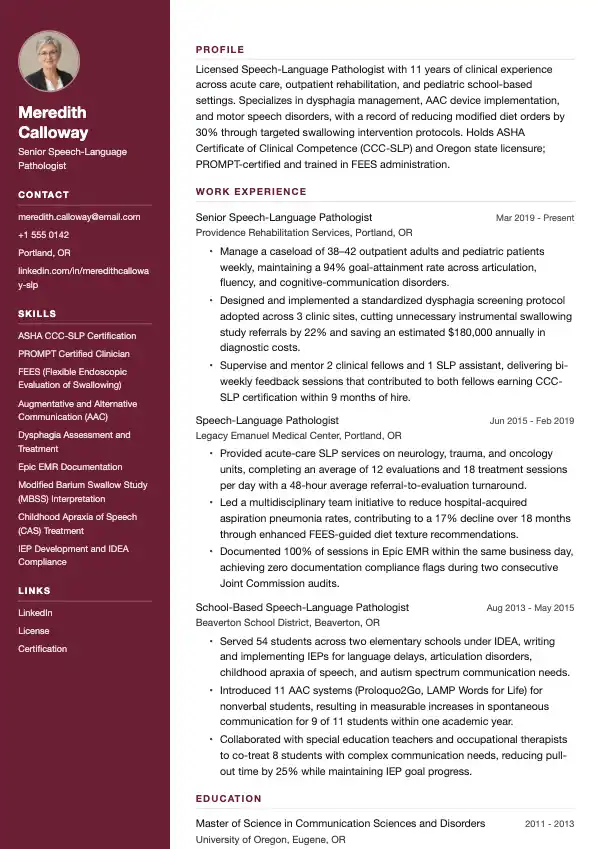
Template: Harbor
Read this resume as text
Meredith Calloway
Senior Speech-Language Pathologist
meredith.calloway@email.com · +1 555 0142 · Portland, OR · linkedin.com/in/meredithcalloway-slp
- Profile
- Licensed Speech-Language Pathologist with 11 years of clinical experience across acute care, outpatient rehabilitation, and pediatric school-based settings. Specializes in dysphagia management, AAC device implementation, and motor speech disorders, with a record of reducing modified diet orders by 30% through targeted swallowing intervention protocols. Holds ASHA Certificate of Clinical Competence (CCC-SLP) and Oregon state licensure; PROMPT-certified and trained in FEES administration.
- Work Experience
Senior Speech-Language Pathologist
Providence Rehabilitation Services, Portland, OR · Mar 2019 - Present
- Manage a caseload of 38–42 outpatient adults and pediatric patients weekly, maintaining a 94% goal-attainment rate across articulation, fluency, and cognitive-communication disorders.
- Designed and implemented a standardized dysphagia screening protocol adopted across 3 clinic sites, cutting unnecessary instrumental swallowing study referrals by 22% and saving an estimated $180,000 annually in diagnostic costs.
- Supervise and mentor 2 clinical fellows and 1 SLP assistant, delivering bi-weekly feedback sessions that contributed to both fellows earning CCC-SLP certification within 9 months of hire.
Speech-Language Pathologist
Legacy Emanuel Medical Center, Portland, OR · Jun 2015 - Feb 2019
- Provided acute-care SLP services on neurology, trauma, and oncology units, completing an average of 12 evaluations and 18 treatment sessions per day with a 48-hour average referral-to-evaluation turnaround.
- Led a multidisciplinary team initiative to reduce hospital-acquired aspiration pneumonia rates, contributing to a 17% decline over 18 months through enhanced FEES-guided diet texture recommendations.
- Documented 100% of sessions in Epic EMR within the same business day, achieving zero documentation compliance flags during two consecutive Joint Commission audits.
School-Based Speech-Language Pathologist
Beaverton School District, Beaverton, OR · Aug 2013 - May 2015
- Served 54 students across two elementary schools under IDEA, writing and implementing IEPs for language delays, articulation disorders, childhood apraxia of speech, and autism spectrum communication needs.
- Introduced 11 AAC systems (Proloquo2Go, LAMP Words for Life) for nonverbal students, resulting in measurable increases in spontaneous communication for 9 of 11 students within one academic year.
- Collaborated with special education teachers and occupational therapists to co-treat 8 students with complex communication needs, reducing pull-out time by 25% while maintaining IEP goal progress.
- Education
Master of Science in Communication Sciences and Disorders
University of Oregon, Eugene, OR · 2011 - 2013
Graduate Thesis: Efficacy of PROMPT Intervention in Children with Childhood Apraxia of Speech — presented at ASHA Annual Convention 2013
Bachelor of Science in Communication Disorders
Oregon State University, Corvallis, OR · 2007 - 2011
Summa Cum Laude; Dean's List all 8 semesters
- Skills
- ASHA CCC-SLP Certification · PROMPT Certified Clinician · FEES (Flexible Endoscopic Evaluation of Swallowing) · Augmentative and Alternative Communication (AAC) · Dysphagia Assessment and Treatment · Epic EMR Documentation · Modified Barium Swallow Study (MBSS) Interpretation · Childhood Apraxia of Speech (CAS) Treatment · IEP Development and IDEA Compliance
- Links
- LinkedIn · License · Certification
What makes this resume work
- The summary names the three distinct settings (acute care, outpatient, school-based) in one sentence, immediately signaling versatility to hiring managers scanning for cross-setting experience.
- Every bullet anchors a clinical action to a quantified result — reduced referrals by 22%, aspiration pneumonia down 17% — giving department heads concrete evidence of impact rather than a list of duties.
- Hard skills are listed as exact credentialing terms (CCC-SLP, PROMPT, FEES, MBSS) that match the precise strings recruiters and ATS engines search, rather than paraphrased descriptions.
- The education section includes a thesis title and conference presentation, differentiating Meredith from candidates with identical degrees and GPA by demonstrating early research engagement.
Keywords that help you pass the ATS
Work the ones that fit your experience into your resume, naturally, not stuffed.
How to write a Speech-Language Pathologist resume
Choose the right format for a Speech-Language Pathologist resume
Use a reverse-chronological format unless you are a new graduate or making a significant specialty switch. Hiring managers in school districts, hospitals, and private practices expect to see your most recent position first, followed by a clear progression of settings and caseload types.
Keep your resume to one page if you have fewer than seven years of experience; two pages are acceptable for experienced SLPs with varied settings, publications, or supervisory history. Use clean section headers, consistent font sizing (10–12 pt body text), and enough white space so that a busy department head can scan it quickly.
- Lead with a professional summary, then licenses/certifications, then work experience, then education
- List setting type next to each job title (e.g., acute care, outpatient pediatric, Title I school district)
- Use a two-column layout only if you are submitting a PDF directly; avoid it for ATS uploads
- Save the file as a PDF unless the job posting explicitly requests a .docx
Write a professional summary that positions your SLP specialty
Your summary should tell the reader your years of experience, the populations you serve, your primary clinical focus, and one measurable outcome — all in three to four sentences. Generic phrases like 'compassionate communicator' waste space; specifics about your caseload or outcomes do not.
Example: "Licensed Speech-Language Pathologist with 8 years of experience across acute care and outpatient rehabilitation settings, specializing in dysphagia management and AAC implementation for adults with acquired neurological conditions. Proficient in MBSS interpretation, FEES procedure support, and PrAACtical AAC frameworks. Reduced 30-day hospital readmission rates related to aspiration pneumonia by 18% through a standardized dysphagia screening protocol introduced at St. Augustine Medical Center."
Write work-experience bullets that show clinical and operational impact
Each bullet should follow an action-verb + task + outcome structure. Quantify wherever possible: caseload size, percentage improvements, number of staff trained, or reduction in wait times. Vague bullets like 'provided therapy services' tell a recruiter nothing about your scope or effectiveness.
Focus on the specific disorders, assessment tools, and intervention approaches you used. A school-based SLP bullet should look different from a hospital-based one.
- Managed a caseload of 62 students (K–8) with language disorders, articulation delays, and autism spectrum disorder; achieved IEP goal attainment rates of 84%, exceeding district average by 11 percentage points
- Conducted MBSS studies in collaboration with radiology staff for 15–20 patients per month, reducing inappropriate diet texture upgrades by 23% over 12 months through evidence-based dysphagia protocol revision
Skills and certifications recruiters and ATS systems look for
Most SLP applications go through an ATS, where recruiters search for credentials and assessment tools by name. Include exact credential abbreviations (CCC-SLP, CF-SLP) and spell out full tool and assessment names so both the system and the reader recognize them. Separate clinical skills from technical or administrative ones.
Certifications beyond your state license and ASHA CCC meaningfully differentiate you — BCS-S (Board Certified Specialist in Swallowing and Swallowing Disorders), PROMPT training level, or LSVT LOUD certification are worth listing explicitly.
- Credentials: CCC-SLP, state licensure (list your state), BCS-S, LSVT LOUD, PROMPT Bridging, SLP-D
- Assessment tools: CELF-5, GFTA-3, VMPAC, PLS-5, ADOS-2 (if trained), MBS Measurement Tool (MBSImP)
- Clinical areas: dysphagia, AAC, aphasia, fluency disorders, voice disorders, pediatric feeding, TBI rehabilitation
- Software and documentation: Theralytics, Fusion Web Clinic, Epic, WebPT, Boardmaker, Snap Core First
- Billing and compliance: IEP development, Medicaid billing codes, Medicare KX modifier threshold awareness, progress note writing
Education, licenses, and extras that close the deal
List your master's degree first (MS or MA in Communication Sciences and Disorders is the standard entry credential in the US), followed by your bachelor's if it adds context. Include institution name, location, graduation year, and GPA only if it was above 3.5 and you graduated within the last five years.
Your ASHA Certificate of Clinical Competence and state license must appear prominently — either in a dedicated 'Licenses & Certifications' section near the top or immediately after your summary. Include license numbers and expiration dates if the job posting requests them. Extras worth adding: clinical fellowship supervisor experience, university adjunct teaching, published case studies in AJSLP or Language Speech and Hearing Services in Schools, ASHA SIG memberships, and bilingual service delivery languages (specify proficiency level).
- List CEU-earning specialty training (e.g., SOS Feeding Approach, DIR/Floortime Level 1) under a 'Professional Development' subsection
- Bilingual SLPs should note languages and whether services are provided in that language clinically, not just conversationally
- Volunteer or pro bono clinic work (e.g., university community clinics) strengthens school-based and nonprofit applications
Mistakes to avoid
- Listing 'ASHA member' without specifying your CCC-SLP status leaves recruiters uncertain whether you have completed your clinical fellowship and hold full certification.
- Using the same resume for school-district and medical-setting applications without tailoring caseload language, assessment tools, and compliance terminology to match the specific setting.
- Omitting caseload size and disorder breakdown from work-experience bullets, which forces hiring managers to guess whether your experience matches their patient population.
- Burying your state license and CCC-SLP credential in the education section rather than surfacing them near the top, causing ATS filters to miss required credential keywords.
Frequently asked questions
- Do I need a separate resume for school-based versus medical SLP jobs?
- Yes, you should tailor each version meaningfully. School-based resumes should emphasize IEP development, IDEA compliance, collaboration with special education teams, and tools like CELF-5 or GFTA-3. Medical resumes should foreground dysphagia protocols, MBSS or FEES experience, Epic documentation, and Medicare/Medicaid billing familiarity. Using one generic resume for both settings will likely rank low in keyword searches and fall flat with a department head who does not see their setting reflected.
- Should a new graduate SLP include their clinical fellowship on their resume?
- Yes — list your CF position exactly as you would a job, noting that it is a supervised clinical fellowship in the title line (e.g., 'Speech-Language Pathologist — Clinical Fellowship, ABC Rehabilitation Center'). Include caseload details, supervisors' specialties, and any measurable outcomes just as you would for a licensed position. If you are still completing your CF, mark the end date as 'present' and note your projected CCC-SLP completion date in your summary.
- How do I show AAC experience on a resume if I have not held a formal AAC specialist title?
- Call it out directly in your bullets with the specific devices and software you have used — Tobii Dynavox, Snap Core First, Proloquo2Go, LAMP Words for Life — and describe the population and outcomes. If you have completed any manufacturer training or attended an AAC institute, list it under professional development. Recruiters hiring for positions with complex communication needs will scan for device names and frameworks, not just the word 'AAC.'
Make it yours in minutes
Open this example in the builder, swap in your details, and export a clean, ATS-ready resume.
Once your resume is ready
More for this application
- Template style
- Nursing resume templates