Resume example
Veterinarian resume example
By the Resumade team · About our content
A veterinarian resume must clear ATS keyword filters built around AVMA competencies and convince a practice owner you can handle real caseloads independently. This example leads with specialty depth, hard patient-outcome numbers, and protocol-level detail that generic resumes never include.
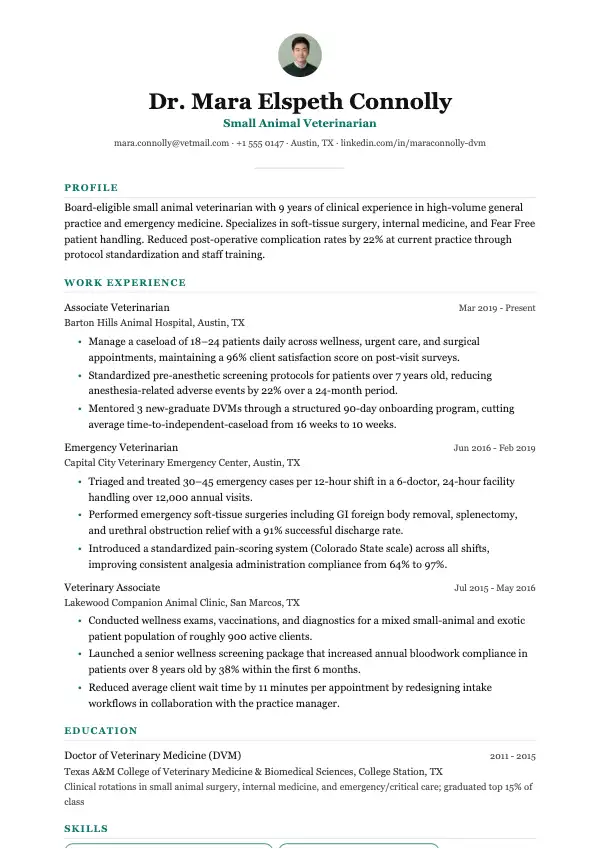
Template: Classic
Read this resume as text
Dr. Mara Elspeth Connolly
Small Animal Veterinarian
mara.connolly@vetmail.com · +1 555 0147 · Austin, TX · linkedin.com/in/maraconnolly-dvm
- Profile
- Board-eligible small animal veterinarian with 9 years of clinical experience in high-volume general practice and emergency medicine. Specializes in soft-tissue surgery, internal medicine, and Fear Free patient handling. Reduced post-operative complication rates by 22% at current practice through protocol standardization and staff training.
- Work Experience
Associate Veterinarian
Barton Hills Animal Hospital, Austin, TX · Mar 2019 - Present
- Manage a caseload of 18–24 patients daily across wellness, urgent care, and surgical appointments, maintaining a 96% client satisfaction score on post-visit surveys.
- Standardized pre-anesthetic screening protocols for patients over 7 years old, reducing anesthesia-related adverse events by 22% over a 24-month period.
- Mentored 3 new-graduate DVMs through a structured 90-day onboarding program, cutting average time-to-independent-caseload from 16 weeks to 10 weeks.
Emergency Veterinarian
Capital City Veterinary Emergency Center, Austin, TX · Jun 2016 - Feb 2019
- Triaged and treated 30–45 emergency cases per 12-hour shift in a 6-doctor, 24-hour facility handling over 12,000 annual visits.
- Performed emergency soft-tissue surgeries including GI foreign body removal, splenectomy, and urethral obstruction relief with a 91% successful discharge rate.
- Introduced a standardized pain-scoring system (Colorado State scale) across all shifts, improving consistent analgesia administration compliance from 64% to 97%.
Veterinary Associate
Lakewood Companion Animal Clinic, San Marcos, TX · Jul 2015 - May 2016
- Conducted wellness exams, vaccinations, and diagnostics for a mixed small-animal and exotic patient population of roughly 900 active clients.
- Launched a senior wellness screening package that increased annual bloodwork compliance in patients over 8 years old by 38% within the first 6 months.
- Reduced average client wait time by 11 minutes per appointment by redesigning intake workflows in collaboration with the practice manager.
- Education
Doctor of Veterinary Medicine (DVM)
Texas A&M College of Veterinary Medicine & Biomedical Sciences, College Station, TX · 2011 - 2015
Clinical rotations in small animal surgery, internal medicine, and emergency/critical care; graduated top 15% of class
- Skills
- Small Animal Surgery (soft-tissue & orthopedic) · Emergency & Critical Care Medicine · Diagnostic Imaging (digital radiography, abdominal ultrasound) · Anesthesia Monitoring & Protocol Design · Fear Free Certified Professional (FFCP) · Internal Medicine – endocrinology, gastroenterology · Veterinary Client Communication & Case Presentation · IDEXX & Heska in-house laboratory platforms · DEA Registered – Schedule II–V controlled substances
- Links
- LinkedIn: linkedin.com/in/maraconnolly-dvm · License: Texas Veterinary License #TX-DVM-48821 (verifiable via state board)
What makes this resume work
- The summary names board-eligibility, years of experience, and a headline metric (22% complication reduction) in three sentences — giving a hiring manager an immediate reason to keep reading.
- Each bullet opens with a strong action verb and closes with a specific number (percentages, patient counts, time savings), making impact concrete rather than claimed.
- Skills are grouped by clinical relevance — surgery, diagnostics, certification, platform — so ATS systems parsing for Fear Free, IDEXX, or anesthesia terms score the resume highly.
- Two distinct practice settings (emergency center plus general practice) are shown in sequence, demonstrating clinical range without needing a separate 'areas of expertise' box that wastes space.
Keywords that help you pass the ATS
Work the ones that fit your experience into your resume, naturally, not stuffed.
How to write a Veterinarian resume
Choose the right format for a Veterinarian resume
Use a reverse-chronological format. Hiring managers at private practices, corporate groups like VCA or Banfield, and specialty hospitals all expect to see your most recent role first. A functional or hybrid format raises red flags unless you are making a significant specialty switch, such as moving from mixed-animal practice to research.
Keep the resume to one page if you have fewer than eight years of experience; two pages are acceptable for specialists, academics, or those with extensive publication records. Use clean section headers, consistent font sizing (10–12 pt body, 14–16 pt name), and at least 0.5-inch margins. Submit as a PDF unless the job posting explicitly requests a Word file.
- Lead with your name, license number(s), and state(s) of licensure directly under your contact information
- Place DEA registration status in the header or summary if you hold one — many practices filter on this immediately
- List board certifications (DACVIM, DACVS, DACVECC, etc.) after your name using standard AVMA abbreviations
- Avoid photos, graphics, or tables — applicant tracking systems used by corporate groups often misparse them
Write a professional summary that earns a second look
Your summary is three to four sentences that answer: what species and practice type you know, what you do especially well clinically, and what you bring to this specific role. Skip objectives and generic phrases like 'passionate animal lover.' Recruiters read dozens of those.
Here is a concrete example for a small-animal associate candidate: "Small-animal veterinarian with 6 years of experience in high-volume general practice, averaging 18–22 appointments daily. Proficient in soft-tissue surgery, digital radiography interpretation, and Fear Free handling techniques. Experienced with Cornerstone and Avimark practice management software. Seeking an associate role with mentorship in minimally invasive procedures at a progressive AAHA-accredited hospital."
Write work-experience bullets that show clinical and business impact
Each bullet should follow an action-verb + task + measurable result structure. Veterinary hiring managers care about caseload volume, surgery numbers, revenue contribution, client retention, and patient outcomes. If your practice used VetSuccess or Rapport dashboards, you likely have access to real numbers — use them.
Avoid vague bullets like 'performed surgeries' or 'worked with clients.' Specificity signals competence.
- Performed an average of 12 soft-tissue and orthopedic surgeries per week, including tibial plateau leveling osteotomy (TPLO) and gastropexy, maintaining a less-than-2% complication rate over 3 years
- Increased preventive care compliance by 31% over 18 months by implementing a structured wellness reminder protocol in Avimark, directly contributing to $94,000 in additional annual revenue
Skills and certifications recruiters and ATS systems look for
Corporate groups and specialty hospitals run resumes through ATS platforms before a human reads them. Include a dedicated Skills section with exact terminology. Mix hard clinical skills with software and soft skills relevant to practice management.
Certifications beyond your DVM carry real weight. Fear Free Certified Professional and Low Stress Handling certification are valued by many progressive practices. RECOVER certification signals emergency readiness. Any RACE-approved CE hours in a relevant specialty are worth listing.
- Clinical skills: ultrasonography, endoscopy, laparoscopy, digital dental radiography, in-house laboratory interpretation (Idexx, Heska)
- Software: Cornerstone, Avimark, ezyVet, Shepherd, VetSuccess Analytics
- Certifications: Fear Free Certified Professional (FFCP), RECOVER CPR certification, USDA Accreditation (Category I or II), DEA Schedule II–V registration
- Soft skills worth naming: client communication, multilingual consultation (if applicable), mentorship of technicians and interns
- Species-specific keywords: small animal, equine, bovine, exotic/avian, zoo/wildlife — only list what you actually practice
Education, licenses, and extras that complete the picture
List your DVM or VMD with institution, graduation year, and any honors such as class rank or research distinction. If you completed an internship or residency, list it separately above your general education block — it functions more like work experience and should be treated accordingly. AVMA-accredited international degrees should note accreditation status explicitly.
Under a Licenses & Certifications section, list every active state veterinary license with its number and expiration year. If you are licensed in multiple states, list all of them — multi-state licensure is a genuine differentiator for relief veterinarians and telehealth roles. Include DEA registration, USDA accreditation, and any controlled substance registrations. Publications, conference presentations, or AVMA/AAHA committee involvement belong in a brief Extras or Professional Affiliations section at the bottom.
Mistakes to avoid
- Omitting your state license number and DEA status forces recruiters to follow up before they can even verify eligibility, which often means your resume gets skipped.
- Using species or procedure terms inconsistently — writing 'TPLO' in one place and 'tibial plateau leveling osteotomy' nowhere else — causes ATS systems to miss keyword matches for specialty roles.
- Listing continuing education hours as a lump total ('120 CE hours completed') instead of naming relevant courses gives hiring managers no signal about your actual clinical focus areas.
- Writing a summary or bullet points calibrated to a general audience rather than the specific practice type — a mixed-animal rural practice and a veterinary oncology referral center need completely different emphasis, and sending the same resume to both hurts your chances at both.
Frequently asked questions
- Should I include my NAVLE score or class rank on a Veterinarian resume?
- Only include your NAVLE score if you are a new graduate and it was notably high, and even then it is optional — most hiring veterinarians do not request it. Class rank is worth listing if you graduated in the top 10–15% and your school reports it. After your first associate role, drop both and let your clinical record speak.
- How do I list a veterinary internship on my resume?
- Treat a rotating or specialty internship as a full work-experience entry, not as education. Place it in your Experience section with the hospital name, location, internship title, and dates, then write two to four bullets describing caseload, procedures, and any measurable outcomes. This is especially important for new graduates because it is often the most substantive clinical experience on the page.
- Do relief veterinarians need a different resume format?
- Yes. If you work relief through a platform like Relief Rover or independently across multiple practices, group your relief work under a single 'Relief Veterinarian (Independent Contractor)' header with a date range, then list the practice types and species seen as sub-bullets rather than separate jobs. This prevents the resume from looking like a series of short tenures and makes your breadth of experience readable at a glance.
Make it yours in minutes
Open this example in the builder, swap in your details, and export a clean, ATS-ready resume.
Once your resume is ready
More for this application
- Template style
- Professional resume templates