Resume example
Veterinary Technician resume example
By the Resumade team · About our content
A strong Veterinary Technician resume must clear ATS filters loaded with procedure-specific terminology while showing a hiring manager measurable clinical competence. This example does both: it surfaces licensure, specialty keywords, and hard numbers in every bullet.
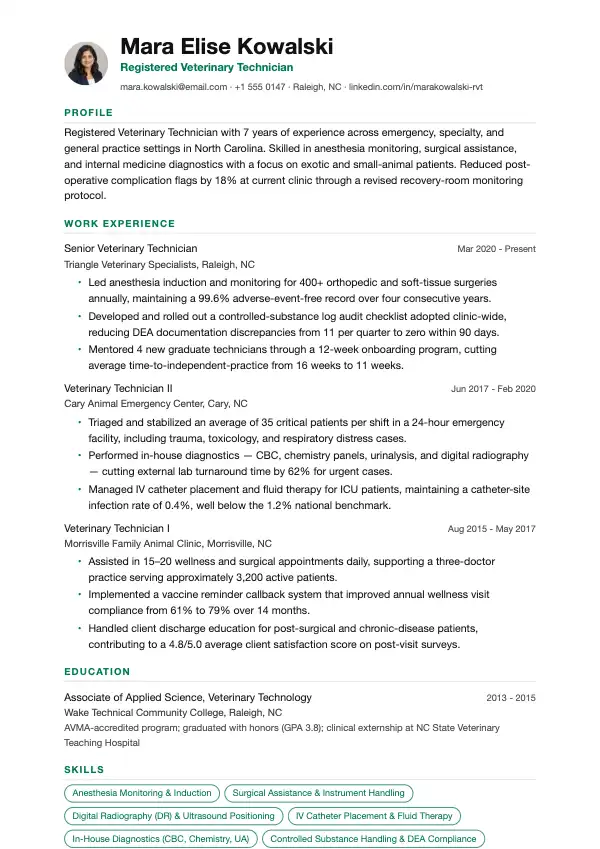
Template: Modern
Read this resume as text
Mara Elise Kowalski
Registered Veterinary Technician
mara.kowalski@email.com · +1 555 0147 · Raleigh, NC · linkedin.com/in/marakowalski-rvt
- Profile
- Registered Veterinary Technician with 7 years of experience across emergency, specialty, and general practice settings in North Carolina. Skilled in anesthesia monitoring, surgical assistance, and internal medicine diagnostics with a focus on exotic and small-animal patients. Reduced post-operative complication flags by 18% at current clinic through a revised recovery-room monitoring protocol.
- Work Experience
Senior Veterinary Technician
Triangle Veterinary Specialists, Raleigh, NC · Mar 2020 - Present
- Led anesthesia induction and monitoring for 400+ orthopedic and soft-tissue surgeries annually, maintaining a 99.6% adverse-event-free record over four consecutive years.
- Developed and rolled out a controlled-substance log audit checklist adopted clinic-wide, reducing DEA documentation discrepancies from 11 per quarter to zero within 90 days.
- Mentored 4 new graduate technicians through a 12-week onboarding program, cutting average time-to-independent-practice from 16 weeks to 11 weeks.
Veterinary Technician II
Cary Animal Emergency Center, Cary, NC · Jun 2017 - Feb 2020
- Triaged and stabilized an average of 35 critical patients per shift in a 24-hour emergency facility, including trauma, toxicology, and respiratory distress cases.
- Performed in-house diagnostics — CBC, chemistry panels, urinalysis, and digital radiography — cutting external lab turnaround time by 62% for urgent cases.
- Managed IV catheter placement and fluid therapy for ICU patients, maintaining a catheter-site infection rate of 0.4%, well below the 1.2% national benchmark.
Veterinary Technician I
Morrisville Family Animal Clinic, Morrisville, NC · Aug 2015 - May 2017
- Assisted in 15–20 wellness and surgical appointments daily, supporting a three-doctor practice serving approximately 3,200 active patients.
- Implemented a vaccine reminder callback system that improved annual wellness visit compliance from 61% to 79% over 14 months.
- Handled client discharge education for post-surgical and chronic-disease patients, contributing to a 4.8/5.0 average client satisfaction score on post-visit surveys.
- Education
Associate of Applied Science, Veterinary Technology
Wake Technical Community College, Raleigh, NC · 2013 - 2015
AVMA-accredited program; graduated with honors (GPA 3.8); clinical externship at NC State Veterinary Teaching Hospital
- Skills
- Anesthesia Monitoring & Induction · Surgical Assistance & Instrument Handling · Digital Radiography (DR) & Ultrasound Positioning · IV Catheter Placement & Fluid Therapy · In-House Diagnostics (CBC, Chemistry, UA) · Controlled Substance Handling & DEA Compliance · Exotic & Small Animal Restraint · Registered Veterinary Technician (RVT) — NC License #RVT-28741 · Fear Free Certified Professional (FFCP)
- Links
- LinkedIn: linkedin.com/in/marakowalski-rvt · License: North Carolina RVT License #RVT-28741 (verifiable via state board)
What makes this resume work
- The summary names seniority, practice types, and one headline metric — the 18% complication-flag reduction — so a hiring manager knows the candidate's value before reading a single bullet.
- Every experience bullet opens with a distinct action verb (Led, Developed, Triaged, Performed, Managed, Implemented) and closes with a quantified outcome, eliminating vague filler and giving proof of impact.
- Hard skills are listed as discrete, searchable phrases — 'DEA Compliance,' 'Fear Free Certified,' 'IV Catheter Placement' — matching the exact language recruiters and ATS systems use to filter applicants.
- Including the NC license number and the board that issued it signals professional credibility instantly and removes friction for credentialing staff who must confirm licensure before extending an offer.
Keywords that help you pass the ATS
Work the ones that fit your experience into your resume, naturally, not stuffed.
How to write a Veterinary Technician resume
Choose the right format for a Veterinary Technician resume
Use a reverse-chronological format unless you are switching specialties or re-entering the field after a gap. Hiring managers at clinics, emergency hospitals, and specialty practices scan quickly, so keep your resume to one page if you have fewer than ten years of experience, and two pages maximum if you hold an advanced certification or have worked in multiple specialty areas.
Use clear section headers, consistent font sizes (10–12pt body, 14–16pt name), and enough white space to make the document readable on screen and in print. Avoid tables and text boxes — many applicant tracking systems used by larger veterinary groups and corporate chains like VCA, Banfield, and BluePearl will scramble them.
- Reverse-chronological order for most candidates
- One page for under 10 years of experience
- Standard fonts: Calibri, Arial, or Georgia
- No tables, text boxes, or embedded images
- Save and submit as a PDF unless the posting specifies otherwise
Write a professional summary that gets you past the first scan
Your summary sits directly below your name and contact information. It should be three to four sentences that state your credential, years of experience, the patient populations you know best, and one or two clinical strengths. Avoid vague openers like 'hardworking team player.' Be specific about species, settings, and skills.
Example: "Licensed Veterinary Technician (LVT) with 6 years of experience in high-volume emergency and critical care settings. Proficient in anesthesia monitoring, IV catheter placement, and ventilator management for canine, feline, and avian patients. Experienced with Idexx Cornerstone and ezyVet practice management software. VTS (ECC) candidate completing final case logs for submission in 2027."
Write work-experience bullets that show clinical impact
Each bullet should follow an action verb + task + result or scale format. Quantify wherever possible: number of patients seen per shift, surgery caseload, staff you trained, or efficiency gains you contributed to. Avoid describing your duties in generic terms — 'assisted veterinarians' tells a hiring manager nothing.
Focus on technical procedures, equipment you operated, and any leadership or mentorship responsibilities. Specialty practices in particular want to see procedure-specific language that matches their caseload.
- Monitored anesthesia for 12–18 patients per shift across soft-tissue and orthopedic surgeries, maintaining zero adverse intraoperative events over a 24-month period.
- Trained and onboarded 7 new veterinary assistants on venipuncture, catheter placement, and restraint techniques, reducing orientation time from 4 weeks to 2.5 weeks.
Include the skills and certifications ATS systems and recruiters actually search for
List your state license and any national credentials prominently — either in a dedicated certifications section or directly after your name in the header. Recruiters at corporate veterinary groups often search for 'LVT,' 'CVT,' 'RVT,' or 'LVMT' by name. Include the full term and the abbreviation.
Your skills section should reflect the actual tools and procedures of the role you are targeting. A general practice position calls for different keywords than an emergency, oncology, or zoo medicine posting.
- Credentials: LVT, CVT, RVT, LVMT, VTS (specialty area), Fear Free Certified Professional
- Clinical skills: anesthesia induction and monitoring, endotracheal intubation, IV/IO catheter placement, blood draws, urinalysis, digital radiography, dental prophylaxis
- Equipment: Surgivet monitors, Mindray patient monitors, DR digital X-ray systems, i-STAT analyzers, Idexx in-house analyzers
- Software: Cornerstone, AVImark, ezyVet, Shepherd, ImproMed
- Soft skills worth naming: triage prioritization, client communication, controlled substance log compliance
List your education, licenses, and extras correctly
Include your Associate of Applied Science in Veterinary Technology (or bachelor's degree if applicable), the school name, and graduation year. You do not need to list your GPA unless you graduated within the past two years and it is above 3.5. Place your state license number and expiration date in this section or in your header — many hiring managers require it before scheduling an interview.
Add continuing education, species-specific training, or relevant volunteer experience below your formal education. Completing wet labs through NAVC, VetMedTeam, or your state VMA annual conference is worth listing if it demonstrates a skill relevant to the job. RECOVER CPR certification is worth including if you hold it.
- State veterinary technician license: include license number and expiration date
- VTNE passage implied by licensure — no need to list the exam separately
- RECOVER CPR certification
- NAVTA membership or committee involvement if applicable
- Species endorsements or exotics training if targeting a specialty or zoo practice
Mistakes to avoid
- Listing your credential only as an abbreviation without spelling it out at least once causes ATS filters to miss your application when employers search for 'Licensed Veterinary Technician' as a full phrase.
- Writing 'assisted with surgeries' or 'helped veterinarians' instead of naming the specific procedures you performed independently makes your technical competency invisible to reviewers.
- Omitting your state license number and expiration date forces hiring managers to follow up before they can move you forward, which often means they move on to another candidate instead.
- Using a single generic resume for every application rather than swapping in keywords from the specific job posting (emergency vs. general practice vs. specialty) dramatically reduces your match rate with ATS screening tools.
Frequently asked questions
- Should I put my LVT or RVT credential after my name on my resume?
- Yes — place your primary credential directly after your name in the header, for example 'Jordan Mills, LVT.' This immediately signals your licensure status before a recruiter reads a single line of your resume. If you hold a VTS designation, add that as well.
- How do I write a Veterinary Technician resume if I just graduated and have no paid experience?
- Lead with your externship hours and clinical rotations, naming the practice types, species, and procedures you completed. Include any veterinary assistant, kennel technician, or animal shelter volunteer work, and list the specific hands-on skills you performed in each role. New graduates who itemize clinical competencies clearly compete effectively against candidates with short paid work histories.
- Do I need a different resume to apply to specialty or emergency practices versus general practice?
- Yes, and the difference matters more than in most professions. Emergency and specialty employers screen for procedure-specific language — ventilator management, chemotherapy administration, advanced anesthesia monitoring — that general practice postings rarely mention. Review the job description carefully and mirror its terminology in your bullets and skills section to pass both ATS filters and clinical director review.
Make it yours in minutes
Open this example in the builder, swap in your details, and export a clean, ATS-ready resume.
Once your resume is ready
More for this application
- Template style
- Nursing resume templates