Resume example
Occupational Therapist resume example
By the Resumade team · About our content
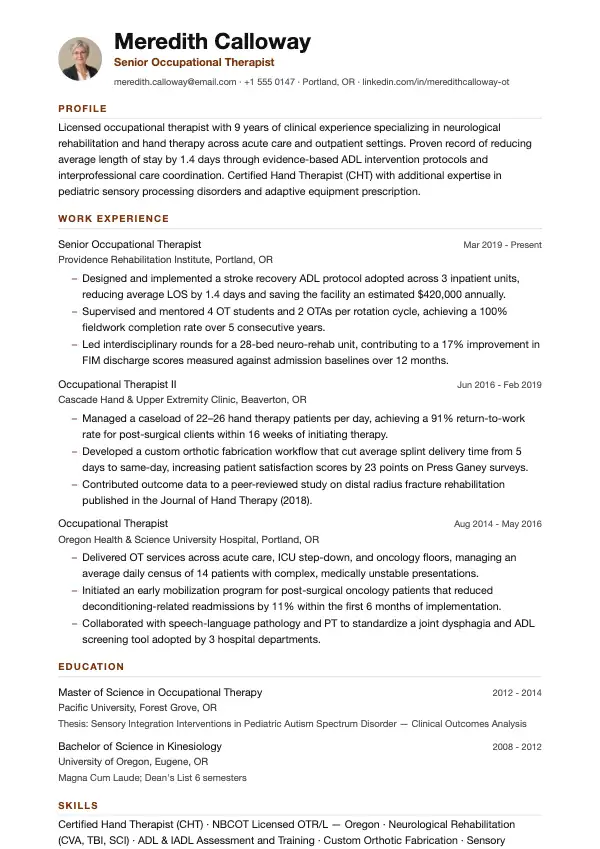
An OT resume must satisfy ATS keyword scans for licensure, clinical settings, and assessment tools while giving hiring managers instant proof of patient outcomes. This example front-loads credentials and quantifies impact at every role.
Template: Wren
Read this resume as text
Meredith Calloway
Senior Occupational Therapist
meredith.calloway@email.com · +1 555 0147 · Portland, OR · linkedin.com/in/meredithcalloway-ot
- Profile
- Licensed occupational therapist with 9 years of clinical experience specializing in neurological rehabilitation and hand therapy across acute care and outpatient settings. Proven record of reducing average length of stay by 1.4 days through evidence-based ADL intervention protocols and interprofessional care coordination. Certified Hand Therapist (CHT) with additional expertise in pediatric sensory processing disorders and adaptive equipment prescription.
- Work Experience
Senior Occupational Therapist
Providence Rehabilitation Institute, Portland, OR · Mar 2019 - Present
- Designed and implemented a stroke recovery ADL protocol adopted across 3 inpatient units, reducing average LOS by 1.4 days and saving the facility an estimated $420,000 annually.
- Supervised and mentored 4 OT students and 2 OTAs per rotation cycle, achieving a 100% fieldwork completion rate over 5 consecutive years.
- Led interdisciplinary rounds for a 28-bed neuro-rehab unit, contributing to a 17% improvement in FIM discharge scores measured against admission baselines over 12 months.
Occupational Therapist II
Cascade Hand & Upper Extremity Clinic, Beaverton, OR · Jun 2016 - Feb 2019
- Managed a caseload of 22–26 hand therapy patients per day, achieving a 91% return-to-work rate for post-surgical clients within 16 weeks of initiating therapy.
- Developed a custom orthotic fabrication workflow that cut average splint delivery time from 5 days to same-day, increasing patient satisfaction scores by 23 points on Press Ganey surveys.
- Contributed outcome data to a peer-reviewed study on distal radius fracture rehabilitation published in the Journal of Hand Therapy (2018).
Occupational Therapist
Oregon Health & Science University Hospital, Portland, OR · Aug 2014 - May 2016
- Delivered OT services across acute care, ICU step-down, and oncology floors, managing an average daily census of 14 patients with complex, medically unstable presentations.
- Initiated an early mobilization program for post-surgical oncology patients that reduced deconditioning-related readmissions by 11% within the first 6 months of implementation.
- Collaborated with speech-language pathology and PT to standardize a joint dysphagia and ADL screening tool adopted by 3 hospital departments.
- Education
Master of Science in Occupational Therapy
Pacific University, Forest Grove, OR · 2012 - 2014
Thesis: Sensory Integration Interventions in Pediatric Autism Spectrum Disorder — Clinical Outcomes Analysis
Bachelor of Science in Kinesiology
University of Oregon, Eugene, OR · 2008 - 2012
Magna Cum Laude; Dean's List 6 semesters
- Skills
- Certified Hand Therapist (CHT) · NBCOT Licensed OTR/L — Oregon · Neurological Rehabilitation (CVA, TBI, SCI) · ADL & IADL Assessment and Training · Custom Orthotic Fabrication · Sensory Integration Therapy · FIM & COPM Outcome Measurement · Epic EMR & ReDoc Documentation · Adaptive Equipment Prescription & Training
- Links
- LinkedIn: linkedin.com/in/meredithcalloway-ot · License: Oregon Occupational Therapist License #OTR-024891 (verifiable via state board) · Portfolio: meredithcalloway.com/clinical-outcomes
What makes this resume work
- The summary names licensure (OTR/L, CHT), years of experience, and two distinct specialisms in three sentences — giving recruiters everything they need to shortlist before reading a single bullet.
- Every bullet opens with a strong action verb and closes with a specific number — dollar savings, percentage improvements, or patient volume — making clinical impact tangible rather than assumed.
- Skills are listed as discrete, searchable terms (Epic EMR, FIM, COPM, CHT) that mirror the exact language used in job postings and ATS databases, not vague descriptors.
- Including a published journal contribution and a thesis topic signals scholarly credibility and differentiates this candidate from peers with identical clinical hours but no research footprint.
Keywords that help you pass the ATS
Work the ones that fit your experience into your resume, naturally, not stuffed.
How to write an Occupational Therapist resume
Choose the right format for an Occupational Therapist resume
Recruiters spend about seven seconds on a first scan (Ladders eye-tracking study, 2018), so a clean chronological format works best. List your most recent position first, keep margins between 0.75 and 1 inch, and use a single readable font like Calibri or Georgia at 10–12pt. Two pages are acceptable once you have more than five years of experience; one page is fine for new graduates or those coming straight out of a fieldwork placement.
Use clearly labeled sections so applicant tracking systems (ATS) used by hospital networks like HCA Healthcare or Kaiser Permanente can parse your file. Save as a PDF unless the posting explicitly requests a Word document. Avoid tables, text boxes, and headers embedded in the document footer — these break ATS parsing and can cause your license number or certifications to disappear from the extracted text.
- Chronological order for experienced OTs; functional or hybrid only if you are changing specialties
- File name: FirstName-LastName-OT-Resume.pdf
- Section order: Contact info → Summary → Licensure → Experience → Skills → Education → Certifications
Write a professional summary that targets the specific OT role
Your summary sits directly below your name and contact block. It should be three to four sentences that name your specialty, years of experience, one or two measurable achievements, and the setting you work in — acute care, pediatric outpatient, skilled nursing, school-based, or home health. Avoid vague openers like 'dedicated professional.' Recruiters reading for a pediatric sensory integration role need to see that specialty in the first line.
Example: "Licensed Occupational Therapist (OTR/L) with 7 years of experience in pediatric outpatient settings specializing in sensory processing disorders and fine motor development. Consistently maintain a caseload of 45+ patients per week while achieving a 92% goal-attainment rate across IEP-aligned treatment plans. Certified in the Sensory Integration and Praxis Tests (SIPT) and trained in DIR/Floortime. Seeking to bring evidence-based pediatric OT practice to the outpatient clinic team at Children's Health."
Write work-experience bullets that show outcomes, not just duties
Each bullet should follow an action verb → intervention or system → measurable result structure. Avoid listing job duties copied from a position description. Hiring managers already know OTs conduct evaluations and write SOAP notes — show what your work produced. Use numbers wherever possible: caseload size, discharge rates, productivity percentages, patient satisfaction scores, or program outcomes.
Pull data from your productivity reports, department dashboards, or annual reviews. Even estimates with context ('approximately,' 'average of') are more persuasive than no numbers at all.
- Reduced average length of stay by 1.3 days for post-surgical orthopedic patients by implementing a standardized ADL retraining protocol across a 22-bed acute care unit.
- Grew a school-based OT caseload from 38 to 67 students over 18 months by collaborating with special education coordinators to identify unserved students qualifying under IDEA Part B.
Skills and certifications recruiters and ATS systems look for
Include a dedicated skills section with both clinical competencies and the specific assessments, frames of reference, and software platforms you use. ATS systems at large health systems keyword-match against the job description, so mirror the language in the posting. List certifications separately with the issuing body and expiration or renewal date.
Specialty certifications — such as hand therapy (CHT) or low vision — can set you apart for senior roles. If you use documentation platforms daily, name them explicitly.
- Assessments: COPM, FIM, KELS, BOT-2, SIPT, AMPS, Allen Cognitive Level Screen
- Frames of reference: Biomechanical, Sensory Integration, Model of Human Occupation (MOHO), Cognitive Disabilities
- Documentation platforms: Epic, Cerner, WebPT, Raintree
- Certifications worth listing: CHT (Hand Therapy Certification Commission), SIPT certification, CAPS (Certified Aging-in-Place Specialist), NDT, LSVT BIG
- Soft skills to name specifically: interdisciplinary team collaboration, caregiver training, IEP/IFSP development
Education, licenses, and extras that complete the picture
List your degree (MOT, MSOT, or OTD), institution, and graduation year. If you graduated within the last three years, include your GPA if it was 3.5 or above and note any Level II fieldwork distinctions. Your NBCOT certification (OTR or COTA) and state license number must appear on the resume — many hospital credentialing teams check both before passing the file to the hiring manager. List every active state license if you hold more than one.
Add a separate line for continuing education courses that are directly relevant to the target role, particularly if you lack a formal specialty certification. Membership in AOTA or a state OT association signals professional engagement and is worth a single line. If you have published, presented at AOTA Annual Conference, or contributed to program development, add a brief Publications or Presentations section at the bottom.
- Format: Doctor of Occupational Therapy (OTD), University of Southern California, 2019
- License line: OTR/L — California License #XXXXXXX, expires 12/2027; NBCOT Certified
- Include CPR/BLS certification with expiration date — many facilities require it at hire
Mistakes to avoid
- Listing 'NBCOT certified' without including your actual license number forces recruiters to make an extra verification step and often gets your application deprioritized.
- Using productivity language like 'maintained high caseload' instead of a specific number undersells your capacity — many OT roles have explicit productivity targets, so showing you met or exceeded them matters.
- Omitting the clinical setting from each job entry (acute care, SNF, outpatient, school-based) makes it impossible for a recruiter to quickly assess whether your experience matches the open position.
- Copying the same generic summary and skills section across every application instead of mirroring the specialty language in each job posting causes ATS keyword mismatches and lower ranking in applicant queues.
Frequently asked questions
- Should I include my NBCOT number on my OT resume?
- Yes, include both your state license number and your NBCOT certification status. Many hospital systems and school districts run a credential check before forwarding your resume to the hiring manager, and having the number visible speeds up that process. Format it clearly under a 'Licensure' heading near the top of the document.
- How long should an Occupational Therapist resume be?
- One page is appropriate for new graduates and OTs with fewer than five years of experience. Two pages are standard once you have multiple settings, specialty certifications, or program development work to document. A third page is rarely justified unless you have an extensive publication or presentation record.
- Do I need a different resume for school-based OT versus hospital OT jobs?
- Yes, and the differences go beyond swapping a few words. School-based roles require you to emphasize IEP and IFSP experience, IDEA Part B knowledge, collaboration with special education teams, and assessments like the BOT-2 or SIPT. Hospital roles prioritize FIM scoring, discharge planning, productivity metrics, and EMR platforms like Epic or Cerner. Tailor your summary, skills section, and bullet emphasis for each setting.
Make it yours in minutes
Open this example in the builder, swap in your details, and export a clean, ATS-ready resume.
Once your resume is ready
More for this application
- Template style
- Nursing resume templates