Resume example
Pilot resume example
By the Resumade team · About our content
A Pilot resume must clear FAA credential filters and airline ATS keyword scans before a chief pilot ever reads it. This example leads with certifications, type ratings, and verified block hours so nothing critical is buried.
Template: Graphite
Read this resume as text
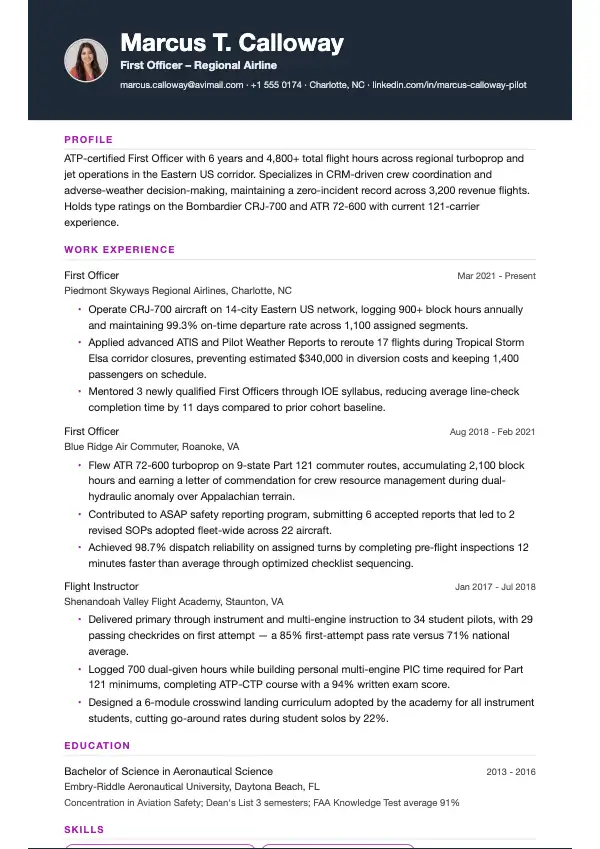
Marcus T. Calloway
First Officer – Regional Airline
marcus.calloway@avimail.com · +1 555 0174 · Charlotte, NC · linkedin.com/in/marcus-calloway-pilot
- Profile
- ATP-certified First Officer with 6 years and 4,800+ total flight hours across regional turboprop and jet operations in the Eastern US corridor. Specializes in CRM-driven crew coordination and adverse-weather decision-making, maintaining a zero-incident record across 3,200 revenue flights. Holds type ratings on the Bombardier CRJ-700 and ATR 72-600 with current 121-carrier experience.
- Work Experience
First Officer
Piedmont Skyways Regional Airlines, Charlotte, NC · Mar 2021 - Present
- Operate CRJ-700 aircraft on 14-city Eastern US network, logging 900+ block hours annually and maintaining 99.3% on-time departure rate across 1,100 assigned segments.
- Applied advanced ATIS and Pilot Weather Reports to reroute 17 flights during Tropical Storm Elsa corridor closures, preventing estimated $340,000 in diversion costs and keeping 1,400 passengers on schedule.
- Mentored 3 newly qualified First Officers through IOE syllabus, reducing average line-check completion time by 11 days compared to prior cohort baseline.
First Officer
Blue Ridge Air Commuter, Roanoke, VA · Aug 2018 - Feb 2021
- Flew ATR 72-600 turboprop on 9-state Part 121 commuter routes, accumulating 2,100 block hours and earning a letter of commendation for crew resource management during dual-hydraulic anomaly over Appalachian terrain.
- Contributed to ASAP safety reporting program, submitting 6 accepted reports that led to 2 revised SOPs adopted fleet-wide across 22 aircraft.
- Achieved 98.7% dispatch reliability on assigned turns by completing pre-flight inspections 12 minutes faster than average through optimized checklist sequencing.
Flight Instructor
Shenandoah Valley Flight Academy, Staunton, VA · Jan 2017 - Jul 2018
- Delivered primary through instrument and multi-engine instruction to 34 student pilots, with 29 passing checkrides on first attempt — a 85% first-attempt pass rate versus 71% national average.
- Logged 700 dual-given hours while building personal multi-engine PIC time required for Part 121 minimums, completing ATP-CTP course with a 94% written exam score.
- Designed a 6-module crosswind landing curriculum adopted by the academy for all instrument students, cutting go-around rates during student solos by 22%.
- Education
Bachelor of Science in Aeronautical Science
Embry-Riddle Aeronautical University, Daytona Beach, FL · 2013 - 2016
Concentration in Aviation Safety; Dean's List 3 semesters; FAA Knowledge Test average 91%
- Skills
- ATP Certificate – Airplane Multiengine Land · Type Rating: Bombardier CRJ-700 · Type Rating: ATR 72-600 · FAA Part 121 Operations · Crew Resource Management (CRM) · FOQA / ASAP Safety Reporting · Jeppesen Charts & FMS Programming · Adverse Weather Decision-Making · RVSM / RNAV / RNP Operations
- Links
- LinkedIn: linkedin.com/in/marcus-calloway-pilot · Certificate: FAA Airline Transport Pilot certificate (verifiable via FAA Airmen Inquiry)
What makes this resume work
- The summary opens with ATP certification and a precise 4,800-hour total, the two figures airline recruiters filter on first, before any other context is given.
- Each bullet pairs an operational action with a dollar figure, percentage, or flight-count so the hiring manager can gauge scale and impact without reading between the lines.
- Hard skills are listed as recruiters search them — 'Type Rating: CRJ-700' not just 'jet experience' — directly matching the language in FAA and airline job postings.
- Three roles tell a clear progression story: CFI building hours, regional turboprop Part 121, then jet upgrade, which matches the exact pathway airline HR teams expect to see.
Keywords that help you pass the ATS
Work the ones that fit your experience into your resume, naturally, not stuffed.
How to write a Pilot resume
Choose the right format for a Pilot resume
Use a reverse-chronological format. Airline and charter hiring managers scan resumes quickly, and they want your most recent aircraft type, total flight hours, and certificates visible immediately — not buried under an objective statement or a skills matrix.
Keep the resume to one page if you have fewer than ten years of experience; two pages are acceptable for captains or pilots with type ratings on multiple aircraft. Use clean section headers, consistent font sizing (10–12 pt), and no graphics or tables that break applicant tracking systems used by major carriers like Delta, United, and Southwest.
- Place total flight hours, PIC hours, and instrument hours in your summary or a dedicated 'Flight Hours' snapshot near the top
- List your highest certificate and active medical class in the header alongside your name and contact information
- Use standard section labels (Experience, Certifications, Education) so ATS parses your resume correctly
- Avoid multi-column layouts — many airline HR systems read left to right and will scramble columns
Write a professional summary that grounds the hiring manager fast
Your summary should function like a clearance readback: concise, accurate, and confirming the most critical facts. Include your certificate level, total flight hours, aircraft types, and the kind of operation you're targeting. Skip phrases like 'passionate aviator' — they add nothing.
Example: "ATP-certified Boeing 737 First Officer with 4,800 total flight hours and 2,100 PIC hours across Part 121 and Part 135 operations. Holds current First-Class Medical, ICAO English Proficiency Level 6, and type ratings in B-737 and CL-65 (CRJ-700). Seeking a Captain upgrade position with a US major or ultra-low-cost carrier."
Write work-experience bullets that show output, not just duties
Every bullet should answer 'so what?' Hiring managers at regionals and majors see hundreds of resumes from pilots who flew the same routes on the same aircraft. Differentiate yourself with specifics: on-time performance, safety records, fleet size, mentorship scope, or special assignments. Use past tense for previous roles, present tense for your current one.
Lead each bullet with a strong action verb — Commanded, Coordinated, Reduced, Mentored, Qualified — and follow with a measurable result wherever possible.
- Commanded CRJ-900 on 1,200+ revenue flights across 47 domestic destinations, maintaining a 98.6% on-time departure rate over three consecutive quarters
- Mentored 12 new-hire First Officers through initial operating experience, reducing average IOE completion time by 15% against fleet baseline
Skills and certifications recruiters and ATS look for
Airline recruiters and HR screeners search applications for specific keywords and certificate names. List certifications by their official FAA designation, not informal shorthand, and include the issuing authority where relevant. For international operations, note ICAO English Proficiency level and any foreign licenses or validations (such as EASA).
Include a dedicated 'Certifications & Ratings' section separate from your skills list so both humans and ATS can find it instantly.
- Airline Transport Pilot Certificate (ATP) — FAA
- Type ratings: B737, A320, CL-65 (CRJ-700/900), EMB-145 (list only those you currently hold)
- First-Class FAA Medical Certificate with expiration month and year
- Instrument Rating, Multi-Engine Land (MEL), Commercial Certificate if ATP not yet held
- CRM (Crew Resource Management), TCAS, GPWS, RNP/RNAV, ETOPS, RVSM, de-icing procedures
Education, licenses, and extras that round out your file
List your highest academic degree first, then your flight training institution if it is separate. Many carriers list a four-year degree as preferred rather than required, so include your field of study and graduation year. If you attended an aviation university such as Embry-Riddle or UND Aerospace, name it explicitly — recruiters recognize these programs.
Add a final section for military service (include MOS/AFSC, aircraft, and total military flight hours), union membership (ALPA, APA, IBT), and languages if you hold ICAO Level 4 or above in a second language. Do not include a photo, date of birth, or medical history beyond certificate class — these are not appropriate on a US pilot resume and can create legal exposure for employers.
- Include military DD-214 information or equivalent only as a brief line item, not a full description
- Note any 135 or 121 check airman, simulator instructor, or line check airman qualifications
- List FAASTeam Wings Program participation or aviation safety reporting (ASAP, FOQA) involvement if applicable
Mistakes to avoid
- Listing flight hours only in the experience section instead of surfacing total time, PIC time, and instrument time prominently near the top where screeners expect to find them.
- Using vague language like 'responsible for safe flight operations' instead of quantified accomplishments tied to specific aircraft, routes, or operational metrics.
- Omitting the expiration status or class of your FAA Medical Certificate, which immediately raises a red flag for airline HR teams reviewing your file.
- Applying a single generic resume to both regional airline and corporate/charter positions without tailoring the summary and highlighted aircraft types to match the specific operation.
Frequently asked questions
- How many flight hours should I put on my pilot resume?
- List total flight hours, pilot-in-command (PIC) hours, instrument hours, multi-engine hours, and night hours at minimum — these are the figures airline and charter HR teams check against their published minimums before reading anything else. Place them in your summary or a dedicated hours snapshot near the top of the page. Never round up or estimate; FAA records and logbook audits during background checks will surface any discrepancy.
- Should a pilot resume be one page or two pages?
- One page is standard for pilots with fewer than ten years of experience or a single aircraft type. Two pages are acceptable — and sometimes expected — for captains, check airmen, or pilots holding multiple type ratings with extensive Part 121 or military histories. Regardless of length, your certificate, medical class, and total hours should appear on page one.
- Do major airlines use ATS to screen pilot resumes?
- Yes — most carriers, from regionals to majors, collect pilot applications through online systems that parse them and ask qualifying questions before a recruiter reviews them. Use the exact FAA certificate names and rating designations rather than abbreviations or informal terms, and avoid tables, text boxes, or graphics that these systems cannot parse. Submitting through a carrier's direct portal does not bypass that screening.
Make it yours in minutes
Open this example in the builder, swap in your details, and export a clean, ATS-ready resume.
Once your resume is ready
More for this application
- Template style
- Modern resume templates