Resume example
Purchasing Manager resume example
By the Resumade team · About our content
A Purchasing Manager resume must clear ATS keyword filters on sourcing tools and spend categories, then convince a hiring manager with dollar-denominated proof of savings and supplier performance gains. This example does both.
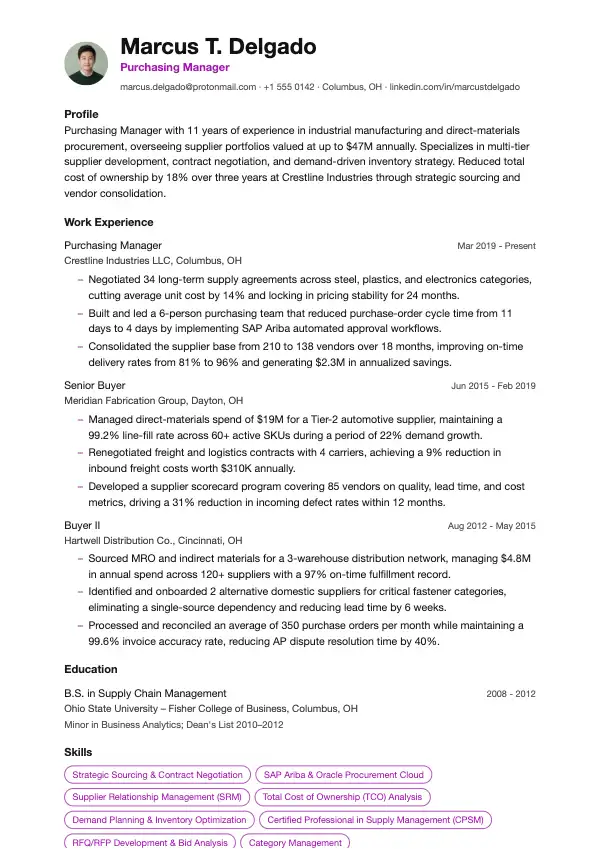
Template: Minimal
Read this resume as text
Marcus T. Delgado
Purchasing Manager
marcus.delgado@protonmail.com · +1 555 0142 · Columbus, OH · linkedin.com/in/marcustdelgado
- Profile
- Purchasing Manager with 11 years of experience in industrial manufacturing and direct-materials procurement, overseeing supplier portfolios valued at up to $47M annually. Specializes in multi-tier supplier development, contract negotiation, and demand-driven inventory strategy. Reduced total cost of ownership by 18% over three years at Crestline Industries through strategic sourcing and vendor consolidation.
- Work Experience
Purchasing Manager
Crestline Industries LLC, Columbus, OH · Mar 2019 - Present
- Negotiated 34 long-term supply agreements across steel, plastics, and electronics categories, cutting average unit cost by 14% and locking in pricing stability for 24 months.
- Built and led a 6-person purchasing team that reduced purchase-order cycle time from 11 days to 4 days by implementing SAP Ariba automated approval workflows.
- Consolidated the supplier base from 210 to 138 vendors over 18 months, improving on-time delivery rates from 81% to 96% and generating $2.3M in annualized savings.
Senior Buyer
Meridian Fabrication Group, Dayton, OH · Jun 2015 - Feb 2019
- Managed direct-materials spend of $19M for a Tier-2 automotive supplier, maintaining a 99.2% line-fill rate across 60+ active SKUs during a period of 22% demand growth.
- Renegotiated freight and logistics contracts with 4 carriers, achieving a 9% reduction in inbound freight costs worth $310K annually.
- Developed a supplier scorecard program covering 85 vendors on quality, lead time, and cost metrics, driving a 31% reduction in incoming defect rates within 12 months.
Buyer II
Hartwell Distribution Co., Cincinnati, OH · Aug 2012 - May 2015
- Sourced MRO and indirect materials for a 3-warehouse distribution network, managing $4.8M in annual spend across 120+ suppliers with a 97% on-time fulfillment record.
- Identified and onboarded 2 alternative domestic suppliers for critical fastener categories, eliminating a single-source dependency and reducing lead time by 6 weeks.
- Processed and reconciled an average of 350 purchase orders per month while maintaining a 99.6% invoice accuracy rate, reducing AP dispute resolution time by 40%.
- Education
B.S. in Supply Chain Management
Ohio State University – Fisher College of Business, Columbus, OH · 2008 - 2012
Minor in Business Analytics; Dean's List 2010–2012
- Skills
- Strategic Sourcing & Contract Negotiation · SAP Ariba & Oracle Procurement Cloud · Supplier Relationship Management (SRM) · Total Cost of Ownership (TCO) Analysis · Demand Planning & Inventory Optimization · Certified Professional in Supply Management (CPSM) · RFQ/RFP Development & Bid Analysis · Category Management · Lean Procurement & Kaizen Methodologies
- Links
- LinkedIn: linkedin.com/in/marcustdelgado · Certification: CPSM, 2019, Institute for Supply Management (verifiable via ISM)
What makes this resume work
- Every bullet closes with a hard number — dollar savings, percentage improvement, or a count — so hiring managers can immediately gauge the scale and impact of Marcus's decisions rather than inferring them.
- The skills section uses exact phrases recruiters type into ATS searches ('Total Cost of Ownership,' 'Supplier Relationship Management,' 'SAP Ariba') rather than vague labels like 'procurement software.'
- The summary front-loads seniority, domain specificity, and a single standout result in three sentences, giving a time-pressed hiring manager a complete picture before they read a single bullet.
- Career progression is unmistakable — Buyer II to Senior Buyer to Manager — and each role shows increasing spend responsibility ($4.8M → $19M → $47M), which signals organic growth rather than lateral movement.
Keywords that help you pass the ATS
Work the ones that fit your experience into your resume, naturally, not stuffed.
How to write a Purchasing Manager resume
Choose the right format for a Purchasing Manager resume
Use a reverse-chronological format. Purchasing managers are evaluated on the depth and progression of their sourcing, negotiation, and supplier-management experience, and hiring managers want to see that trajectory immediately. A functional or hybrid format raises red flags for this role because it obscures tenure and scope.
Keep the resume to two pages if you have more than ten years of experience; one page if you have fewer. Use clean section headers, consistent date formatting (Month YYYY), and enough white space to make the document scannable. Avoid tables and text boxes — many applicant tracking systems used by mid-size manufacturers, retailers, and distributors still misparse them.
- Standard font: Calibri, Garamond, or Arial at 10–12 pt
- Margins: 0.75–1 inch on all sides
- File format: PDF unless the job posting explicitly requests a Word document
- Section order: Contact info → Summary → Work Experience → Skills → Certifications → Education
Write a professional summary that earns a second look
Your summary is three to four lines that answer: what category of purchasing you manage (direct vs. indirect, raw materials, MRO, services), the scale you operate at (spend under management, team size, supplier count), and one or two outcomes you consistently deliver. Skip objectives and personality adjectives entirely.
Example: "Purchasing Manager with 9 years of experience managing $40M in annual direct-materials spend across automotive Tier 1 suppliers. Reduced supplier base by 22% over three years while cutting average lead time by 11 days. Experienced with SAP Ariba, contract negotiation under UCC terms, and cross-functional S&OP alignment. CPM certified."
Write work-experience bullets that prove impact
Each bullet should follow an action-result structure and include at least one number. Recruiters in supply chain and procurement specifically look for spend managed, cost savings achieved, supplier consolidation ratios, on-time delivery rates, and contract cycle-time reductions. Vague bullets like 'managed vendor relationships' get skimmed past.
Pull your numbers from annual performance reviews, spend analytics dashboards (Coupa, SAP Ariba, Jaggaer), or internal scorecards. If a figure is confidential, express it as a percentage or index rather than omitting it entirely.
- Renegotiated 34 supplier contracts using competitive bidding and should-cost modeling, delivering $2.1M in annualized savings against a $28M indirect spend portfolio.
- Implemented a supplier scorecard program in Coupa for 60 active vendors, improving on-time delivery from 81% to 94% within 18 months and reducing quality escapes by 30%.
Skills and certifications recruiters and ATS systems look for
Purchasing manager job postings consistently filter for a core set of hard skills and recognized credentials. List tools and systems by name — not just 'ERP experience' — because ATS keyword matching is literal. Certifications carry real weight in procurement; the CPM (Certified Purchasing Manager) from ISM and the CPSM (Certified Professional in Supply Management) are the two most recognized in the US. The CPIM (from APICS/ASCM) is valued in manufacturing-adjacent roles.
Place certifications in a dedicated section with the issuing body and year. Do not bury them in the skills list where they can be missed.
- Procurement platforms: SAP Ariba, Coupa, Jaggaer, Oracle Procurement Cloud, GEP SMART
- Skills: strategic sourcing, RFQ/RFP management, contract negotiation, supplier development, spend analysis, demand forecasting, S&OP
- Certifications: CPSM (ISM), CPM (ISM), CPIM (ASCM), CIPP, PMP (if managing capital projects)
- Soft skills worth naming: cross-functional collaboration, total cost of ownership (TCO) analysis, risk mitigation
Education, licenses, and extras that round out the resume
A bachelor's degree in supply chain management, business administration, operations management, or engineering is the standard baseline for purchasing manager roles. An MBA or a master's in supply chain strengthens candidacy for senior or director-track positions. List your degree, institution, and graduation year — GPA only if you graduated within the last three years and it was above 3.5.
Add a brief 'Additional' or 'Professional Development' section if you have relevant extras: ISM chapter leadership, NAPM membership, Six Sigma Green or Black Belt, export compliance training (EAR/ITAR), or experience with minority and women-owned business enterprise (MWBE) supplier programs. These signal engagement with the profession beyond the day job and matter to larger employers with supplier diversity mandates.
Mistakes to avoid
- Listing spend managed only as a vague range ('multi-million dollar budgets') instead of a specific figure makes it impossible for hiring managers to benchmark your scope against the role they are filling.
- Omitting the procurement software you have used by name is a critical error because recruiters at large employers often search by exact tool names like 'Coupa' or 'SAP Ariba.'
- Describing responsibilities rather than outcomes — writing 'responsible for supplier negotiations' instead of quantifying what those negotiations produced — makes your resume indistinguishable from every other applicant.
- Leaving certifications off the resume entirely or burying a CPSM or CPM inside a dense skills list causes them to be overlooked, even though they are often listed as preferred qualifications in job postings.
Frequently asked questions
- Do I need a CPSM or CPM certification to get a purchasing manager job?
- You do not strictly need one to be hired, but both certifications — especially the CPSM from ISM — appear as preferred qualifications in a significant share of mid-to-senior purchasing manager postings. Candidates with a CPSM consistently report stronger interview call rates for roles above $80K. If you are actively job searching without one, consider listing it as 'in progress' if you have started the coursework.
- How do I show purchasing manager experience if my title was 'Buyer' or 'Senior Buyer'?
- Use your official title but let your bullet points do the reframing — emphasize the scope of spend you managed, any direct reports or junior buyers you mentored, and strategic sourcing projects you led rather than transactional purchasing tasks. If you functionally performed manager-level work, you can add a brief parenthetical like 'Senior Buyer (de facto Purchasing Manager for MRO category)' to clarify scope without misrepresenting your title.
- How far back should my work history go on a purchasing manager resume?
- Limit detailed bullet points to the last 10 to 15 years. Earlier roles can be listed with just the title, company, and dates in a condensed line if they are relevant to your progression. Anything beyond 15 years that does not add unique context — such as a formative role in a highly specialized commodity — can be dropped entirely to keep the resume focused and within two pages.
Make it yours in minutes
Open this example in the builder, swap in your details, and export a clean, ATS-ready resume.
Once your resume is ready
More for this application
- Template style
- Minimalist resume templates