Resume example
Supply Chain Analyst resume example
By the Resumade team · About our content
A Supply Chain Analyst resume must clear ATS keyword filters for tools and methodologies while proving business impact to hiring managers. This example does both: hard skills are named explicitly and every role quantifies outcomes.
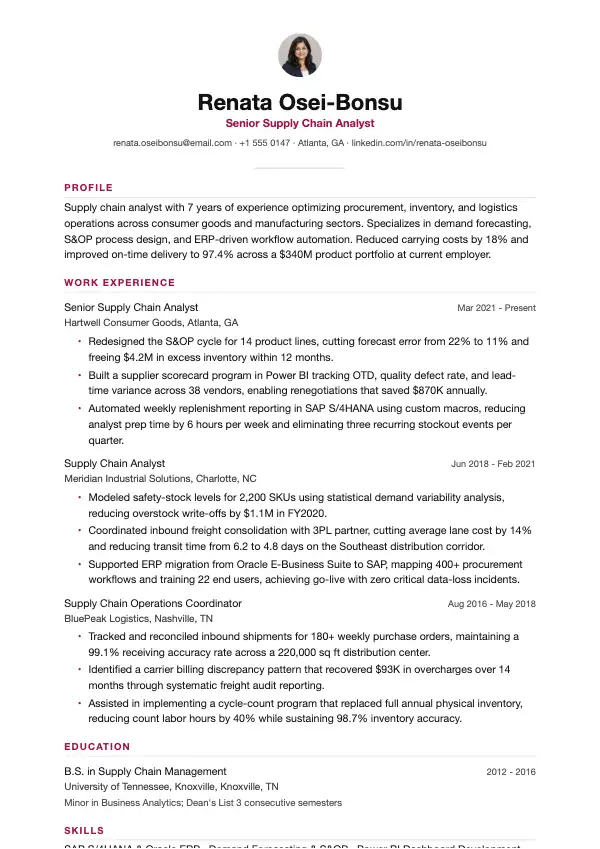
Template: Windsor
Read this resume as text
Renata Osei-Bonsu
Senior Supply Chain Analyst
renata.oseibonsu@email.com · +1 555 0147 · Atlanta, GA · linkedin.com/in/renata-oseibonsu
- Profile
- Supply chain analyst with 7 years of experience optimizing procurement, inventory, and logistics operations across consumer goods and manufacturing sectors. Specializes in demand forecasting, S&OP process design, and ERP-driven workflow automation. Reduced carrying costs by 18% and improved on-time delivery to 97.4% across a $340M product portfolio at current employer.
- Work Experience
Senior Supply Chain Analyst
Hartwell Consumer Goods, Atlanta, GA · Mar 2021 - Present
- Redesigned the S&OP cycle for 14 product lines, cutting forecast error from 22% to 11% and freeing $4.2M in excess inventory within 12 months.
- Built a supplier scorecard program in Power BI tracking OTD, quality defect rate, and lead-time variance across 38 vendors, enabling renegotiations that saved $870K annually.
- Automated weekly replenishment reporting in SAP S/4HANA using custom macros, reducing analyst prep time by 6 hours per week and eliminating three recurring stockout events per quarter.
Supply Chain Analyst
Meridian Industrial Solutions, Charlotte, NC · Jun 2018 - Feb 2021
- Modeled safety-stock levels for 2,200 SKUs using statistical demand variability analysis, reducing overstock write-offs by $1.1M in FY2020.
- Coordinated inbound freight consolidation with 3PL partner, cutting average lane cost by 14% and reducing transit time from 6.2 to 4.8 days on the Southeast distribution corridor.
- Supported ERP migration from Oracle E-Business Suite to SAP, mapping 400+ procurement workflows and training 22 end users, achieving go-live with zero critical data-loss incidents.
Supply Chain Operations Coordinator
BluePeak Logistics, Nashville, TN · Aug 2016 - May 2018
- Tracked and reconciled inbound shipments for 180+ weekly purchase orders, maintaining a 99.1% receiving accuracy rate across a 220,000 sq ft distribution center.
- Identified a carrier billing discrepancy pattern that recovered $93K in overcharges over 14 months through systematic freight audit reporting.
- Assisted in implementing a cycle-count program that replaced full annual physical inventory, reducing count labor hours by 40% while sustaining 98.7% inventory accuracy.
- Education
B.S. in Supply Chain Management
University of Tennessee, Knoxville, Knoxville, TN · 2012 - 2016
Minor in Business Analytics; Dean's List 3 consecutive semesters
- Skills
- SAP S/4HANA & Oracle ERP · Demand Forecasting & S&OP · Power BI Dashboard Development · Inventory Optimization · Supplier Relationship Management · SQL (intermediate) · APICS CSCP Certified · Lean Six Sigma Green Belt · Advanced Excel & VBA
- Links
- LinkedIn: linkedin.com/in/renata-oseibonsu
What makes this resume work
- The summary front-loads seniority, domain breadth, and two headline numbers — a forecast-error reduction and a portfolio-scale metric — giving a hiring manager an immediate reason to keep reading.
- Every bullet opens with a strong action verb and closes with a dollar figure, percentage, or time saving, making it trivial for a recruiter to calculate the candidate's ROI.
- Skills are listed as discrete, searchable terms (SAP S/4HANA, APICS CSCP, Power BI) rather than vague categories, matching the exact strings supply chain recruiters enter into ATS search filters.
- Career progression is explicit — Coordinator to Analyst to Senior Analyst across three employers — which signals upward trajectory without requiring the reader to infer it from job titles alone.
Keywords that help you pass the ATS
Work the ones that fit your experience into your resume, naturally, not stuffed.
How to write a Supply Chain Analyst resume
Choose the right format for a Supply Chain Analyst resume
Use a reverse-chronological format. Hiring managers at manufacturers, 3PLs, retailers, and consulting firms expect to scan your most recent role first and trace your progression backward. A functional or hybrid format raises red flags unless you are making a significant industry pivot.
Keep the resume to one page if you have fewer than eight years of experience; two pages are acceptable beyond that. Use clean section headers, consistent date formatting (Month Year), and enough white space to survive ATS parsing. Avoid tables, text boxes, and graphics — many applicant tracking systems used by companies like Amazon, Walmart, and Target strip that formatting entirely.
- Margins: 0.5–1 inch on all sides
- Font: 10–12 pt in Arial, Calibri, or Georgia
- File format: PDF unless the job posting explicitly requests a Word doc
- Section order: Contact info → Summary → Experience → Skills → Education → Certifications
Write a professional summary that frames your supply chain specialty
Your summary sits at the top and does one job: tell the recruiter in three sentences which part of the supply chain you own, at what scale, and what you deliver. Skip objective statements and generic phrases like 'results-driven professional.' Name the tools you use, the function you specialize in (demand planning, procurement, S&OP, logistics, inventory optimization), and a concrete outcome.
Example: "Supply Chain Analyst with six years of experience in demand planning and inventory optimization for a $1.2B consumer goods manufacturer. Proficient in SAP IBP, Kinaxis RapidResponse, and advanced Excel modeling; reduced excess inventory by 18% over two fiscal years by redesigning safety stock parameters. APICS CSCP certified, with cross-functional experience partnering with procurement, finance, and commercial sales teams."
Write work-experience bullets that show impact, not just tasks
Each bullet should follow an action verb → task → quantified result structure. Supply chain roles generate measurable data constantly — use it. Recruiters want to see cycle time reductions, forecast accuracy percentages, cost savings in dollars, fill rates, and inventory turns. Avoid bullets that only describe responsibilities without outcomes; 'Managed purchase orders' tells a hiring manager nothing.
Tailor your bullets to the job description. If the posting mentions OTIF (on-time in-full) performance, use that exact language. If it references S&OP, describe your specific role in that process.
- Improved forecast accuracy from 71% to 88% over 12 months by implementing a statistical baseline model in SAP IBP, reducing expediting costs by $340K annually.
- Renegotiated freight contracts with three regional carriers, cutting inbound logistics spend by 12% ($210K/year) while maintaining a 98.4% on-time delivery rate.
List the skills and certifications recruiters and ATS systems look for
Supply chain job postings are highly tool-specific. A generic 'proficient in Microsoft Office' line will not get you through ATS filters. List the exact software platforms, methodologies, and credentials you hold. Separate hard skills from soft skills — recruiters skim the hard skills section first.
Certifications carry real weight in this field. APICS CSCP and CPIM are the most recognized across industries. CPSM (ISM) is valued in procurement-heavy roles. Six Sigma Green or Black Belt matters for roles at manufacturers with continuous improvement programs. If you are newer to the field, the Google Supply Chain Certificate or Coursera's IBM Supply Chain specialization are worth listing while you pursue APICS credentials.
- ERP/Planning tools: SAP S/4HANA, SAP IBP, Oracle SCM Cloud, Kinaxis RapidResponse, Blue Yonder (JDA)
- Analytics: Advanced Excel (VLOOKUP, Power Query, pivot tables), SQL, Tableau, Power BI, Python (pandas)
- Methodologies: S&OP, DDMRP, Lean, Six Sigma, VMI, ABC-XYZ analysis
- Certifications: APICS CSCP, APICS CPIM, ISM CPSM, Six Sigma Green Belt, PMP (for project-heavy roles)
- Domain terms to include: safety stock, EOQ, OTIF, fill rate, landed cost, lead time variability, SKU rationalization
Education, licenses, and extras that strengthen a supply chain resume
A bachelor's degree in supply chain management, operations management, industrial engineering, business, or logistics is the standard baseline. An MBA with a supply chain concentration adds leverage for senior analyst and manager roles. List your degree, institution, graduation year, and GPA only if it was 3.5 or above and you graduated within the last three years.
Add a brief Additional section for relevant extras: language skills (Spanish and Mandarin are genuinely useful in global procurement and manufacturing roles), international experience, or published process improvement projects. If you have completed relevant coursework in transportation management, operations research, or econometrics, list it under your degree rather than in a separate section.
Mistakes to avoid
- Listing tools without context — writing 'SAP' with no indication of which module (MM, IBP, S/4HANA) or how you used it tells recruiters almost nothing.
- Omitting quantified metrics entirely, which is a missed opportunity in a data-heavy field where forecast accuracy, inventory turns, and cost savings are standard KPIs.
- Using a job description that reads like a duty roster ('Responsible for purchase orders, supplier communications, and reporting') instead of showing decisions made and outcomes achieved.
- Leaving certifications in progress off the resume — if you are actively pursuing APICS CPIM, list it as 'APICS CPIM (expected May 2027)' so recruiters know you are invested in the credential.
Frequently asked questions
- Do I need APICS certification to get a Supply Chain Analyst job?
- No, but it meaningfully improves your competitiveness, especially at mid-size and large companies with formal supply chain functions. Entry-level roles often hire without it, but many job postings list CSCP or CPIM as preferred. If you are early in your career, prioritize getting the experience first and pursue the certification while working.
- How do I write a Supply Chain Analyst resume with no direct experience?
- Lead with transferable analytical experience — internships, operations roles, purchasing assistant positions, or academic projects involving forecasting, data analysis, or process improvement. Quantify whatever you can, even from non-supply-chain roles, and highlight relevant tools like Excel, SQL, or any ERP exposure. A relevant certification and a strong summary that names the function you are targeting will help bridge the gap.
- Should I tailor my resume for each supply chain job application?
- Yes, and the minimum change is matching the language in your summary and skills section to the exact terms in the job posting. If one posting says 'demand planning' and another says 'forecasting,' use their word. ATS systems score keyword matches, and supply chain job descriptions vary significantly between industries like retail, pharma, automotive, and CPG, so a one-size resume will underperform.
Make it yours in minutes
Open this example in the builder, swap in your details, and export a clean, ATS-ready resume.
Once your resume is ready
More for this application
- Template style
- Professional resume templates