Resume example
Recruiter resume example
By the Resumade team · About our content
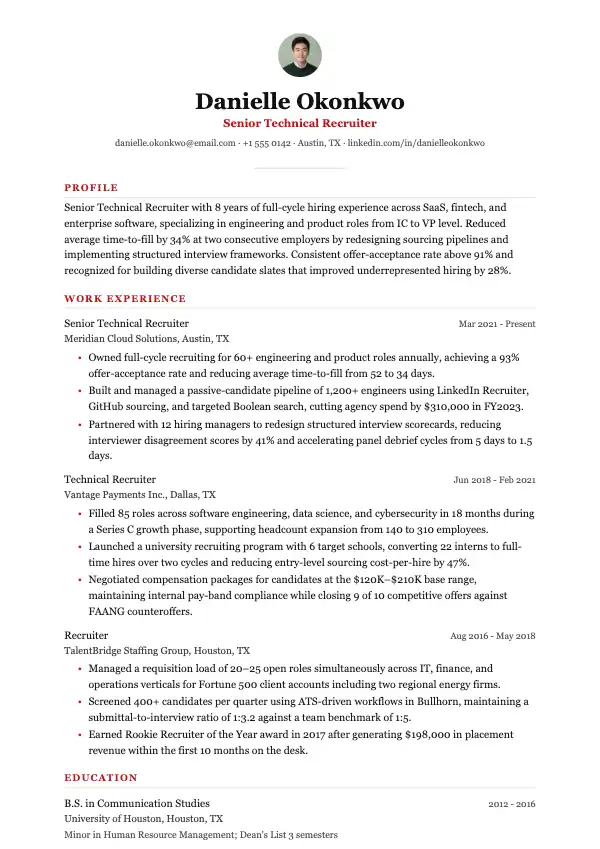
A recruiter resume must prove sourcing depth and business impact in the first scroll—both to ATS keyword filters and to TA leaders who read dozens of these. This example leads with quantified outcomes, mirrors the language hiring managers actually search, and structures skills for instant scannability.
Template: Classic
Read this resume as text
Danielle Okonkwo
Senior Technical Recruiter
danielle.okonkwo@email.com · +1 555 0142 · Austin, TX · linkedin.com/in/danielleokonkwo
- Profile
- Senior Technical Recruiter with 8 years of full-cycle hiring experience across SaaS, fintech, and enterprise software, specializing in engineering and product roles from IC to VP level. Reduced average time-to-fill by 34% at two consecutive employers by redesigning sourcing pipelines and implementing structured interview frameworks. Consistent offer-acceptance rate above 91% and recognized for building diverse candidate slates that improved underrepresented hiring by 28%.
- Work Experience
Senior Technical Recruiter
Meridian Cloud Solutions, Austin, TX · Mar 2021 - Present
- Owned full-cycle recruiting for 60+ engineering and product roles annually, achieving a 93% offer-acceptance rate and reducing average time-to-fill from 52 to 34 days.
- Built and managed a passive-candidate pipeline of 1,200+ engineers using LinkedIn Recruiter, GitHub sourcing, and targeted Boolean search, cutting agency spend by $310,000 in FY2023.
- Partnered with 12 hiring managers to redesign structured interview scorecards, reducing interviewer disagreement scores by 41% and accelerating panel debrief cycles from 5 days to 1.5 days.
Technical Recruiter
Vantage Payments Inc., Dallas, TX · Jun 2018 - Feb 2021
- Filled 85 roles across software engineering, data science, and cybersecurity in 18 months during a Series C growth phase, supporting headcount expansion from 140 to 310 employees.
- Launched a university recruiting program with 6 target schools, converting 22 interns to full-time hires over two cycles and reducing entry-level sourcing cost-per-hire by 47%.
- Negotiated compensation packages for candidates at the $120K–$210K base range, maintaining internal pay-band compliance while closing 9 of 10 competitive offers against FAANG counteroffers.
Recruiter
TalentBridge Staffing Group, Houston, TX · Aug 2016 - May 2018
- Managed a requisition load of 20–25 open roles simultaneously across IT, finance, and operations verticals for Fortune 500 client accounts including two regional energy firms.
- Screened 400+ candidates per quarter using ATS-driven workflows in Bullhorn, maintaining a submittal-to-interview ratio of 1:3.2 against a team benchmark of 1:5.
- Earned Rookie Recruiter of the Year award in 2017 after generating $198,000 in placement revenue within the first 10 months on the desk.
- Education
B.S. in Communication Studies
University of Houston, Houston, TX · 2012 - 2016
Minor in Human Resource Management; Dean's List 3 semesters
- Skills
- Full-Cycle Technical Recruiting · LinkedIn Recruiter & Boolean Sourcing · Greenhouse ATS · Workday Recruiting · Structured Interviewing & Scorecards · Compensation Benchmarking (Radford, Levels.fyi) · EEOC Compliance & DEI Sourcing Strategies · Offer Negotiation & Closing · Talent Market Mapping
- Links
- LinkedIn: linkedin.com/in/danielleokonkwo
What makes this resume work
- Every bullet opens with a strong action verb and closes with a specific metric—days saved, dollars cut, or percentages moved—so hiring managers can immediately calculate the candidate's ROI.
- The skills section uses exact tool names and industry-standard terminology (Greenhouse, Radford, Boolean Sourcing) rather than vague phrases, ensuring the resume surfaces in ATS keyword searches run by TA directors.
- The summary front-loads seniority, domain specialization, and two headline numbers in three sentences, giving a recruiter reading on mobile a complete picture before they reach the experience section.
- Career progression is visible at a glance: agency desk to in-house to senior in-house, with each role showing a clear step up in scope (requisition volume, compensation bands, strategic ownership), which signals intentional growth rather than lateral drift.
Keywords that help you pass the ATS
Work the ones that fit your experience into your resume, naturally, not stuffed.
How to write a Recruiter resume
Choose the right format for a Recruiter resume
Use a reverse-chronological format. Hiring managers and HR directors scan recruiter resumes fast — they know exactly what to look for — so bury nothing important. Lead with your most recent role and work backward. A functional or hybrid format signals you are hiding gaps or thin experience, which is a red flag in a profession built on transparency.
Keep the resume to one page if you have under ten years of experience; two pages are acceptable for senior or executive recruiters managing full-cycle enterprise hiring. Use clean section headers, consistent date formatting (Month Year), and 0.75-inch margins. ATS platforms like Greenhouse, Lever, and Workday parse resumes before a human ever sees them, so avoid tables, text boxes, and graphics.
- Font: Calibri, Garamond, or Arial at 10–12pt body, 14–16pt name
- Sections in order: Contact Info → Summary → Experience → Skills → Education → Certifications
- File format: PDF unless the job posting explicitly requests .docx
- No headshots, no icons, no color gradients — they break ATS parsing
Write a professional summary that sells your recruiting record
Your summary is three to four sentences that answer: what type of recruiter you are, what industries or functions you cover, and what you measurably deliver. Skip phrases like 'results-driven' or 'passionate about people.' Specificity is the only thing that works here.
Example: "Full-cycle technical recruiter with seven years placing software engineers and data scientists at Series B through public-stage SaaS companies. Averaged 38-day time-to-fill on hard-to-source roles by building passive candidate pipelines through LinkedIn Recruiter, GitHub sourcing, and targeted Boolean search. Managed requisition loads of 20–30 open roles simultaneously while maintaining a 92% offer-acceptance rate. Experienced with Greenhouse ATS, Gem, and structured behavioral interviewing frameworks."
Write work-experience bullets that prove recruiting performance
Every bullet should answer 'so what?' with a number. Recruiters live in metrics — time-to-fill, cost-per-hire, offer-acceptance rate, pipeline conversion, requisition load, quality-of-hire scores — so a resume without them looks like you either did not track your work or did not perform well enough to want to share it. Use past tense for previous roles, present tense for your current one.
Lead bullets with strong action verbs: sourced, filled, reduced, built, partnered, negotiated, screened, closed. Avoid vague openers like 'responsible for' or 'assisted with.'
- Reduced average time-to-fill from 67 days to 41 days by implementing a structured sourcing cadence in LinkedIn Recruiter and building a pre-qualified talent pool of 400+ passive candidates across the engineering org.
- Filled 112 requisitions in FY2023 across sales, marketing, and operations at a cost-per-hire of $3,200 — 28% below the company benchmark — by expanding sourcing to niche job boards including We Work Remotely and Built In.
Skills and certifications that recruiters and ATS systems look for
List hard skills in a dedicated skills section rather than burying them in bullets. Recruiters are evaluated on ATS proficiency, sourcing tools, interviewing methodology, and compliance knowledge. Soft skills like 'communication' belong in your summary or bullets with context — not as standalone list items.
Certifications carry real weight in recruiting. SHRM-CP and SHRM-SCP signal HR fluency. AIRS certifications (CIR, CDR, CSSR) are respected in sourcing-heavy roles. LinkedIn Recruiter certification is table stakes for corporate recruiters. If you recruit in staffing, note any state-specific staffing industry licenses or agency compliance training.
- ATS platforms: Greenhouse, Lever, Workday, iCIMS, Taleo, Bullhorn
- Sourcing tools: LinkedIn Recruiter, Gem, Seekout, HireEZ, ZoomInfo
- Methodologies: structured interviewing, competency-based interviewing, DEIB sourcing strategies
- Certifications: SHRM-CP, SHRM-SCP, AIRS CIR, AIRS CDR, LinkedIn Recruiter Certification, PHR
- Compliance: EEOC guidelines, OFCCP requirements, GDPR basics for global roles
Education, licenses, and extras worth including
A bachelor's degree in HR, business, psychology, or communications is common but not universally required in recruiting — especially in agency or technical recruiting. List your degree, institution, and graduation year. Omit GPA unless you graduated within the last two years and it is above 3.5. If you completed relevant coursework in organizational behavior, labor law, or industrial psychology, a brief note is fine.
Add a separate Certifications section if you hold more than one credential — do not fold them into Education. Include volunteer recruiting work (e.g., sourcing for nonprofits), conference speaking (SHRM Annual, SourceCon), or published content if it reinforces your expertise. These extras matter more in recruiting than in most fields because they signal you stay current in a profession that changes quickly.
Mistakes to avoid
- Listing ATS platforms you have only logged into once — interviewers will probe your depth of use, and claiming Workday when you only used it to post jobs will surface immediately.
- Omitting metrics entirely and describing duties instead of outcomes, which makes your resume indistinguishable from a job description.
- Using a generic summary that could apply to any HR professional rather than specifying your recruiting niche, industry focus, and tool stack.
- Failing to tailor your resume for agency versus corporate recruiting roles — the vocabulary, metrics, and priorities differ significantly, and a one-size-fits-all resume signals low effort to a hiring manager who recruits for a living.
Frequently asked questions
- Should a recruiter include a LinkedIn URL on their resume?
- Yes, and it should be a customized URL (linkedin.com/in/yourname), not the default string of numbers. Your LinkedIn profile will be scrutinized more carefully for a recruiting role than almost any other profession, so make sure it is complete, your headline is specific, and your recommendations are current before you apply.
- What metrics should a recruiter put on a resume?
- Focus on time-to-fill, offer-acceptance rate, cost-per-hire, requisition load, and source-of-hire breakdown. If you work in agency recruiting, include revenue generated, bill rate, or number of placements per quarter. Pick the three or four metrics most relevant to the role you are targeting and make sure every number is defensible in an interview.
- How do you write a recruiter resume with no corporate experience, only agency experience?
- Translate agency metrics into language corporate teams value: placements become hires, client requisitions become hiring manager partnerships, and bill rates become cost-per-hire proxies. Emphasize your full-cycle experience, volume, and speed, since agency recruiters typically out-pace corporate counterparts on those dimensions. Highlight any experience recruiting for the specific function or industry the corporate role focuses on.
Make it yours in minutes
Open this example in the builder, swap in your details, and export a clean, ATS-ready resume.
Once your resume is ready
More for this application
- Template style
- Professional resume templates