Resume example
Store Manager resume example
By the Resumade team · About our content
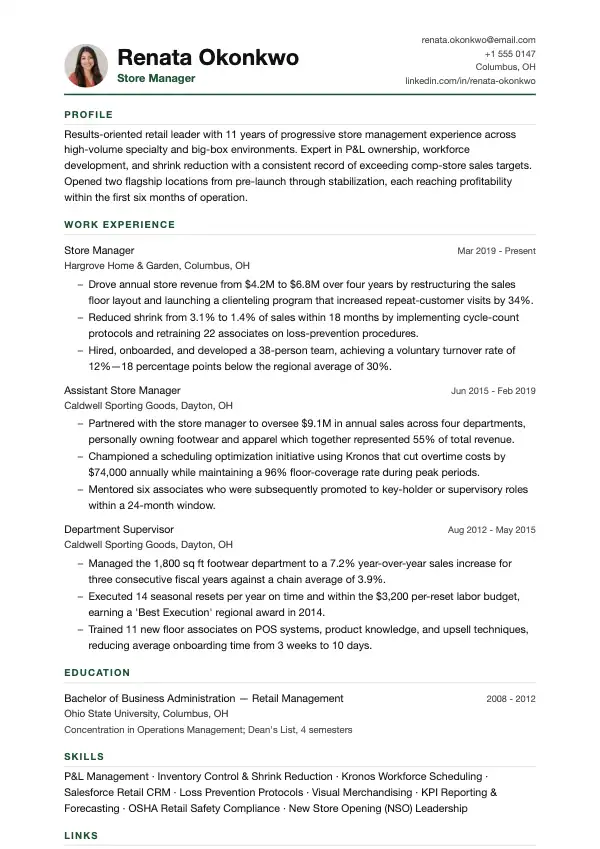
A Store Manager resume must prove fiscal accountability and people leadership in the first glance—ATS scans for operational keywords while hiring managers look for numbers that move. This example delivers both through metric-anchored bullets and a skills block tuned to common applicant-tracking filters.
Template: Meridian
Read this resume as text
Renata Okonkwo
Store Manager
renata.okonkwo@email.com · +1 555 0147 · Columbus, OH · linkedin.com/in/renata-okonkwo
- Profile
- Results-oriented retail leader with 11 years of progressive store management experience across high-volume specialty and big-box environments. Expert in P&L ownership, workforce development, and shrink reduction with a consistent record of exceeding comp-store sales targets. Opened two flagship locations from pre-launch through stabilization, each reaching profitability within the first six months of operation.
- Work Experience
Store Manager
Hargrove Home & Garden, Columbus, OH · Mar 2019 - Present
- Drove annual store revenue from $4.2M to $6.8M over four years by restructuring the sales floor layout and launching a clienteling program that increased repeat-customer visits by 34%.
- Reduced shrink from 3.1% to 1.4% of sales within 18 months by implementing cycle-count protocols and retraining 22 associates on loss-prevention procedures.
- Hired, onboarded, and developed a 38-person team, achieving a voluntary turnover rate of 12%—18 percentage points below the regional average of 30%.
Assistant Store Manager
Caldwell Sporting Goods, Dayton, OH · Jun 2015 - Feb 2019
- Partnered with the store manager to oversee $9.1M in annual sales across four departments, personally owning footwear and apparel which together represented 55% of total revenue.
- Championed a scheduling optimization initiative using Kronos that cut overtime costs by $74,000 annually while maintaining a 96% floor-coverage rate during peak periods.
- Mentored six associates who were subsequently promoted to key-holder or supervisory roles within a 24-month window.
Department Supervisor
Caldwell Sporting Goods, Dayton, OH · Aug 2012 - May 2015
- Managed the 1,800 sq ft footwear department to a 7.2% year-over-year sales increase for three consecutive fiscal years against a chain average of 3.9%.
- Executed 14 seasonal resets per year on time and within the $3,200 per-reset labor budget, earning a 'Best Execution' regional award in 2014.
- Trained 11 new floor associates on POS systems, product knowledge, and upsell techniques, reducing average onboarding time from 3 weeks to 10 days.
- Education
Bachelor of Business Administration — Retail Management
Ohio State University, Columbus, OH · 2008 - 2012
Concentration in Operations Management; Dean's List, 4 semesters
- Skills
- P&L Management · Inventory Control & Shrink Reduction · Kronos Workforce Scheduling · Salesforce Retail CRM · Loss Prevention Protocols · Visual Merchandising · KPI Reporting & Forecasting · OSHA Retail Safety Compliance · New Store Opening (NSO) Leadership
- Links
- LinkedIn: linkedin.com/in/renata-okonkwo
What makes this resume work
- Every bullet opens with a strong action verb and closes with a quantified outcome—revenue figures, percentage changes, or dollar savings—so hiring managers can immediately gauge the candidate's business impact without reading between the lines.
- The skills section lists specific tools (Kronos, Salesforce Retail CRM) alongside competency areas (P&L Management, NSO Leadership), which satisfies both keyword-matching algorithms and the practical expectations of operations-focused interviewers.
- Career progression is shown within the same company before the current role, demonstrating loyalty and internal credibility while also illustrating a clear upward trajectory from supervisor to assistant manager to full store manager.
- The summary front-loads seniority (11 years), domain specificity (specialty and big-box), and a flagship achievement (two profitable store openings), giving a recruiter on a quick first scan an instant read on fit before they reach the experience section.
Keywords that help you pass the ATS
Work the ones that fit your experience into your resume, naturally, not stuffed.
How to write a Store Manager resume
Choose the right format for a Store Manager resume
Use a reverse-chronological format. Recruiters spend about seven seconds on an initial scan (Ladders eye-tracking study, 2018), and retail hiring managers want to see your most recent store immediately — its banner, volume, and headcount. A functional or hybrid format buries that information and raises red flags.
Keep the resume to one page if you have fewer than ten years of experience; two pages are acceptable if you have managed multiple locations or a district. Use clean section headers, consistent font sizing (10–12 pt body, 14–16 pt name), and at least 0.5-inch margins. Save and submit as a PDF unless the job posting specifically requests a Word file.
- Lead with your name, city/state, phone, professional email, and a LinkedIn URL
- Order sections: Summary → Work Experience → Skills → Education/Certifications
- Avoid tables and text boxes — many ATS platforms cannot parse them
- Use bold sparingly to highlight store names or volume figures, not decorative text
Write a professional summary that sells your store leadership
Your summary is three to four lines at the top of the resume. It should name your retail specialty (grocery, specialty apparel, big-box, etc.), your years of experience, your typical store volume, and one standout result. Skip objectives — they tell the employer what you want, not what you deliver.
A strong example: "Results-driven Store Manager with 9 years of retail leadership across high-volume specialty apparel locations ($8M–$12M annual revenue). Consistent track record of reducing shrink below 1.2%, developing internal talent into assistant managers, and driving comp-store sales growth averaging 6% YOY. Experienced with Kronos workforce scheduling, NetSuite inventory, and POS systems including NCR and Lightspeed."
Write work-experience bullets that prove impact with numbers
Every bullet should follow an action-verb → task → measurable result structure. Generic phrases like 'responsible for store operations' tell a recruiter nothing. Quantify headcount managed, revenue overseen, shrink percentages, conversion rates, NPS or mystery-shop scores, and payroll budget adherence. If you do not have exact figures, use ranges or percentages you can defend in an interview.
Pull metrics from your store's P&L, weekly sales reports, and annual reviews before you write a single bullet. Retailers track everything — use it.
- Reduced inventory shrink from 2.8% to 1.1% over 18 months by implementing cycle-count schedules and retraining a 42-person team on loss-prevention protocols, saving approximately $190,000 annually
- Grew comparable-store sales 11% YOY at a $14M suburban big-box location by restructuring floor coverage during peak hours and launching a clienteling program that increased repeat-customer visits by 23%
Skills and certifications recruiters and ATS systems look for
Most retail ATS filters scan for a combination of hard operational skills and software keywords. Build a dedicated Skills section and mirror language from the job posting. Do not list every tool you have ever touched — prioritize the ones you use regularly and can discuss in depth.
Certifications matter more than many store managers realize. The National Retail Federation's Retail Management Certificate, OSHA 10 or 30 (especially for home improvement and grocery), ServSafe Manager Certification (food retail), and Shrinkage & Loss Prevention credentials from the Loss Prevention Foundation (LPC, LPQ) are all recognized differentiators.
- Workforce scheduling: Kronos/UKG, HotSchedules, Deputy
- Inventory & POS: NetSuite, Lightspeed, NCR, Shopify POS, Manhattan Associates WMS
- Reporting & analytics: Tableau, Microsoft Power BI, retailer-specific dashboards (Reflexis, Dayforce)
- Hard skills to name: P&L management, shrink reduction, merchandise planning, visual merchandising, payroll budgeting, KPI reporting, succession planning
- Soft skills worth listing (briefly): conflict resolution, coaching and development, vendor negotiation
Education, licenses, and extras that round out the resume
A bachelor's degree in business, retail management, or a related field is preferred at larger chains but rarely a hard requirement. List your highest degree, the institution, and graduation year. If you did not finish a degree, list completed coursework or an associate degree — do not omit it. Many successful store managers list a high school diploma plus certifications and compensate with strong metrics throughout the experience section.
Add a brief Additional section for things that differentiate you: bilingual fluency (list the language and proficiency level), volunteer leadership roles, or a history of opening new store locations. If you have been promoted internally — assistant manager to co-manager to store manager — call that out explicitly in your job titles or a brief note; internal promotions signal that past employers trusted you, which is one of the strongest signals you can send.
Mistakes to avoid
- Listing duties instead of outcomes — writing 'managed a team of associates' without stating headcount, turnover rate improved, or any result makes the bullet invisible to a hiring manager.
- Omitting store volume and size context, which forces the recruiter to guess whether you ran a kiosk or a $20M flagship location.
- Using a generic skills list that ignores the specific POS, scheduling, or inventory platforms named in the job posting, causing the resume to fail basic ATS keyword matching.
- Including outdated or irrelevant experience from more than 15 years ago in full bullet detail, which pushes key metrics and recent leadership off the first page.
Frequently asked questions
- Should a Store Manager resume be one page or two pages?
- One page is standard for managers with fewer than ten years of experience or a single-location background. Two pages are appropriate if you have managed multiple stores, held district-level responsibilities, or have a decade or more of progressive retail leadership. Never pad to fill a second page — every line should earn its place.
- What is the best way to show promotions from Assistant Manager to Store Manager on a resume?
- Stack the titles under a single employer entry with separate date ranges and bullet sets for each role. This format signals internal growth without making it look like two different jobs. Lead the section header with the company name and total tenure, then indent each title beneath it.
- Do Store Manager resumes need a cover letter?
- Yes, when the posting requests one or when you are applying to a brand whose culture is a strong fit you want to explain. Use the cover letter to tell the story behind one or two numbers on your resume — why shrink spiked, how you turned around a struggling location — context that a bullet cannot carry. Keep it to three short paragraphs and under 300 words.
Make it yours in minutes
Open this example in the builder, swap in your details, and export a clean, ATS-ready resume.
Once your resume is ready
More for this application
- Template style
- Professional resume templates