Resume example
Warehouse Worker resume example
By the Resumade team · About our content
Warehouse recruiters search applicants by equipment certification and WMS platform, so a strong warehouse resume names both in plain words near the top. This example leads with a certified skill set, quantifies throughput and accuracy, and shows career progression from clerk to senior associate.
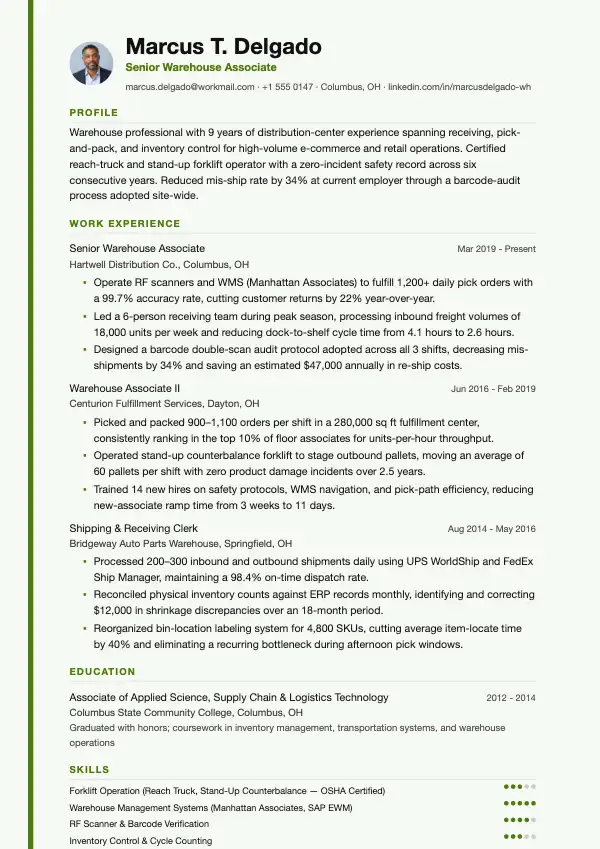
Template: Cadence
Read this resume as text
Marcus T. Delgado
Senior Warehouse Associate
marcus.delgado@workmail.com · +1 555 0147 · Columbus, OH · linkedin.com/in/marcusdelgado-wh
- Profile
- Warehouse professional with 9 years of distribution-center experience spanning receiving, pick-and-pack, and inventory control for high-volume e-commerce and retail operations. Certified reach-truck and stand-up forklift operator with a zero-incident safety record across six consecutive years. Reduced mis-ship rate by 34% at current employer through a barcode-audit process adopted site-wide.
- Work Experience
Senior Warehouse Associate
Hartwell Distribution Co., Columbus, OH · Mar 2019 - Present
- Operate RF scanners and WMS (Manhattan Associates) to fulfill 1,200+ daily pick orders with a 99.7% accuracy rate, cutting customer returns by 22% year-over-year.
- Led a 6-person receiving team during peak season, processing inbound freight volumes of 18,000 units per week and reducing dock-to-shelf cycle time from 4.1 hours to 2.6 hours.
- Designed a barcode double-scan audit protocol adopted across all 3 shifts, decreasing mis-shipments by 34% and saving an estimated $47,000 annually in re-ship costs.
Warehouse Associate II
Centurion Fulfillment Services, Dayton, OH · Jun 2016 - Feb 2019
- Picked and packed 900–1,100 orders per shift in a 280,000 sq ft fulfillment center, consistently ranking in the top 10% of floor associates for units-per-hour throughput.
- Operated stand-up counterbalance forklift to stage outbound pallets, moving an average of 60 pallets per shift with zero product damage incidents over 2.5 years.
- Trained 14 new hires on safety protocols, WMS navigation, and pick-path efficiency, reducing new-associate ramp time from 3 weeks to 11 days.
Shipping & Receiving Clerk
Bridgeway Auto Parts Warehouse, Springfield, OH · Aug 2014 - May 2016
- Processed 200–300 inbound and outbound shipments daily using UPS WorldShip and FedEx Ship Manager, maintaining a 98.4% on-time dispatch rate.
- Reconciled physical inventory counts against ERP records monthly, identifying and correcting $12,000 in shrinkage discrepancies over an 18-month period.
- Reorganized bin-location labeling system for 4,800 SKUs, cutting average item-locate time by 40% and eliminating a recurring bottleneck during afternoon pick windows.
- Education
Associate of Applied Science, Supply Chain & Logistics Technology
Columbus State Community College, Columbus, OH · 2012 - 2014
Graduated with honors; coursework in inventory management, transportation systems, and warehouse operations
- Skills
- Forklift Operation (Reach Truck, Stand-Up Counterbalance — OSHA Certified) · Warehouse Management Systems (Manhattan Associates, SAP EWM) · RF Scanner & Barcode Verification · Inventory Control & Cycle Counting · Pick, Pack & Ship Operations · Pallet Jack Operation (Electric & Manual) · OSHA 10 Certified · Shipping Software (UPS WorldShip, FedEx Ship Manager) · Hazmat Handling (DOT Compliant)
- Links
- LinkedIn: linkedin.com/in/marcusdelgado-wh · Forklift Certification: Forklift operator certification, 2021 (employer-issued; record on request)
What makes this resume work
- The summary names the specific WMS platform (Manhattan Associates) and a headline result (34% mis-ship reduction) in the first paragraph, giving screeners an immediate reason to keep reading.
- Every bullet closes with a measurable outcome — units per hour, dollars saved, or percentage improvement — so hiring managers can benchmark Marcus against other candidates without guessing.
- Hard skills are listed using the exact terminology recruiters search: 'Reach Truck,' 'Stand-Up Counterbalance,' 'OSHA Certified,' and named software products rather than vague phrases like 'warehouse equipment.'
- The training bullet in the Centurion role demonstrates leadership potential (14 new hires, ramp time cut from 3 weeks to 11 days), positioning Marcus for lead or supervisor roles without overstating his current title.
Keywords that help you pass the ATS
Work the ones that fit your experience into your resume, naturally, not stuffed.
How to write a Warehouse Worker resume
Choose the right format for a Warehouse Worker resume
Use a reverse-chronological format. Warehouse hiring managers scan quickly, and they want to see your most recent employer first. Keep your resume to one page unless you have more than ten years of direct warehouse experience, in which case two pages is acceptable.
Use a clean, single-column or two-column layout with clear section headers. Avoid tables or text boxes — many applicant tracking systems (ATS) used by Amazon, XPO, and Penske strip out that formatting and scramble your content. Stick to standard fonts like Arial or Calibri at 10–12 pt and save as a PDF unless the job posting specifies otherwise.
- Sections to include: Contact Info, Summary, Work Experience, Skills, Certifications, Education
- Put your forklift certifications and OSHA training near the top — they are often knockout criteria
- List your shift availability (days, nights, weekends) somewhere visible; many warehouse roles require flexibility
Write a professional summary that gets you past the first cut
Your summary sits at the top of the resume and should be three to four sentences that tell a hiring manager your experience level, the equipment you operate, and one or two measurable contributions. Skip phrases like 'hard-working team player' — they waste space and say nothing a recruiter can act on.
Here is a strong example: "Warehouse Associate with 6 years of experience in high-volume distribution centers supporting e-commerce and retail fulfillment. Certified forklift operator (sit-down counterbalance and reach truck) with a clean safety record across 10,000+ operating hours. Consistently picked 350+ units per hour using RF scanners in a pick-to-light environment. Seeking a night-shift lead role where I can apply WMS experience in Manhattan Associates to improve throughput."
Write work-experience bullets that prove output, not just effort
Every bullet should answer: what did you do, how did you do it, and what was the result? Use action verbs like operated, loaded, picked, palletized, staged, audited, or replenished. Quantify wherever possible — units per hour, order accuracy rate, tonnage moved, error rate, or attendance record. Hiring managers at large DCs set performance benchmarks, and showing you already meet or beat them is a strong signal.
If you do not have exact numbers, use ranges or context ('high-volume 500,000 sq ft facility,' 'peak season team of 40'). Never leave bullets as pure task lists.
- Operated a Raymond reach truck to pull and stage 1,200 pallets per week in a 300,000 sq ft cross-dock facility, maintaining a 99.4% inventory accuracy rate audited monthly.
- Reduced mis-picks by 18% over one quarter by implementing a double-scan verification step during order fulfillment, processing an average of 400 units per hour using Zebra RF scanners.
Skills and certifications recruiters and ATS systems look for
Warehouse job postings are keyword-heavy. Pull the exact language from each posting and mirror it in your skills section. Separate hard skills (equipment, software, certifications) from physical or operational skills. Do not lump everything into a generic list.
Certifications carry real weight. An OSHA 10 card, a current forklift operator certification (OSHA 29 CFR 1910.178), or a Hazmat handler certification can move your resume above applicants who lack them. List the issuing body and the year issued or renewed.
- Equipment: sit-down counterbalance forklift, reach truck, order picker, pallet jack (electric and manual), cherry picker, dock leveler
- Software/systems: WMS platforms (Manhattan Associates, SAP EWM, HighJump), RF scanners (Zebra, Honeywell), voice-pick systems
- Certifications: OSHA 10 General Industry, Forklift Operator Certification (OSHA 29 CFR 1910.178), Hazmat Handler, First Aid/CPR (Red Cross)
- Operational skills: receiving, put-away, pick-and-pack, cycle counting, cross-docking, kitting, LTL/FTL load planning
- Safety knowledge: lockout/tagout (LOTO), PPE compliance, GMP if food or pharma distribution
Education, licenses, and extras that close the deal
Most warehouse roles require a high school diploma or GED — list it with the school name, city, state, and graduation year. If you have a relevant associate degree in supply chain or logistics, list that instead. Do not omit education even if it feels basic; ATS filters often screen for it.
Add a separate 'Licenses & Additional Training' line for your CDL Class A or B if you have one — this dramatically expands the roles you qualify for. Include any employer-sponsored training programs (Amazon Path to Excellence, Prologis Essentials, community college logistics certificates). If you are bilingual, note it; many large DCs actively seek Spanish-English speakers for team lead roles.
Mistakes to avoid
- Listing forklift experience without specifying the equipment class (sit-down counterbalance, reach truck, order picker) makes your certification impossible for a recruiter to verify against job requirements.
- Omitting shift availability forces a recruiter to call you before knowing if you can even work the open shift, which often means they move on to the next candidate.
- Using a table or text box layout causes ATS systems like Workday and iCIMS to misread or drop entire sections, so your certifications and skills may never appear in the parsed profile.
- Writing bullets as a duty list ('Responsible for picking orders') instead of showing output ('Picked 380 units per hour with 99.6% accuracy') gives the hiring manager no basis to compare you to benchmarks.
Frequently asked questions
- Do I need a forklift certification before applying for a warehouse job?
- Not always — many employers will certify you in-house after hiring, and federal OSHA rules require that certification happen at the specific facility on the specific equipment anyway. However, having a prior certification from a previous employer shows you already have operating hours and reduces training time, which is a real advantage. List any certification you hold, including the equipment type and approximate hours operated.
- How do I write a warehouse resume with no experience?
- Lead with transferable physical or logistics experience: retail stocking, moving company work, construction labor, or military supply roles all translate well. Highlight any RF scanner, inventory software, or safety training exposure. Volunteer for an OSHA 10 General Industry course online — it costs under $100 and gives you a credential to put on the resume immediately.
- Should I include my pick rate or productivity numbers on my resume?
- Yes, and this is one of the most effective things you can do on a warehouse resume. Hiring managers at large fulfillment centers set engineered labor standards, and showing that you hit 110% of rate or averaged 400 units per hour tells them you will not be a performance management issue. If you do not know your exact rate, ask a supervisor or check your productivity reports before you leave a job.
Make it yours in minutes
Open this example in the builder, swap in your details, and export a clean, ATS-ready resume.
Once your resume is ready
More for this application
- Template style
- Simple resume templates