Resume example
Restaurant Manager resume example
By the Resumade team · About our content
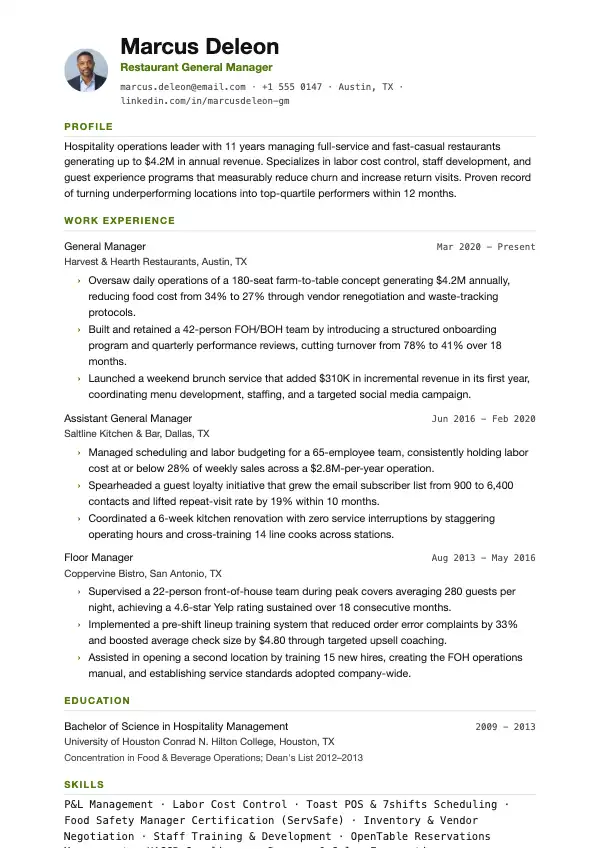
Restaurant groups search manager resumes for operations, cost-control, and compliance terms, then read them for revenue and team results. This example leads with revenue scale, pairs every role with hard numbers, and front-loads the skills section with tools recruiters actually search.
Template: Circuit
Read this resume as text
Marcus Deleon
Restaurant General Manager
marcus.deleon@email.com · +1 555 0147 · Austin, TX · linkedin.com/in/marcusdeleon-gm
- Profile
- Hospitality operations leader with 11 years managing full-service and fast-casual restaurants generating up to $4.2M in annual revenue. Specializes in labor cost control, staff development, and guest experience programs that measurably reduce churn and increase return visits. Proven record of turning underperforming locations into top-quartile performers within 12 months.
- Work Experience
General Manager
Harvest & Hearth Restaurants, Austin, TX · Mar 2020 - Present
- Oversaw daily operations of a 180-seat farm-to-table concept generating $4.2M annually, reducing food cost from 34% to 27% through vendor renegotiation and waste-tracking protocols.
- Built and retained a 42-person FOH/BOH team by introducing a structured onboarding program and quarterly performance reviews, cutting turnover from 78% to 41% over 18 months.
- Launched a weekend brunch service that added $310K in incremental revenue in its first year, coordinating menu development, staffing, and a targeted social media campaign.
Assistant General Manager
Saltline Kitchen & Bar, Dallas, TX · Jun 2016 - Feb 2020
- Managed scheduling and labor budgeting for a 65-employee team, consistently holding labor cost at or below 28% of weekly sales across a $2.8M-per-year operation.
- Spearheaded a guest loyalty initiative that grew the email subscriber list from 900 to 6,400 contacts and lifted repeat-visit rate by 19% within 10 months.
- Coordinated a 6-week kitchen renovation with zero service interruptions by staggering operating hours and cross-training 14 line cooks across stations.
Floor Manager
Coppervine Bistro, San Antonio, TX · Aug 2013 - May 2016
- Supervised a 22-person front-of-house team during peak covers averaging 280 guests per night, achieving a 4.6-star Yelp rating sustained over 18 consecutive months.
- Implemented a pre-shift lineup training system that reduced order error complaints by 33% and boosted average check size by $4.80 through targeted upsell coaching.
- Assisted in opening a second location by training 15 new hires, creating the FOH operations manual, and establishing service standards adopted company-wide.
- Education
Bachelor of Science in Hospitality Management
University of Houston Conrad N. Hilton College, Houston, TX · 2009 - 2013
Concentration in Food & Beverage Operations; Dean's List 2012–2013
- Skills
- P&L Management · Labor Cost Control · Toast POS & 7shifts Scheduling · Food Safety Manager Certification (ServSafe) · Inventory & Vendor Negotiation · Staff Training & Development · OpenTable Reservations Management · HACCP Compliance · Revenue & Sales Forecasting
- Links
- LinkedIn: linkedin.com/in/marcusdeleon-gm
What makes this resume work
- Every bullet opens with a strong action verb and closes with a specific, quantified outcome — percentages, dollar figures, or headcounts — so hiring managers can immediately gauge impact rather than infer it.
- The skills section lists real software (Toast POS, 7shifts, OpenTable) and a named certification (ServSafe) rather than vague phrases, which directly matches the Boolean searches recruiters run in applicant tracking systems.
- The summary establishes revenue scale ($4.2M) and seniority (11 years) in the first sentence, answering the two questions every hiring manager asks before reading further: how big a shop can this person run, and for how long?
- Career progression is visible at a glance — Floor Manager to AGM to GM across three distinct employers — demonstrating steady growth without requiring the reader to do the math themselves.
Keywords that help you pass the ATS
Work the ones that fit your experience into your resume, naturally, not stuffed.
How to write a Restaurant Manager resume
Choose the right format for a Restaurant Manager resume
Use a reverse-chronological format. Hiring managers in food service want to see your most recent operation first — concept type, seat count, and revenue scale matter immediately. A functional or hybrid format raises red flags unless you are making a significant industry pivot.
Keep the resume to one page if you have under ten years of experience; two pages are acceptable for multi-unit or regional managers. Use clear section headers, consistent date formatting (Month YYYY), and at least 0.75-inch margins. Avoid graphics-heavy templates — many restaurant groups use applicant tracking systems like Workday or iCIMS that parse plain text.
- Standard sections: Contact Info, Summary, Work Experience, Skills, Certifications, Education
- Font: 10–12 pt Georgia, Calibri, or Garamond — nothing decorative
- File format: PDF unless the job posting specifically requests a Word document
- List each venue with its concept type (fast casual, fine dining, QSR, polished casual) and seat count
Write a professional summary that names the operation
Your summary should run three to four sentences and front-load the type of restaurant you have managed, your tenure, and one or two headline results. Generic phrases like 'results-driven leader' waste space. Recruiters give a summary only a quick first scan, so be specific about concept, volume, and what you actually improved.
Example: "Hands-on Restaurant Manager with eight years overseeing full-service Italian concepts ranging from 120 to 200 seats and $3.2M–$4.8M in annual revenue. Reduced food cost from 34% to 28% over two years at Carmine's Trattoria by renegotiating produce contracts and tightening portion controls. Certified ServSafe Manager; experienced with OpenTable, Toast POS, and 7shifts scheduling software. Seeking a GM role with a polished-casual group in the mid-Atlantic region."
Write work-experience bullets that use real restaurant metrics
Every bullet should follow an action-metric-context structure. Restaurant managers have access to concrete numbers — food cost percentage, labor cost percentage, guest satisfaction scores, Yelp or Google ratings, table turn times, revenue per available seat, and staff retention rates. Use them. Vague bullets like 'managed a team' tell a hiring manager nothing about the scale or outcome of your work.
Quantify openings, turnarounds, and expansions. If you launched a new location, state the opening timeline and first-month revenue. If you inherited a struggling unit, state what the metrics were before and after your tenure.
- Reduced hourly staff turnover from 78% to 41% in 14 months by implementing a structured onboarding program and weekly one-on-ones, saving an estimated $62,000 in annual recruiting and training costs.
- Grew weekend brunch revenue by 22% ($18K per month) by introducing a prix-fixe bottomless brunch format and coordinating a targeted social media push that increased covers from 190 to 235 per Sunday.
Skills and certifications recruiters and ATS systems look for
List hard skills in a dedicated skills section so ATS parsers catch them. Prioritize tools and credentials that appear in the job posting, then add industry-standard ones. Soft skills like 'communication' belong in your bullets as demonstrated behaviors, not in a skills list.
Certifications carry real weight in restaurant management hiring. ServSafe Manager Certification is the baseline expectation in most US markets. TIPS or RAMP certification matters for full-service and bar-forward concepts. If you manage a property with a liquor license, note your state-specific alcohol service training.
- POS systems: Toast, Aloha, Micros, Square for Restaurants, Lightspeed
- Scheduling and labor tools: 7shifts, HotSchedules (Fourth), When I Work
- Inventory and food cost: MarketMan, BlueCart, Compeat, Restaurant365
- Certifications: ServSafe Manager, TIPS Certified, HACCP, CPR/First Aid
- Reservation and guest management: OpenTable, Resy, SevenRooms
Education, licenses, and additional credentials
A bachelor's degree in hospitality management, business, or a related field is preferred at many full-service and hotel restaurant groups, but it is rarely a hard requirement for candidates with strong operational track records. List your degree, institution, and graduation year. If you attended a culinary program or completed coursework through the National Restaurant Association Educational Foundation (NRAEF), include it.
Add a separate 'Licenses & Certifications' section if you hold more than two credentials — it is easier for recruiters to scan. Include expiration dates for ServSafe and state alcohol certifications since they lapse. If you have completed a management development program through a restaurant group (Darden, Dine Brands, etc.), list it here as well.
- State food handler manager license (list your specific state and expiration date)
- NRAEF ManageFirst credentials if applicable
- Internal leadership programs from prior employers (e.g., 'Completed Bloomin' Brands GM Certification Program, 2021')
Mistakes to avoid
- Listing POS systems you barely touched — recruiters will probe your Toast or Aloha experience in the interview, and shallow familiarity is easy to expose.
- Omitting the revenue volume and seat count of each venue, which makes it impossible for a hiring manager to gauge whether your experience matches their operation's scale.
- Using a single generic resume for every application instead of swapping in the concept type and keywords (QSR, fine dining, fast casual) that match each specific posting.
- Leaving out ServSafe certification status or listing an expired certification date, both of which create immediate compliance concerns for operators.
Frequently asked questions
- Do I need a degree to get a Restaurant Manager job in the US?
- No, a degree is rarely a strict requirement at the unit manager level. Most operators prioritize demonstrated P&L ownership, food cost control, and staff management over formal education. A hospitality or business degree can help you compete for corporate or multi-unit roles, but a strong track record with specific metrics will outweigh it in most hiring decisions.
- How far back should my work history go on a Restaurant Manager resume?
- Go back ten to fifteen years, or to the point where your roles become irrelevant to management — whichever comes first. If you worked as a line cook or server before moving into management, you can condense those early positions into a single line or omit them entirely. Prioritize depth on your last two or three management roles.
- Should I include my restaurant's name and concept type even if it closed?
- Yes, always include the name and add a brief descriptor in parentheses — for example, 'The Larder Kitchen (polished-casual, 140 seats, closed 2022).' Omitting a closed restaurant looks like a gap, and the context helps recruiters understand the operation you ran. Closures due to economic conditions or ownership decisions are common in this industry and are not held against candidates.
Make it yours in minutes
Open this example in the builder, swap in your details, and export a clean, ATS-ready resume.
Once your resume is ready
More for this application
- Template style
- ATS-Friendly resume templates