Resume example
Salesforce Developer resume example
By the Resumade team · About our content
A Salesforce Developer resume must clear keyword filters for Apex, LWC, and specific Cloud products while proving business impact to hiring managers. This example does both: certifications appear in the skills block for ATS visibility, and every bullet closes with a hard number.
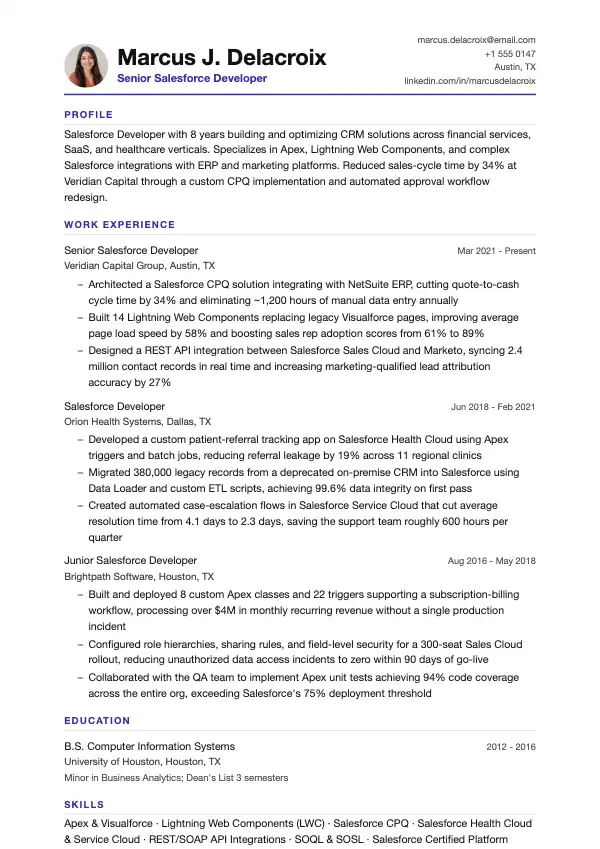
Template: Meridian
Read this resume as text
Marcus J. Delacroix
Senior Salesforce Developer
marcus.delacroix@email.com · +1 555 0147 · Austin, TX · linkedin.com/in/marcusdelacroix
- Profile
- Salesforce Developer with 8 years building and optimizing CRM solutions across financial services, SaaS, and healthcare verticals. Specializes in Apex, Lightning Web Components, and complex Salesforce integrations with ERP and marketing platforms. Reduced sales-cycle time by 34% at Veridian Capital through a custom CPQ implementation and automated approval workflow redesign.
- Work Experience
Senior Salesforce Developer
Veridian Capital Group, Austin, TX · Mar 2021 - Present
- Architected a Salesforce CPQ solution integrating with NetSuite ERP, cutting quote-to-cash cycle time by 34% and eliminating ~1,200 hours of manual data entry annually
- Built 14 Lightning Web Components replacing legacy Visualforce pages, improving average page load speed by 58% and boosting sales rep adoption scores from 61% to 89%
- Designed a REST API integration between Salesforce Sales Cloud and Marketo, syncing 2.4 million contact records in real time and increasing marketing-qualified lead attribution accuracy by 27%
Salesforce Developer
Orion Health Systems, Dallas, TX · Jun 2018 - Feb 2021
- Developed a custom patient-referral tracking app on Salesforce Health Cloud using Apex triggers and batch jobs, reducing referral leakage by 19% across 11 regional clinics
- Migrated 380,000 legacy records from a deprecated on-premise CRM into Salesforce using Data Loader and custom ETL scripts, achieving 99.6% data integrity on first pass
- Created automated case-escalation flows in Salesforce Service Cloud that cut average resolution time from 4.1 days to 2.3 days, saving the support team roughly 600 hours per quarter
Junior Salesforce Developer
Brightpath Software, Houston, TX · Aug 2016 - May 2018
- Built and deployed 8 custom Apex classes and 22 triggers supporting a subscription-billing workflow, processing over $4M in monthly recurring revenue without a single production incident
- Configured role hierarchies, sharing rules, and field-level security for a 300-seat Sales Cloud rollout, reducing unauthorized data access incidents to zero within 90 days of go-live
- Collaborated with the QA team to implement Apex unit tests achieving 94% code coverage across the entire org, exceeding Salesforce's 75% deployment threshold
- Education
B.S. Computer Information Systems
University of Houston, Houston, TX · 2012 - 2016
Minor in Business Analytics; Dean's List 3 semesters
- Skills
- Apex & Visualforce · Lightning Web Components (LWC) · Salesforce CPQ · Salesforce Health Cloud & Service Cloud · REST/SOAP API Integrations · SOQL & SOSL · Salesforce Certified Platform Developer II · Git & CI/CD (Salesforce DX, Jenkins) · Data Loader & ETL (MuleSoft)
- Links
- LinkedIn: linkedin.com/in/marcusdelacroix · GitHub: github.com/mdelacroix-sfdev · Certification: Salesforce Certified Platform Developer II (verifiable via Trailhead)
What makes this resume work
- Each bullet opens with a strong action verb (Architected, Designed, Migrated) and closes with a quantified outcome — percentages, dollar figures, or hours saved — so hiring managers can immediately gauge scope and impact.
- Salesforce certifications are listed verbatim in the skills section ('Salesforce Certified Platform Developer II') matching the exact phrasing recruiters and ATS tools search for, not abbreviated or paraphrased.
- The summary front-loads seniority (8 years), names three distinct verticals, and includes one headline metric in the final sentence, giving the reader a reason to keep reading before they reach the experience section.
- Technical breadth is shown through specificity — naming CPQ, Health Cloud, MuleSoft, Salesforce DX, and Jenkins signals cross-functional expertise without resorting to vague phrases like 'experienced in Salesforce technologies.'
Keywords that help you pass the ATS
Work the ones that fit your experience into your resume, naturally, not stuffed.
How to write a Salesforce Developer resume
Choose the right format for a Salesforce Developer resume
Use a reverse-chronological format. Salesforce hiring managers want to see your most recent platform experience first — Salesforce evolves fast, and a role from 2018 using Classic carries less weight than current Lightning and Flow work. Keep the resume to one page if you have under eight years of experience; two pages are acceptable beyond that.
Use a clean single-column or mild two-column layout with clear section headers. Avoid tables and text boxes — many applicant tracking systems (ATS) used by Salesforce partners and enterprise employers parse these poorly and drop content. Save as a PDF unless the job posting explicitly requests a Word file.
- Margins: 0.5–1 inch; font: 10–12pt in Arial, Calibri, or Georgia
- Order sections: Contact → Summary → Skills → Experience → Certifications → Education
- List your Salesforce org edition experience (Enterprise, Unlimited, Developer) where relevant
- Include a link to your Trailhead profile and, if applicable, your GitHub or AppExchange listings
Write a professional summary that positions you as a Salesforce specialist
Your summary is three to four sentences that answer: what platform areas do you own, what business problems do you solve, and what is your certification level? Generic summaries like 'results-driven developer' waste space. Name the clouds, tools, and scope upfront.
Example: "Salesforce Developer with six years building scalable solutions on Sales Cloud, Service Cloud, and Experience Cloud. Certified Platform Developer II and Administrator, with deep experience in Apex triggers, Lightning Web Components, and REST/SOAP integrations. Reduced case resolution time by 34% at a 900-seat financial services firm by redesigning an Omni-Channel routing workflow. Comfortable leading technical design sessions with business analysts and serving as the Salesforce subject-matter expert for cross-functional projects."
Write work-experience bullets that show impact, not just tasks
Every bullet should follow the pattern: action verb + what you built or changed + measurable result. Avoid listing responsibilities ('Responsible for Apex development'). Instead, show scope: how many users, how much time saved, what revenue or cost was affected, or what error rate dropped. Recruiters at Salesforce ISV partners and enterprise shops screen for complexity — mention org size, number of objects, integration endpoints, or record volumes where relevant.
Quantify deployments, automation coverage, and performance improvements. If you led a migration from Classic to Lightning or from a legacy CRM, state the timeline and user count.
- Built a custom CPQ quoting engine using Apex and SOQL on a 1.2M-record org, cutting average quote generation time from 47 minutes to 11 minutes for a 300-user sales team.
- Designed and deployed 18 Lightning Web Components replacing legacy Visualforce pages, reducing page load times by 62% and eliminating $40K in annual third-party widget licensing costs.
Skills and certifications recruiters and ATS systems look for
Salesforce roles have one of the most certification-driven hiring processes in tech. List every active Salesforce credential with its full official name — ATS systems match on exact strings. Place certifications in their own section rather than burying them in skills.
Your skills section should separate platform-native skills from adjacent technical skills. Do not pad it with generic items like 'Microsoft Office' or 'communication.'
- Certifications that carry weight: Salesforce Certified Platform Developer I and II, Administrator, Advanced Administrator, Platform App Builder, JavaScript Developer I, Integration Architecture Designer, B2B Commerce Developer
- Platform skills: Apex, SOQL/SOSL, Lightning Web Components (LWC), Aura components, Visualforce, Flow Builder, Process Builder (legacy), OmniStudio/Vlocity
- Integration skills: REST and SOAP APIs, MuleSoft, Heroku Connect, Change Data Capture, Platform Events, Named Credentials
- DevOps and tooling: Salesforce DX (SFDX), VS Code with Salesforce Extension Pack, Git, Jenkins, Copado, Gearset, Jira
- Data tools: Data Loader, Workbench, Dataloader.io, Excel/Google Sheets for data mapping
Education, licenses, and extras that strengthen your candidacy
A bachelor's degree in computer science, information systems, or a related field is common but not required — many strong Salesforce Developers are self-taught or transitioned from admin roles. List your degree, institution, and graduation year. If you do not have a degree, your certification stack and Trailhead rank carry more weight, so make those prominent.
Include your Trailhead Ranger rank or higher if you have it, and list any Superbadges relevant to the role (e.g., Apex Specialist, Lightning Web Components Specialist, Apex Integration Services). If you have contributed to open-source Salesforce projects on GitHub or published a managed package on AppExchange, add a 'Projects' section with a one-line description and a URL. Salesforce MVP or community speaker experience is worth one line — it signals credibility in the ecosystem.
Mistakes to avoid
- Listing expired or unverified Salesforce certifications — Salesforce requires maintenance releases twice a year, and recruiters check Credential Verification on the Salesforce website, so only list credentials you have kept current.
- Using vague org descriptions like 'worked with Salesforce' instead of specifying the cloud products, edition, and scale of the org you actually developed on.
- Omitting your Trailhead profile URL when you have a Ranger rank or relevant Superbadges, which is one of the fastest ways a hiring manager validates hands-on platform knowledge.
- Burying certifications at the bottom of the resume under education, when they are often the first filter a Salesforce-specific recruiter applies before reading anything else.
Frequently asked questions
- Do I need a Salesforce certification to get a Salesforce Developer job?
- Not legally required, but practically expected. Most job postings for mid-level and senior roles list Platform Developer I as a minimum, and many enterprise employers and Salesforce partners search applicants by certification. If you are entry-level, earning Platform Developer I before applying gives a recruiter a concrete reason to shortlist you.
- Should I include my Trailhead rank and badges on my resume?
- Yes, include your Trailhead profile URL and note your rank if you are Ranger or above. Superbadges are particularly worth listing because they demonstrate hands-on scenario-based skills, not just quiz knowledge. Keep it to a line or two — do not list every badge, only the ones directly relevant to the role.
- How do I show Salesforce experience if I only worked in sandbox or volunteer projects?
- Create a Projects section and describe the org setup, the features you built, and any measurable outcome — even if the 'client' was a nonprofit or an internal learning project. Specify the objects, automation tools, and integrations involved. Pair this with your Trailhead Superbadges and a GitHub link showing your Salesforce DX project structure to give reviewers something concrete to evaluate.
Make it yours in minutes
Open this example in the builder, swap in your details, and export a clean, ATS-ready resume.
Once your resume is ready
More for this application
- Template style
- Software Engineer resume templates