Resume example
Solutions Architect resume example
By the Resumade team · About our content
A Solutions Architect resume must clear ATS keyword filters for cloud platforms and architecture methodologies, then immediately prove business impact to a hiring manager. This example does both: hard skills and certifications appear verbatim in the skills section, and every bullet pairs a technical action with a dollar, percentage, or time result.
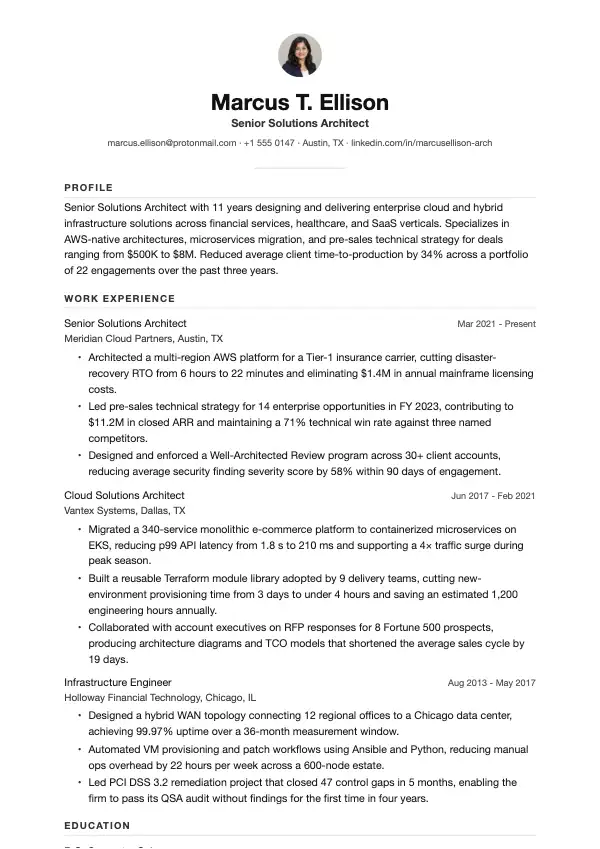
Template: Windsor
Read this resume as text
Marcus T. Ellison
Senior Solutions Architect
marcus.ellison@protonmail.com · +1 555 0147 · Austin, TX · linkedin.com/in/marcusellison-arch
- Profile
- Senior Solutions Architect with 11 years designing and delivering enterprise cloud and hybrid infrastructure solutions across financial services, healthcare, and SaaS verticals. Specializes in AWS-native architectures, microservices migration, and pre-sales technical strategy for deals ranging from $500K to $8M. Reduced average client time-to-production by 34% across a portfolio of 22 engagements over the past three years.
- Work Experience
Senior Solutions Architect
Meridian Cloud Partners, Austin, TX · Mar 2021 - Present
- Architected a multi-region AWS platform for a Tier-1 insurance carrier, cutting disaster-recovery RTO from 6 hours to 22 minutes and eliminating $1.4M in annual mainframe licensing costs.
- Led pre-sales technical strategy for 14 enterprise opportunities in FY 2023, contributing to $11.2M in closed ARR and maintaining a 71% technical win rate against three named competitors.
- Designed and enforced a Well-Architected Review program across 30+ client accounts, reducing average security finding severity score by 58% within 90 days of engagement.
Cloud Solutions Architect
Vantex Systems, Dallas, TX · Jun 2017 - Feb 2021
- Migrated a 340-service monolithic e-commerce platform to containerized microservices on EKS, reducing p99 API latency from 1.8 s to 210 ms and supporting a 4× traffic surge during peak season.
- Built a reusable Terraform module library adopted by 9 delivery teams, cutting new-environment provisioning time from 3 days to under 4 hours and saving an estimated 1,200 engineering hours annually.
- Collaborated with account executives on RFP responses for 8 Fortune 500 prospects, producing architecture diagrams and TCO models that shortened the average sales cycle by 19 days.
Infrastructure Engineer
Holloway Financial Technology, Chicago, IL · Aug 2013 - May 2017
- Designed a hybrid WAN topology connecting 12 regional offices to a Chicago data center, achieving 99.97% uptime over a 36-month measurement window.
- Automated VM provisioning and patch workflows using Ansible and Python, reducing manual ops overhead by 22 hours per week across a 600-node estate.
- Led PCI DSS 3.2 remediation project that closed 47 control gaps in 5 months, enabling the firm to pass its QSA audit without findings for the first time in four years.
- Education
B.S. Computer Science
University of Illinois Urbana-Champaign, Champaign, IL · 2009 - 2013
Concentration in Distributed Systems; Dean's List 4 semesters
- Skills
- AWS Solutions Architect – Professional (SAP-C02) · Terraform & Infrastructure as Code · Kubernetes / Amazon EKS · Microservices & API Gateway Design · Pre-Sales Technical Strategy & RFP Response · Python & Bash Scripting · Network Architecture (BGP, SD-WAN, VPC) · Well-Architected Framework Reviews · HashiCorp Vault & Secrets Management
- Links
- LinkedIn: linkedin.com/in/marcusellison-arch · GitHub: github.com/mellison-arch · Portfolio: marcusellison.dev/case-studies · Certification: AWS Certified Solutions Architect – Professional, SAP-C02 (verifiable via AWS)
What makes this resume work
- The summary opens with seniority and years of experience in the first clause, then names three specific verticals, so a recruiter scanning for industry fit gets the answer in one sentence.
- Each bullet follows a strict verb → technical action → measurable outcome structure — no bullet ends without a number, which makes the candidate's ROI concrete and comparable across applicants.
- The AWS Solutions Architect – Professional certification is listed exactly as AWS titles it, matching the credential string recruiters paste into ATS search fields rather than an abbreviated or informal version.
- The pre-sales win-rate statistic (71% technical win rate, $11.2M ARR) in the most recent role signals that this architect can operate as a revenue partner, differentiating the candidate from purely delivery-focused engineers.
Keywords that help you pass the ATS
Work the ones that fit your experience into your resume, naturally, not stuffed.
How to write a Solutions Architect resume
Choose the right format for a Solutions Architect resume
Use a reverse-chronological format. Hiring managers at enterprise software companies, cloud providers, and consulting firms expect to see your most recent role first and scan for a clear progression from engineer or developer into architecture. A functional or hybrid format raises flags that you are hiding gaps or thin experience.
Keep the resume to two pages if you have more than eight years of experience; one page if you are under five years. Use clean section headers, consistent font sizing (10–12pt body, 14–16pt name), and generous white space. Avoid tables and text boxes — many applicant tracking systems used by Amazon, Microsoft, and large SIs parse these incorrectly and drop your content.
- Sections in order: Contact → Summary → Skills → Work Experience → Certifications → Education
- File format: PDF unless the job posting explicitly requests a .docx
- Margins: 0.5–0.75 inches; no header or footer that cuts off in ATS parsing
- If you hold multiple cloud certifications, give them their own dedicated section — do not bury them in Education
Write a professional summary that earns a second look
Your summary is three to four sentences that answer: what kind of architect are you, what environments have you worked in, and what business outcomes do you drive. Skip 'results-driven professional' and every other generic opener. Name the cloud platforms, workload types, or industry verticals where you have the deepest credibility.
Example: "AWS-certified Solutions Architect with 10 years designing distributed, cloud-native systems for financial services clients with transaction volumes exceeding $2B annually. Deep expertise in microservices migration, multi-region high-availability architectures, and pre-sales technical solutioning for enterprise deals over $5M. Reduced infrastructure costs by 34% at two Fortune 500 clients by leading FinOps governance programs across AWS and Azure hybrid environments."
Write work-experience bullets that show architecture impact
Each bullet should follow an action-result structure and include at least one number. Solutions Architect roles span pre-sales, delivery, and internal platform work — make clear which context you are describing. Quantify latency improvements, cost reductions, team sizes influenced, deal sizes supported, or migration scope. Avoid vague verbs like 'assisted' or 'participated in.'
- Architected a multi-tenant SaaS platform on AWS (EKS, RDS Aurora, CloudFront) serving 4.2M active users, reducing p99 latency from 1,800ms to 210ms and cutting monthly cloud spend by $480K through right-sizing and Reserved Instance planning.
- Led technical solutioning for 11 enterprise pre-sales engagements totaling $28M in contract value, producing reference architectures, threat models, and TCO analyses that contributed to an 8 of 11 win rate over a 14-month period.
Skills and certifications recruiters and ATS systems look for
Solutions Architect job descriptions are heavily keyword-driven. Your skills section should list specific platforms, frameworks, and methodologies — not vague categories. Recruiters filter on certifications before reading anything else, so place yours prominently. The certifications below are the ones that appear most frequently in US job postings and carry the most weight in interviews.
- Cloud platforms: AWS, Microsoft Azure, Google Cloud Platform (GCP)
- Certifications: AWS Certified Solutions Architect – Professional, AWS Certified Solutions Architect – Associate, Microsoft Azure Solutions Architect Expert (AZ-305), Google Professional Cloud Architect, TOGAF 9 or 10
- Architecture tools: Lucidchart, draw.io, Miro, AWS Well-Architected Tool, Azure Architecture Center templates
- Technical skills: Kubernetes, Terraform, CloudFormation, CI/CD pipelines (Jenkins, GitHub Actions), API Gateway, IAM/Zero Trust, microservices, event-driven architecture (Kafka, SQS/SNS)
- Methodologies: TOGAF, C4 model, SABSA (for security-focused roles), Agile/SAFe
Education, licenses, and extras that strengthen your candidacy
A bachelor's degree in Computer Science, Information Systems, or Electrical Engineering is the baseline expectation at most enterprise employers. An MBA or master's in a technical field adds value for roles that blend architecture with business development or product strategy. List your degree, institution, and graduation year — GPA only if you graduated within the last three years and it is above 3.5.
Below education, add a short section for publications, conference talks (AWS re:Invent, Microsoft Build, KubeCon), open-source contributions, or patents. These differentiate you from candidates with identical certifications and job titles. If you have completed vendor-specific training programs — AWS Partner Network training, Google Cloud Partner Advantage, or Microsoft FastTrack — list those too, as they signal pre-sales readiness to hiring managers at consulting firms and SIs.
Mistakes to avoid
- Listing certifications only in the Education section buries your most important credentials where parsers and recruiters may miss them.
- Writing bullets that describe responsibilities ('Responsible for designing cloud solutions') instead of outcomes makes your resume indistinguishable from a job description and gives hiring managers nothing to anchor on.
- Omitting the distinction between pre-sales architecture and delivery architecture confuses recruiters, since many roles require one skillset and not the other, and vague language gets you passed over for both.
- Using a generic skills list with terms like 'cloud computing' and 'leadership' instead of specific platforms and tools causes ATS keyword matching to fail and signals to technical interviewers that your depth is shallow.
Frequently asked questions
- Should a Solutions Architect resume include a portfolio or architecture diagrams?
- Do not embed diagrams in the resume file itself — ATS systems will mangle them. Instead, add a hyperlink in your contact header to a portfolio page, GitHub repo, or Confluence space where diagrams and case studies live. Reference the link briefly in relevant bullets so reviewers know it exists.
- How important is the AWS Certified Solutions Architect – Professional certification versus the Associate level?
- For senior and staff-level roles at enterprise companies or cloud consulting firms, the Professional level is increasingly a baseline filter, not a differentiator. The Associate is a solid entry point but on its own signals a mid-level profile. If you hold the Associate, pair it with a specialty certification (Security, Networking, or Data Analytics) to compensate while you pursue the Professional.
- How do you handle a Solutions Architect resume when your experience is split between pre-sales and internal/delivery roles?
- Call out the context explicitly in each role description — for example, 'Pre-Sales Solutions Architect' versus 'Enterprise Delivery Architect' — rather than using a single umbrella title. In your summary, state which mode is your primary focus going forward. This prevents recruiters from misrouting your application to roles that do not match your actual strengths.
Make it yours in minutes
Open this example in the builder, swap in your details, and export a clean, ATS-ready resume.
Once your resume is ready
More for this application
- Template style
- Software Engineer resume templates