Resume example
Writer resume example
By the Resumade team · About our content
A Writer resume must pass keyword filters for tools and content types while proving to a hiring manager that the candidate moves business metrics, not just word counts. This example does both with specific numbers and domain signals in every section.
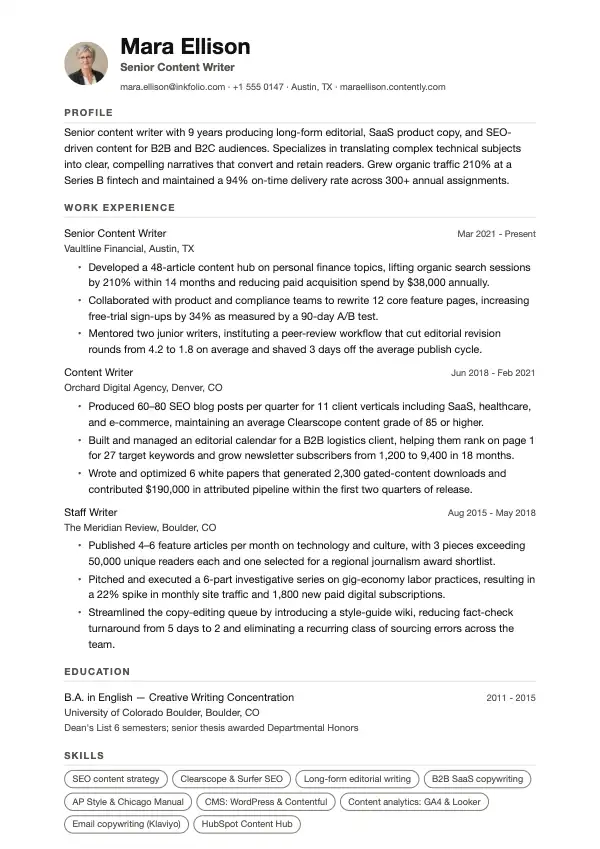
Template: Onyx
Read this resume as text
Mara Ellison
Senior Content Writer
mara.ellison@inkfolio.com · +1 555 0147 · Austin, TX · maraellison.contently.com
- Profile
- Senior content writer with 9 years producing long-form editorial, SaaS product copy, and SEO-driven content for B2B and B2C audiences. Specializes in translating complex technical subjects into clear, compelling narratives that convert and retain readers. Grew organic traffic 210% at a Series B fintech and maintained a 94% on-time delivery rate across 300+ annual assignments.
- Work Experience
Senior Content Writer
Vaultline Financial, Austin, TX · Mar 2021 - Present
- Developed a 48-article content hub on personal finance topics, lifting organic search sessions by 210% within 14 months and reducing paid acquisition spend by $38,000 annually.
- Collaborated with product and compliance teams to rewrite 12 core feature pages, increasing free-trial sign-ups by 34% as measured by a 90-day A/B test.
- Mentored two junior writers, instituting a peer-review workflow that cut editorial revision rounds from 4.2 to 1.8 on average and shaved 3 days off the average publish cycle.
Content Writer
Orchard Digital Agency, Denver, CO · Jun 2018 - Feb 2021
- Produced 60–80 SEO blog posts per quarter for 11 client verticals including SaaS, healthcare, and e-commerce, maintaining an average Clearscope content grade of 85 or higher.
- Built and managed an editorial calendar for a B2B logistics client, helping them rank on page 1 for 27 target keywords and grow newsletter subscribers from 1,200 to 9,400 in 18 months.
- Wrote and optimized 6 white papers that generated 2,300 gated-content downloads and contributed $190,000 in attributed pipeline within the first two quarters of release.
Staff Writer
The Meridian Review, Boulder, CO · Aug 2015 - May 2018
- Published 4–6 feature articles per month on technology and culture, with 3 pieces exceeding 50,000 unique readers each and one selected for a regional journalism award shortlist.
- Pitched and executed a 6-part investigative series on gig-economy labor practices, resulting in a 22% spike in monthly site traffic and 1,800 new paid digital subscriptions.
- Streamlined the copy-editing queue by introducing a style-guide wiki, reducing fact-check turnaround from 5 days to 2 and eliminating a recurring class of sourcing errors across the team.
- Education
B.A. in English — Creative Writing Concentration
University of Colorado Boulder, Boulder, CO · 2011 - 2015
Dean's List 6 semesters; senior thesis awarded Departmental Honors
- Skills
- SEO content strategy · Clearscope & Surfer SEO · Long-form editorial writing · B2B SaaS copywriting · AP Style & Chicago Manual · CMS: WordPress & Contentful · Content analytics: GA4 & Looker · Email copywriting (Klaviyo) · HubSpot Content Hub
- Links
- Portfolio: maraellison.contently.com · LinkedIn: linkedin.com/in/maraellison
What makes this resume work
- The summary names seniority, years of experience, two distinct domains (B2B fintech and editorial), and two headline numbers in three sentences — giving a hiring manager a complete picture before they reach the first job entry.
- Every bullet opens with a strong action verb and closes with a quantified outcome (percentage lifts, dollar figures, subscriber counts), making it easy for recruiters to copy-paste evidence of impact into a scorecard.
- Hard skills are listed as concrete tools and platforms — Clearscope, Surfer SEO, Contentful, GA4 — rather than vague labels like 'SEO' alone, which surfaces the resume in ATS searches that filter by named software.
- The progression from Staff Writer to Agency Writer to in-house Senior Writer tells a deliberate career story: editorial craft → client-facing breadth → strategic ownership, which justifies the senior title without a single word of self-promotion.
Keywords that help you pass the ATS
Work the ones that fit your experience into your resume, naturally, not stuffed.
How to write a Writer resume
Choose the right format for a Writer resume
Most writers do best with a reverse-chronological format: your most recent role at the top, working backward. Recruiters at publishers, agencies, and content studios expect this layout and move on quickly if they have to hunt for dates or job titles.
Keep the document to one page if you have under ten years of experience; two pages are acceptable for senior editors, staff writers, or those with extensive publication credits. Use a clean single-column layout with consistent 10–12pt body text, clear section headers, and at least half-inch margins. Avoid sidebars and text boxes — many applicant tracking systems (ATS) parse these incorrectly and drop your content entirely.
- File format: submit as .docx or PDF unless the job posting specifies otherwise
- Font: Georgia, Garamond, Calibri, or Arial — nothing decorative
- Include a hyperlinked portfolio URL near your contact information
- Use consistent date formatting throughout (e.g., Jan 2021 – Mar 2024)
Write a professional summary that earns the read
Your summary sits directly below your name and contact block. It should be three to four sentences that answer: what type of writer you are, what industries or formats you specialize in, and what measurable value you deliver. Generic openers like 'passionate communicator' waste the recruiter's first look.
Tailor your summary to each role by mirroring language from the job description. If the posting mentions SEO-driven content or B2B SaaS, use those exact terms. Here is a concrete example: "Staff writer with seven years producing long-form B2B content for SaaS and fintech brands. Consistently deliver 2,000–3,500-word articles that rank on page one within 90 days using Clearscope and Surfer SEO. Managed a pipeline of 30+ monthly assignments in WordPress while maintaining a 98% on-time delivery rate across four editorial clients."
Write work-experience bullets that show output, not just duties
Every bullet should follow an action-verb, task, and result structure. Vague bullets like 'wrote articles for the blog' tell a hiring manager nothing about your volume, quality, or impact. Quantify wherever you can: word counts, traffic lifts, conversion rates, publication circulation, or turnaround times. Even if you lack hard analytics, you can cite volume metrics like articles per month or number of clients served.
Pull numbers from Google Analytics, your CMS dashboard, or client reports before you write your resume — you will be surprised how many you have. Two examples you can model:
- Produced 18 SEO articles per month for a cybersecurity SaaS client; organic traffic to targeted pages grew 64% in six months, per Google Search Console data.
- Ghostwrote and edited a 55,000-word industry report for a Fortune 500 logistics firm, delivered two weeks ahead of a hard press deadline with zero revision rounds requested.
Skills and certifications recruiters and ATS look for
List skills in a dedicated section using the exact terminology employers search for. Writing roles usually go through an ATS, where recruiters search by keyword, so matching the job description's language matters. Separate hard skills (tools, platforms, style guides) from soft skills, and keep the soft-skills list short — 'collaborative' and 'deadline-driven' are table stakes, not differentiators.
Certifications carry real weight in content marketing and UX writing roles. The most recognized credentials include HubSpot Content Marketing Certification, Google Analytics 4 (GA4) certification, Nielsen Norman Group UX Writing courses, Poynter NewsU certificates for journalists, and the American Medical Writers Association (AMWA) credential for healthcare writers.
- Tools to list: WordPress, Contentful, HubSpot CMS, Clearscope, Surfer SEO, Grammarly Business, Airtable, Asana, Google Docs, Adobe InCopy
- Style guides: AP Stylebook, Chicago Manual of Style, APA, MLA — list the ones you actually use daily
- SEO skills: keyword research, on-page optimization, internal linking strategy, search intent analysis
- Formats: white papers, case studies, email sequences, UX microcopy, technical documentation, scripts
Education, licenses, and extras that matter for writers
A bachelor's degree in English, Journalism, Communications, or a related field is the baseline expectation at most publishers and agencies. However, many content studios and tech companies care far more about your portfolio and clips than your degree. List your highest degree, institution, and graduation year — you do not need GPA unless you are a recent graduate within the last two years.
In the extras section, include notable publications (The Atlantic, Wired, industry trade journals), awards (ASJA, SPJ, Folio:), or relevant speaking engagements. If you have a Substack or newsletter with a meaningful subscriber count, list it with the number. For technical writers, a Certified Professional Technical Communicator (CPTC) credential from the Society for Technical Communication is worth adding explicitly.
- List clip URLs or a single portfolio link — do not attach PDFs of articles to the resume itself
- Include freelance clients by name if they are recognizable brands (e.g., 'Clients: Salesforce, Shopify, HBR')
- Relevant coursework or bootcamps (e.g., Mediabistro, Poynter, Gotham Writers Workshop) belong here if you lack a traditional degree
Mistakes to avoid
- Listing writing duties without any output metrics makes your resume indistinguishable from every other candidate — always anchor bullets to volume, traffic, or business results.
- Omitting a portfolio link is a disqualifying error for most writing roles; recruiters will not request clips separately if they are not on the resume.
- Using a creative or heavily designed resume template can break ATS parsing, so your application ranks low and reads poorly when it is opened.
- Lumping all writing experience under one generic job title — such as 'Freelance Writer' with no client names, content types, or industries — signals a lack of specialization and makes it harder for recruiters to match you to the role.
Frequently asked questions
- Do I need a portfolio separate from my resume as a writer?
- Yes, always. Your resume should include a single hyperlinked portfolio URL — a personal site, Contently profile, or Muck Rack page — where hiring managers can read full samples. A resume alone will rarely get a writer past the first screen at a publisher, agency, or content team.
- Should a freelance writer list every client on their resume?
- No — curate the list to recognizable brand names or clients most relevant to the job you are applying for. Group smaller or confidential clients under a line like 'Additional clients available upon request' and focus resume space on the engagements where you can cite real metrics or notable publications.
- How important is an English or Journalism degree for a writer resume?
- It helps at traditional editorial outlets and some agencies, but it is rarely a hard requirement in content marketing, UX writing, or technical writing roles. A strong portfolio, relevant certifications like HubSpot or CPTC, and quantified results routinely outweigh a degree at tech companies and startups.
Make it yours in minutes
Open this example in the builder, swap in your details, and export a clean, ATS-ready resume.
Once your resume is ready
More for this application
- Template style
- Serif resume templates